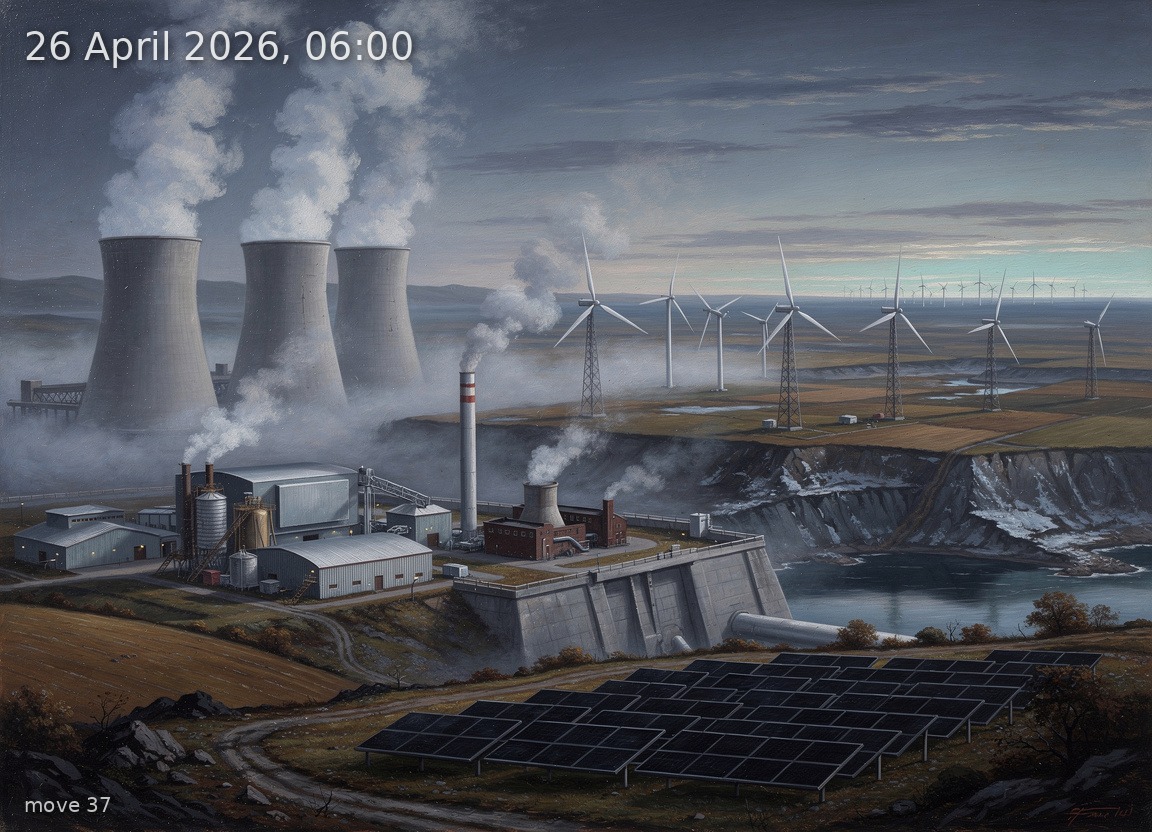
Wind leads at 10.3 GW but 11.2 GW net imports needed as solar and dawn lag behind cold morning demand.
Back
Generation mix
Wind onshore 33%
Wind offshore 8%
Solar 6%
Biomass 17%
Hydro 5%
Natural gas 14%
Hard coal 5%
Brown coal 13%
69%
Renewable share
10.3 GW
Wind (on + offshore)
1.6 GW
Solar
25.3 GW
Total generation
-11.2 GW
Net import
94.2 €/MWh
Day-ahead price
3.7°C / 5 km/h
Temp / Wind speed
Open-Meteo, Kassel (51.3°N 9.5°E)
6% / 0.0 W/m²
Cloud cover / Radiation
208
gCO₂/kWh
Image prompt
Wind onshore 8.4 GW dominates the right half of the scene as dozens of tall three-blade turbines on lattice and tubular towers stretching across rolling farmland into the distance; wind offshore 1.9 GW appears as a faint cluster of turbines on the far-right horizon above a dark sea sliver; brown coal 3.2 GW occupies the left foreground as a massive lignite power station with three hyperbolic cooling towers emitting thick white steam plumes; natural gas 3.5 GW sits left-centre as a compact CCGT plant with tall narrow exhaust stacks and a single modest vapour trail; biomass 4.3 GW appears centre-left as a cluster of industrial buildings with cylindrical wood-pellet silos and low stacks releasing thin grey exhaust; hard coal 1.2 GW is a smaller coal plant behind the gas facility with a single square cooling tower; hydro 1.2 GW is suggested by a concrete dam and reservoir visible in a valley at centre-right; solar 1.6 GW appears as a small field of aluminium-framed crystalline silicon panels in the lower centre, but they are dark and inactive catching no light. The sky is pre-dawn deep blue-grey, no direct sunlight, the faintest pale turquoise glow on the eastern horizon; the air is cold and frosty at 3.7 °C, bare early-spring branches with no leaves, frost on the grass, still air with no motion blur on vegetation. Despite clear skies overhead (6% cloud cover) the atmosphere feels heavy and oppressive reflecting the high electricity price — a brooding low haze clings to the industrial stacks and cooling towers. Sodium-orange streetlights dot a small town in the mid-ground. Highly detailed oil painting in the tradition of 19th-century German Romantic landscape painters — Caspar David Friedrich meets industrial sublime — rich saturated colour palette of indigo, steel blue, amber, and ash grey, visible confident brushwork, atmospheric aerial perspective with deep spatial layering, meticulous engineering detail on all turbine nacelles, rotor blades, cooling tower parabolic geometry, and CCGT exhaust architecture. No text, no labels.