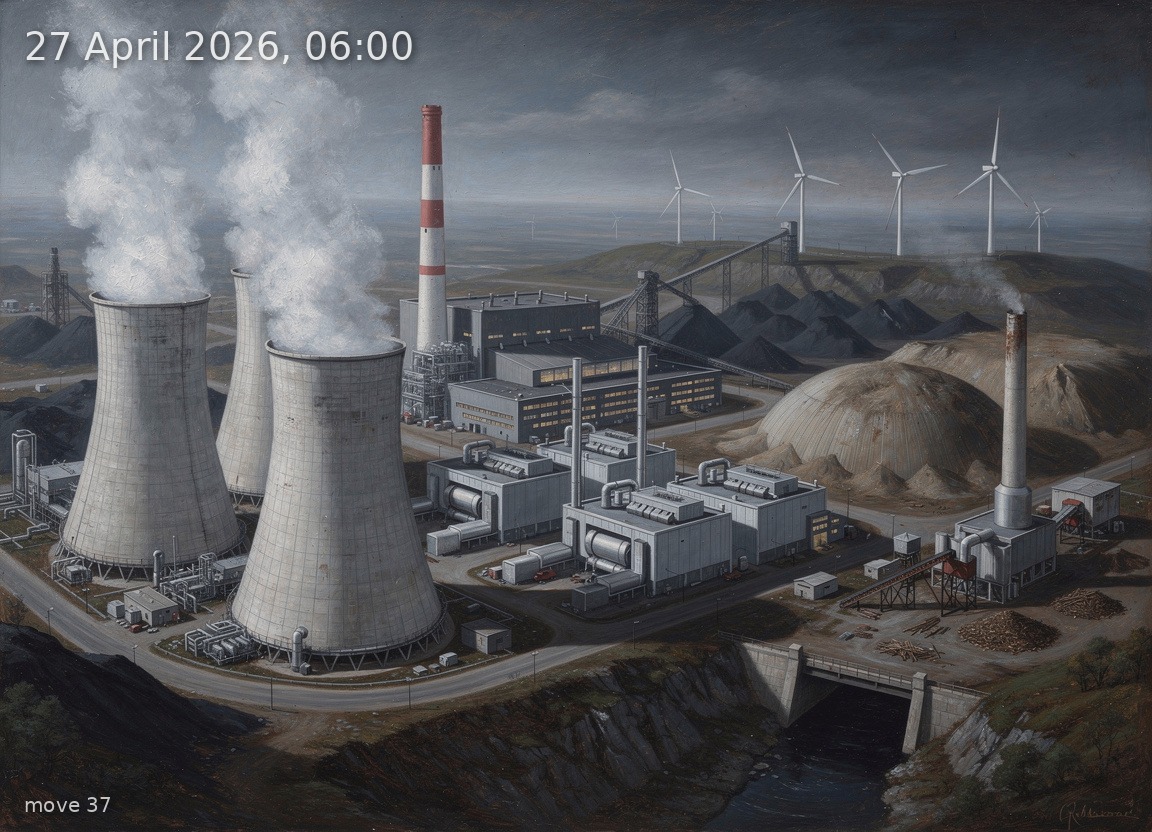
Brown coal, gas, and biomass dominate a windless, pre-dawn grid requiring ~22.8 GW net imports amid cold April weather.
Back
Generation mix
Wind onshore 9%
Wind offshore 0%
Solar 6%
Biomass 16%
Hydro 5%
Natural gas 25%
Hard coal 12%
Brown coal 27%
36%
Renewable share
2.7 GW
Wind (on + offshore)
1.8 GW
Solar
28.4 GW
Total generation
-22.8 GW
Net import
165.6 €/MWh
Day-ahead price
1.2°C / 2 km/h
Temp / Wind speed
Open-Meteo, Kassel (51.3°N 9.5°E)
0% / 0.0 W/m²
Cloud cover / Radiation
432
gCO₂/kWh
Image prompt
Brown coal 7.6 GW dominates the left third of the scene as a cluster of massive hyperbolic cooling towers with thick white-grey steam plumes rising into the cold air; natural gas 7.0 GW fills the centre-left as a row of compact CCGT power plants with tall single exhaust stacks emitting thin plumes; biomass 4.5 GW appears centre-right as a medium-sized industrial facility with a wood-chip storage dome and a squat smokestack; hard coal 3.5 GW sits behind the brown coal complex as a slightly smaller conventional power station with conveyor belts and a tall chimney; wind onshore 2.6 GW is represented by a sparse handful of three-blade turbines on a distant ridge, their rotors virtually motionless in the still air; hydro 1.5 GW appears as a small concrete dam with a reservoir in the far right middle ground; solar 1.8 GW is shown as a field of aluminium-framed crystalline PV panels in the right foreground, but they are dark and inert, catching no light. The time is early dawn at 06:00 in late April—the sky is a deep blue-grey with the faintest pale streak of pre-dawn light along the eastern horizon, no direct sunlight anywhere. The temperature is near freezing: frost coats the barren ground and the grass is pale and stiff, bare-branched trees show only the earliest buds of spring. The air is completely still—no motion in vegetation, smoke rises vertically. The atmosphere is heavy, oppressive, and brooding, reflecting the extreme price of 165.6 EUR/MWh—low dense haze clings to the industrial structures, and the sky feels weighty and leaden despite being clear of clouds. Overhead transmission lines stretch toward the horizon in multiple directions suggesting large-scale power imports. Rendered as a highly detailed oil painting in the tradition of 19th-century German Romantic landscape painters—Caspar David Friedrich meets industrial realism—with rich, dark colour palette of steel blues, ash greys, and muted earth tones, visible impasto brushwork, atmospheric depth and sfumato haze around distant structures, meticulous engineering detail on every turbine nacelle, cooling tower, and exhaust stack. No text, no labels.