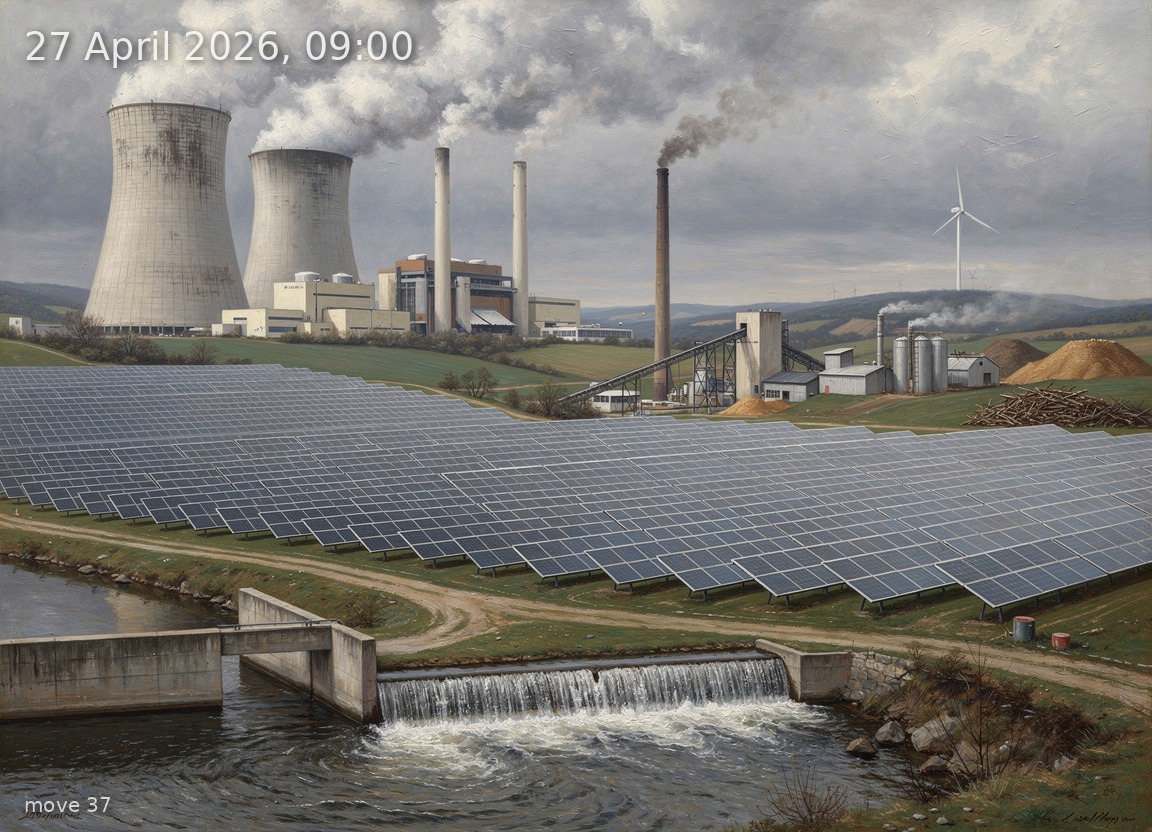
Solar leads at 33.8 GW but near-zero wind and 4.7 GW net imports push prices above 90 EUR/MWh.
Back
Generation mix
Wind onshore 2%
Wind offshore 0%
Solar 64%
Biomass 8%
Hydro 3%
Natural gas 10%
Hard coal 3%
Brown coal 9%
77%
Renewable share
0.9 GW
Wind (on + offshore)
33.8 GW
Solar
52.5 GW
Total generation
-4.7 GW
Net import
92.5 €/MWh
Day-ahead price
6.5°C / 1 km/h
Temp / Wind speed
Open-Meteo, Kassel (51.3°N 9.5°E)
79% / 184.0 W/m²
Cloud cover / Radiation
152
gCO₂/kWh
Image prompt
Solar 33.8 GW dominates the panorama: vast fields of aluminium-framed crystalline silicon photovoltaic panels stretch across rolling central German farmland covering roughly two-thirds of the composition, their blue-grey surfaces catching diffuse daylight under an overcast April sky. Brown coal 5.0 GW occupies the left background as a cluster of towering hyperbolic concrete cooling towers emitting thick white steam plumes that merge with the heavy cloud layer. Natural gas 5.3 GW appears centre-left as a modern combined-cycle gas turbine plant with tall slender exhaust stacks and compact turbine halls, thin grey exhaust rising. Hard coal 1.7 GW sits as a smaller coal-fired station with a single rectangular boiler house and conveyor belts, a narrow smoke trail. Biomass 4.4 GW is represented by a mid-ground wood-chip power plant with cylindrical silos and a low exhaust stack near a pile of timber. Hydro 1.4 GW appears as a concrete run-of-river weir with churning white water on a small river cutting through the foreground. Wind onshore 0.9 GW is a single distant three-blade turbine on a far ridge, its rotor barely turning in the dead-calm air. The sky is heavy and layered — 79% cloud cover rendered as thick stratocumulus in grey and slate-blue, with patches where weak April sunlight (184 W/m² direct radiation) filters through, casting soft diffuse illumination across the landscape. Temperature is 6.5 °C: early spring vegetation, bare-branched oaks just budding, pale green grass, patches of frost in shadow. The atmosphere feels oppressive and weighty, reflecting the high electricity price — a dense, brooding quality to the clouds pressing down on the industrial vista. Time is 09:00 daytime: full daylight but muted, no harsh shadows, soft ambient brightness. Style: highly detailed oil painting in the tradition of 19th-century German Romantic landscape painters such as Caspar David Friedrich and Carl Blechen — rich, layered colour with visible impasto brushwork, atmospheric depth achieved through sfumato haze in the distance, meticulous engineering detail on every turbine nacelle, cooling tower flute, PV module frame, and smokestack. The painting balances sublime industrial grandeur with naturalistic landscape, conveying scale and weight. No text, no labels.