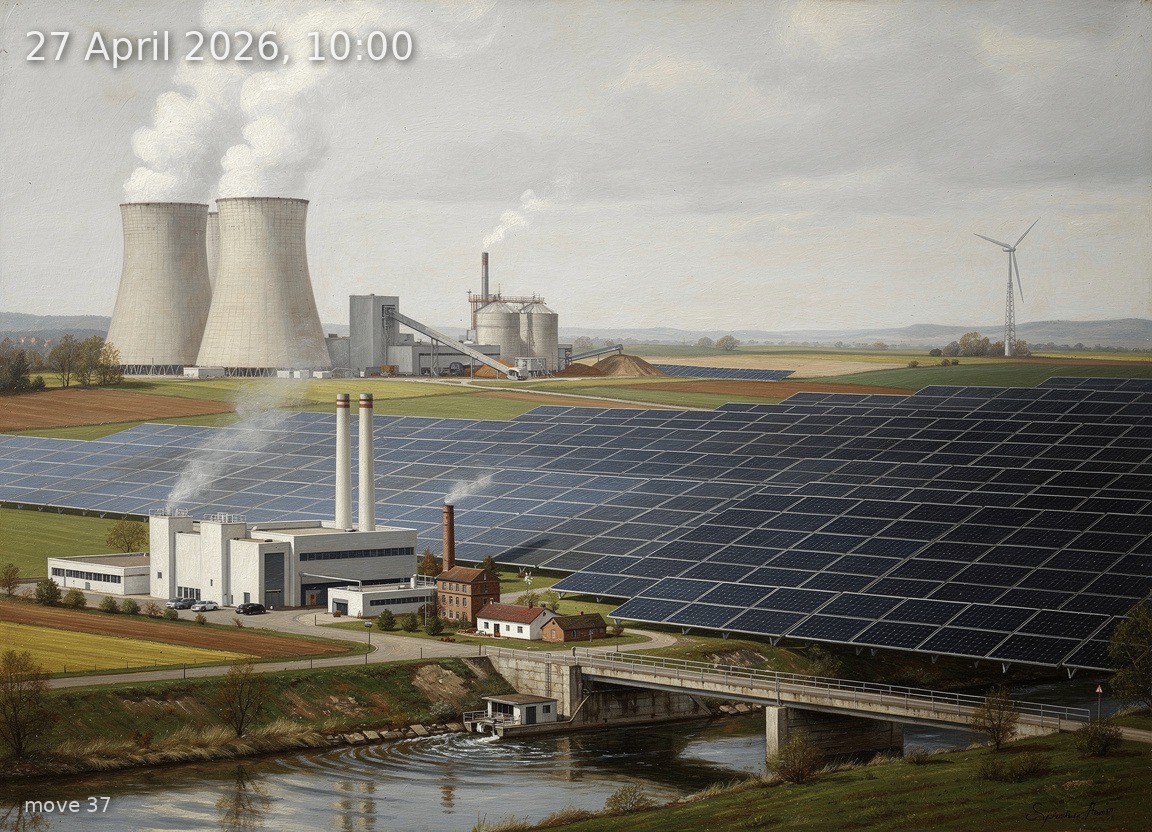
Solar provides 42 GW under overcast skies; near-zero wind forces thermal plants and slight net imports to balance demand.
Back
Generation mix
Wind onshore 1%
Wind offshore 0%
Solar 74%
Biomass 7%
Hydro 2%
Natural gas 6%
Hard coal 2%
Brown coal 7%
84%
Renewable share
0.6 GW
Wind (on + offshore)
42.1 GW
Solar
57.1 GW
Total generation
-1.3 GW
Net import
59.1 €/MWh
Day-ahead price
9.4°C / 1 km/h
Temp / Wind speed
Open-Meteo, Kassel (51.3°N 9.5°E)
100% / 224.0 W/m²
Cloud cover / Radiation
105
gCO₂/kWh
Image prompt
Solar 42.1 GW dominates the scene as an enormous expanse of crystalline silicon PV panels stretching across rolling central-German farmland, covering roughly three-quarters of the composition; brown coal 4.0 GW appears at the far left as a cluster of massive hyperbolic cooling towers with thick white steam plumes rising into the overcast sky; biomass 4.3 GW sits just right of the cooling towers as a compact industrial plant with wood-chip conveyors and a modest smokestack; natural gas 3.6 GW occupies the centre-left as two sleek CCGT combined-cycle units with tall single exhaust stacks emitting thin heat haze; hard coal 1.3 GW is a smaller classical power station with a rectangular brick chimney near the gas plant; hydro 1.3 GW appears as a concrete weir and small run-of-river turbine house along a river in the middle ground; wind onshore 0.5 GW is represented by a single distant three-blade turbine on a lattice tower, its rotor barely turning. The time is 10:00 AM in late April: full daylight but the sky is a uniform bright pearl-grey overcast, no blue patches, yet strong diffuse luminosity bathes the landscape in even, shadowless light with a subtle warm tone. The temperature is cool at 9 °C — early spring: trees show fresh pale-green buds and new grass, but hedgerows are still partly bare. The air is perfectly still — no motion in grass or flags. The price of 59 EUR/MWh is reflected in a slightly heavy, humid atmosphere with low-hanging clouds pressing down. Style: highly detailed oil painting in the tradition of 19th-century German Romantic landscape painters — rich layered colour, visible confident brushwork, atmospheric depth and aerial perspective, meticulous engineering detail on every turbine nacelle, aluminium panel frame, cooling tower shell, and exhaust stack. The composition feels monumental yet measured, an industrial pastoral. No text, no labels.