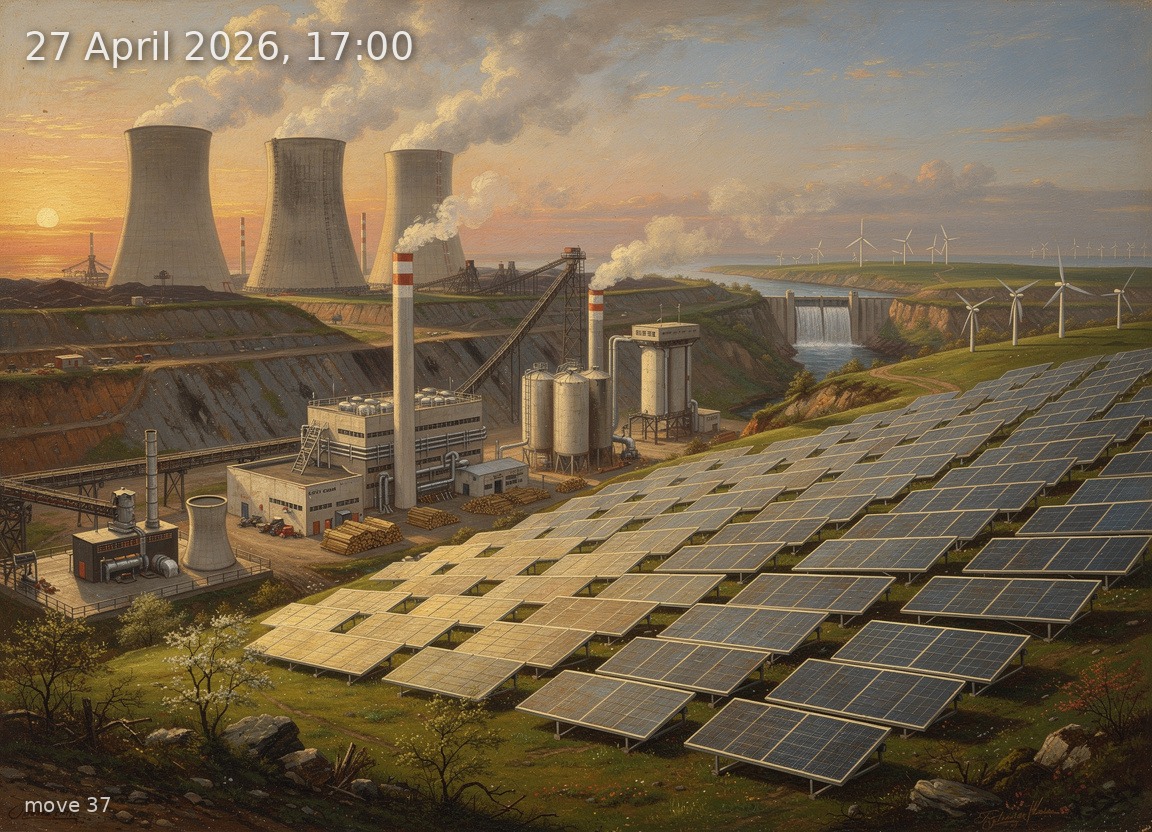
Strong solar and significant lignite underpin generation, but 9.9 GW net imports are needed to meet evening demand.
Back
Generation mix
Wind onshore 6%
Wind offshore 1%
Solar 50%
Biomass 10%
Hydro 3%
Natural gas 9%
Hard coal 5%
Brown coal 15%
71%
Renewable share
3.1 GW
Wind (on + offshore)
22.3 GW
Solar
44.3 GW
Total generation
-9.9 GW
Net import
107.2 €/MWh
Day-ahead price
17.3°C / 8 km/h
Temp / Wind speed
Open-Meteo, Kassel (51.3°N 9.5°E)
53% / 323.0 W/m²
Cloud cover / Radiation
206
gCO₂/kWh
Image prompt
Solar 22.3 GW dominates the right half and centre of the composition as vast fields of aluminium-framed crystalline silicon PV panels catching low-angle golden light, stretching across gentle green spring hillsides. Brown coal 6.7 GW occupies the left quarter as a cluster of massive hyperbolic cooling towers emitting thick white-grey steam plumes, with conveyor belts and open-pit terraces visible at their base. Natural gas 4.0 GW appears as two compact CCGT power plants with tall single exhaust stacks and thin heat-shimmer exhaust, positioned centre-left. Biomass 4.3 GW is rendered as a mid-sized industrial facility with cylindrical silos and a modest stack amid stacked timber, placed behind the gas plants. Hard coal 2.3 GW appears as a smaller coal plant with a rectangular boiler house and a single squat cooling tower, near the lignite complex. Wind onshore 2.8 GW is shown as a small cluster of three-blade turbines on a distant ridge, rotors barely turning in the light breeze. Hydro 1.5 GW is a concrete dam with spillway in a narrow valley in the far background. Wind offshore 0.3 GW is suggested by a few tiny turbines on a hazy horizon line to the far right. The sky is a dusk scene at 17:00 in late April: the sun is low in the west, casting long warm orange-gold rays across the landscape, with broken cumulus clouds covering roughly half the sky, their undersides lit amber and pink while upper portions remain grey. The upper sky transitions from pale blue to deeper tones overhead. Spring vegetation is lush — fresh bright green foliage on deciduous trees, wildflowers in meadows between solar arrays. The atmosphere feels heavy and slightly oppressive, with a faint industrial haze hanging in the valleys, reflecting the high electricity price. Painted in the style of a highly detailed 19th-century German Romantic landscape oil painting — rich impasto brushwork, atmospheric aerial perspective, luminous glazed sky, meticulous engineering detail on every turbine nacelle, every PV cell reflection, every cooling tower's parabolic curve and concrete texture. No text, no labels, no people prominent.