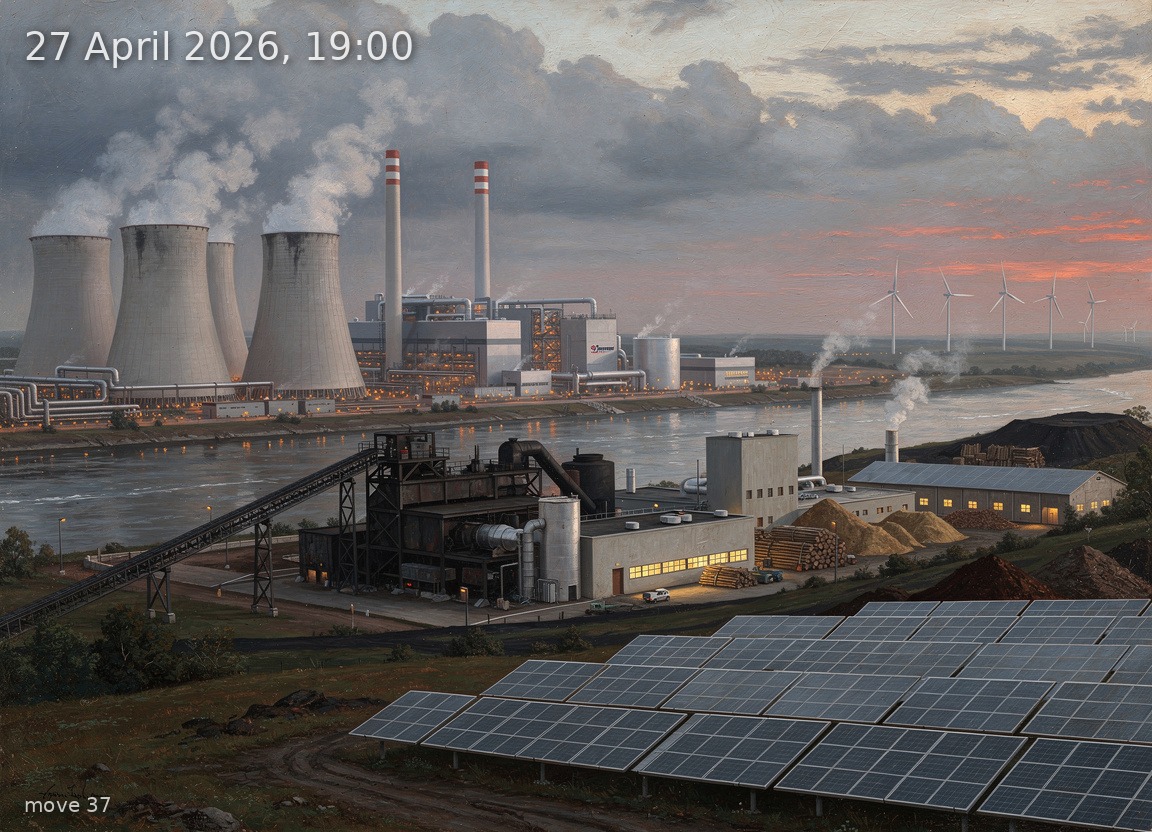
Brown coal, gas, and hard coal dominate evening generation as fading solar and weak wind drive heavy net imports.
Back
Generation mix
Wind onshore 12%
Wind offshore 1%
Solar 11%
Biomass 13%
Hydro 5%
Natural gas 23%
Hard coal 11%
Brown coal 24%
43%
Renewable share
4.7 GW
Wind (on + offshore)
3.8 GW
Solar
34.7 GW
Total generation
-22.1 GW
Net import
172.3 €/MWh
Day-ahead price
16.3°C / 10 km/h
Temp / Wind speed
Open-Meteo, Kassel (51.3°N 9.5°E)
77% / 134.0 W/m²
Cloud cover / Radiation
386
gCO₂/kWh
Image prompt
Brown coal 8.2 GW dominates the left third of the scene as a massive lignite power station complex with three hyperbolic cooling towers issuing thick white steam plumes into the heavy sky; natural gas 7.9 GW fills the centre-left as two sleek CCGT plants with tall single exhaust stacks venting thin heat shimmer; hard coal 3.8 GW appears centre-right as a dark industrial coal plant with conveyor belts and a single squat cooling tower; biomass 4.7 GW is rendered as a cluster of wood-chip-fed CHP plants with modest stacks and stored timber visible in yards, positioned behind the coal plant; wind onshore 4.3 GW appears as a sparse line of seven three-blade turbines on a distant ridge to the far right, rotors turning slowly in light wind; wind offshore 0.5 GW is suggested by two tiny turbines on a far horizon line; solar 3.8 GW is shown as rows of aluminium-framed crystalline silicon panels in a field at the right foreground, catching the last weak reddish-orange light of dusk; hydro 1.7 GW appears as a small concrete dam and reservoir glimpsed in a valley gap between the coal and gas plants. The sky is a late-dusk scene at 19:00 in late April Berlin time: the upper sky deepening from slate grey-blue to near-dark navy, a narrow band of orange-red glow clings to the lower western horizon, 77% cloud cover creates a heavy layered overcast that amplifies an oppressive, weighty atmosphere reflecting the 172.3 EUR/MWh price. Spring vegetation — fresh pale-green birch and beech leaves, bright new grass — frames the foreground at 16°C. Light wind barely stirs the tree branches. The river surface near the cooling towers reflects the fading orange horizon and the industrial sodium lights beginning to flicker on across the plant complexes. Style: highly detailed oil painting in the tradition of 19th-century German Romantic landscape painters such as Caspar David Friedrich and Carl Blechen — rich saturated colour, visible impasto brushwork, atmospheric aerial perspective with industrial haze softening distant elements — yet with meticulous engineering accuracy in every turbine nacelle, PV panel frame, cooling tower curve, and exhaust stack detail. The painting conveys sublime industrial grandeur against a brooding twilight. No text, no labels.