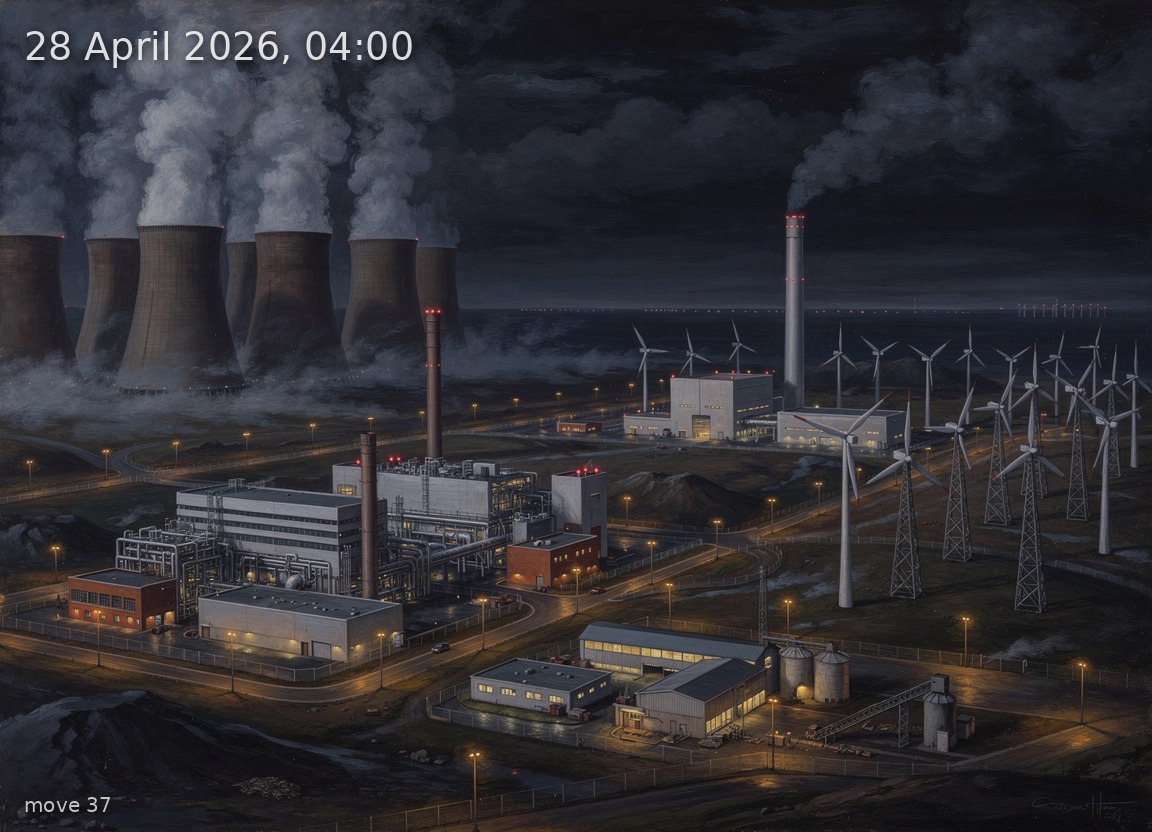
Wind onshore leads at 15.6 GW but coal and gas fill the pre-dawn gap; net imports cover 3.2 GW shortfall.
Back
Generation mix
Wind onshore 38%
Wind offshore 4%
Biomass 10%
Hydro 3%
Natural gas 15%
Hard coal 9%
Brown coal 20%
56%
Renewable share
17.3 GW
Wind (on + offshore)
0.0 GW
Solar
40.9 GW
Total generation
-3.2 GW
Net import
105.3 €/MWh
Day-ahead price
6.5°C / 5 km/h
Temp / Wind speed
Open-Meteo, Kassel (51.3°N 9.5°E)
93% / 0.0 W/m²
Cloud cover / Radiation
307
gCO₂/kWh
Image prompt
Brown coal 8.1 GW dominates the left quarter as a cluster of massive hyperbolic cooling towers with thick white steam plumes rising into the blackness; natural gas 6.2 GW occupies the centre-left as compact combined-cycle gas turbine plants with tall single exhaust stacks and orange-lit control buildings; hard coal 3.9 GW appears centre-right as a smaller coal-fired station with a rectangular chimney emitting faint grey smoke; wind onshore 15.6 GW spans the entire right half and background as dozens of three-blade turbines on lattice and tubular towers, their red aviation warning lights blinking in the dark; wind offshore 1.7 GW is suggested far in the distance as tiny red dots along a dark horizon line; biomass 4.1 GW appears as a mid-ground wood-chip power plant with a low rectangular boiler hall and a gently lit conveyor belt; hydro 1.3 GW is a small concrete dam structure in the lower-right foreground with a faint floodlight illuminating falling water. The sky is completely dark, deep navy-black, 93% overcast so no stars are visible, no twilight or glow on the horizon — it is 4 AM in late April. The only light sources are sodium-orange industrial lamps on plant perimeters, red blinking turbine lights, and the warm yellow glow from control room windows. The temperature is a chilly 6.5°C; bare early-spring branches and damp grass hint at the cold. The atmosphere feels heavy and oppressive, reflecting the high electricity price — low dense clouds pressing down, illuminated from below by the amber industrial glow. Rendered as a highly detailed oil painting in the tradition of 19th-century German Romantic landscape painters such as Caspar David Friedrich and Carl Blechen — rich, dark palette of deep blues, umber, and warm amber highlights, visible confident brushwork, atmospheric depth with layered fog and mist around the cooling towers, meticulous engineering accuracy in every turbine nacelle, rotor blade, cooling tower parabolic profile, and gas-turbine exhaust stack. No text, no labels.