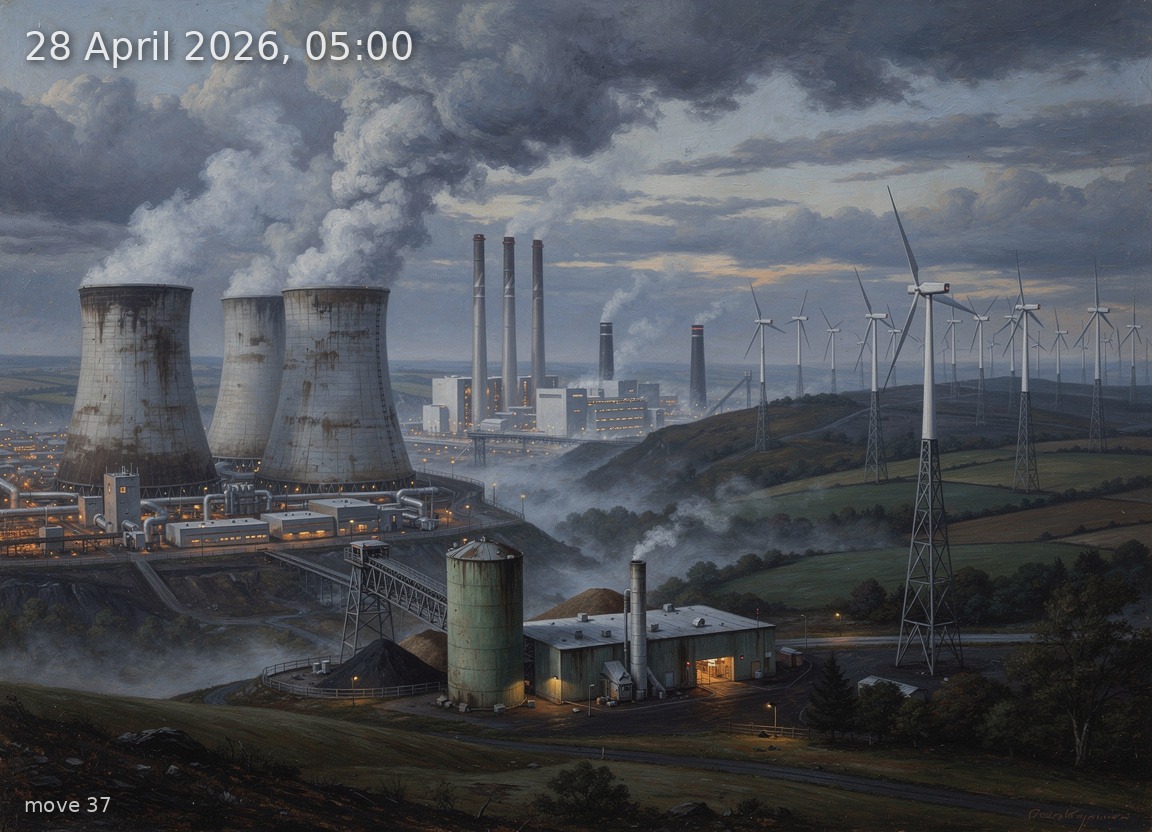
Onshore wind leads at 16.2 GW but pre-dawn darkness and overcast skies force 18.4 GW of fossil thermal dispatch plus 5.5 GW net imports.
Back
Generation mix
Wind onshore 38%
Wind offshore 5%
Solar 0%
Biomass 10%
Hydro 3%
Natural gas 15%
Hard coal 9%
Brown coal 19%
57%
Renewable share
18.5 GW
Wind (on + offshore)
0.0 GW
Solar
42.5 GW
Total generation
-5.5 GW
Net import
111.8 €/MWh
Day-ahead price
6.3°C / 5 km/h
Temp / Wind speed
Open-Meteo, Kassel (51.3°N 9.5°E)
100% / 0.0 W/m²
Cloud cover / Radiation
300
gCO₂/kWh
Image prompt
Brown coal 8.2 GW dominates the left quarter as a cluster of massive hyperbolic cooling towers with thick white-grey steam plumes rising into the overcast sky; natural gas 6.3 GW sits left of centre as three compact CCGT units with tall slender exhaust stacks venting thin heat shimmer; hard coal 3.9 GW appears as a smaller coal-fired station with a single large smokestack and conveyor gantry just right of centre; onshore wind 16.2 GW sweeps across the entire right half and into the background as dozens of tall three-blade turbines on lattice and tubular towers, rotors visibly turning in a moderate breeze; offshore wind 2.3 GW is suggested far in the background right as a faint row of turbines on the horizon above a dark grey sea; biomass 4.2 GW appears as a modest wood-chip plant with a green-tinged silo and small stack near the centre; hydro 1.3 GW is a low concrete run-of-river weir with white churning water in the foreground stream. Time is 05:00 pre-dawn in late April: the sky is deep blue-grey with the faintest hint of pale cold light along the eastern horizon, no direct sun visible, no warm colours in the sky, the landscape largely dark and lit by orange-yellow sodium streetlights along a country road and the amber glow of the industrial facilities. Overcast is total—100% cloud cover presses low and heavy, creating an oppressive, dense atmosphere reflecting the high electricity price. Temperature is 6.3°C: spring vegetation is emerging but subdued, damp grass and bare-branched hedgerows glisten with dew. No solar panels anywhere. Style: highly detailed oil painting in the tradition of Caspar David Friedrich and Carl Blechen—rich, moody palette of slate blues, burnt umber, deep grey-greens, warm industrial amber; visible impasto brushwork on steam plumes and clouds; atmospheric depth with mist and haze between layers of infrastructure; meticulous engineering detail on turbine nacelles, cooling tower parabolic profiles, CCGT stacks, and coal conveyor systems. The composition evokes sublime tension between the natural darkness and the industrial glow. No text, no labels.