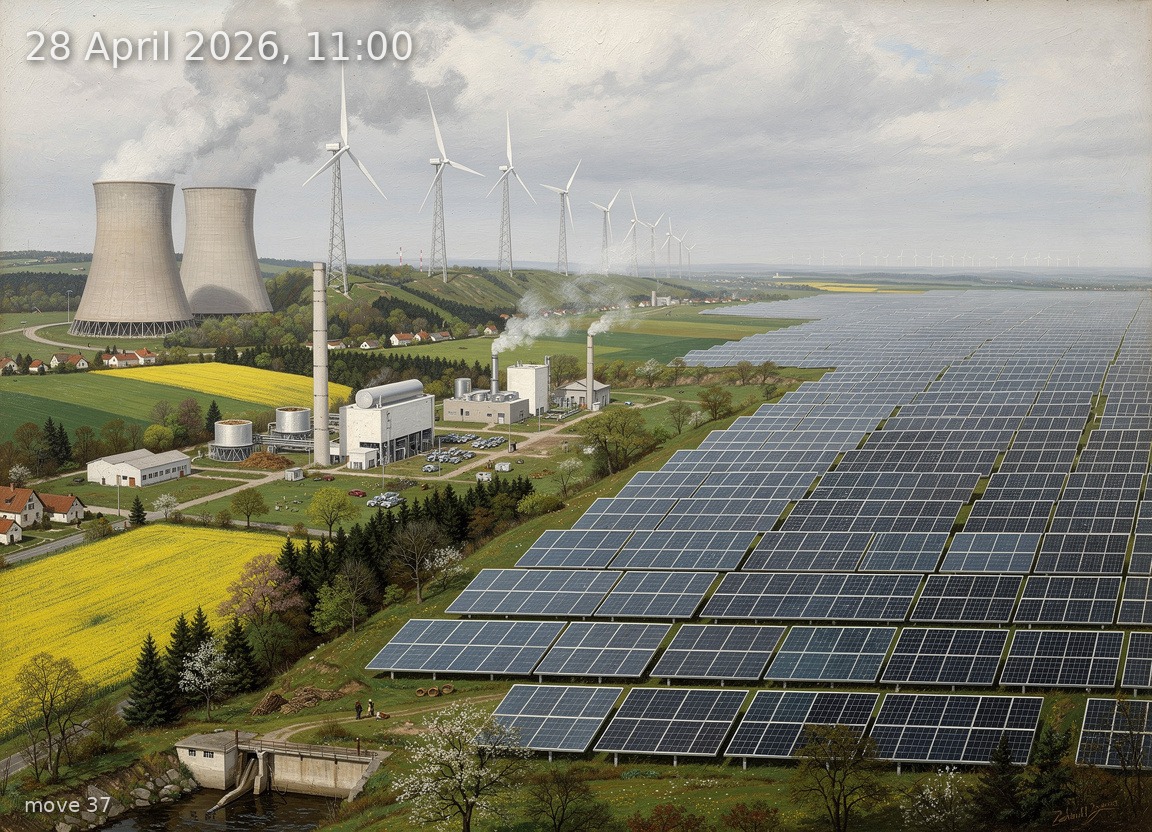
Solar at 48 GW drives 90.6% renewable share and net exports of ~10 GW under overcast spring skies.
Back
Generation mix
Wind onshore 11%
Wind offshore 2%
Solar 70%
Biomass 6%
Hydro 2%
Natural gas 3%
Hard coal 2%
Brown coal 5%
91%
Renewable share
8.7 GW
Wind (on + offshore)
48.0 GW
Solar
68.7 GW
Total generation
+10.0 GW
Net export
-1.1 €/MWh
Day-ahead price
13.3°C / 12 km/h
Temp / Wind speed
Open-Meteo, Kassel (51.3°N 9.5°E)
100% / 339.0 W/m²
Cloud cover / Radiation
66
gCO₂/kWh
Image prompt
Solar 48.0 GW dominates the scene as a vast plain of crystalline silicon PV panels stretching across the entire right two-thirds of the composition, their aluminium frames gleaming under diffused white daylight; wind onshore 7.6 GW appears as a dozen three-blade turbines with white lattice towers arranged along a gentle ridge in the upper-left middle ground, blades turning slowly in light wind; wind offshore 1.1 GW is suggested by a few distant turbines on a hazy horizon line; biomass 4.2 GW is rendered as a mid-ground cluster of wood-chip-fed power stations with modest stacks and thin white exhaust; brown coal 3.2 GW occupies the far left as two hyperbolic cooling towers releasing soft grey-white steam plumes; natural gas 2.0 GW sits beside them as a compact CCGT unit with a single tall exhaust stack and faint heat shimmer; hard coal 1.2 GW appears as a smaller conventional plant with a single square cooling tower, slightly set back; hydro 1.4 GW is depicted as a small concrete dam and penstock visible in a valley at the left edge. The sky is fully overcast with a uniform layer of white-grey stratus clouds typical of a mild Central European spring day at 11:00, bright and diffused with no direct sun disc visible yet strong ambient light illuminating everything evenly. The landscape is spring in central Germany—fresh bright-green foliage on deciduous trees, rapeseed fields beginning to yellow, temperature around 13°C suggested by light jackets on tiny figures near the solar field. The atmosphere is calm, open, almost serene, matching the negative electricity price. Painted in the style of a highly detailed 19th-century German Romantic oil painting—rich layered colour, visible impasto brushwork, atmospheric aerial perspective fading into the overcast distance—yet with meticulous engineering accuracy on every turbine nacelle, every PV cell busbar, every cooling tower's parabolic curve. No text, no labels.