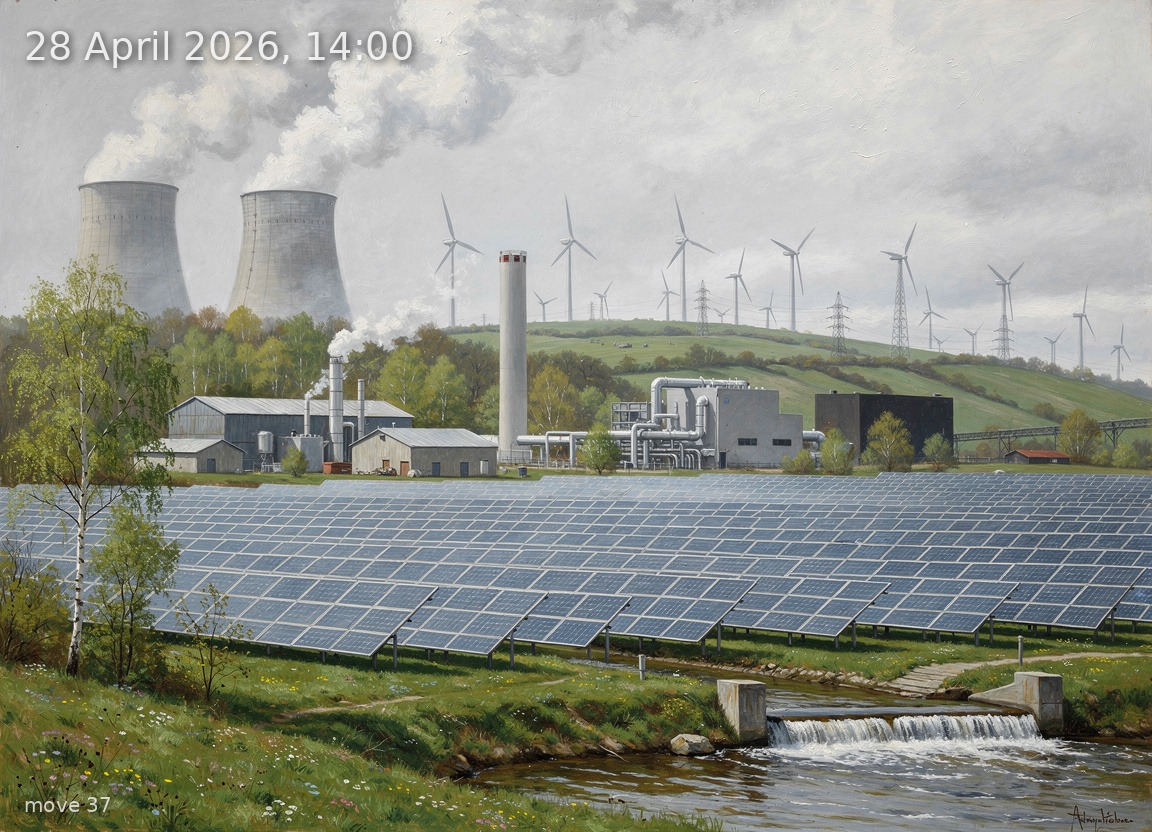
Solar at 46.3 GW drives massive net exports and deeply negative prices on a mild April afternoon.
Back
Generation mix
Wind onshore 13%
Wind offshore 1%
Solar 69%
Biomass 6%
Hydro 2%
Natural gas 3%
Hard coal 2%
Brown coal 5%
90%
Renewable share
9.4 GW
Wind (on + offshore)
46.3 GW
Solar
67.4 GW
Total generation
+14.7 GW
Net export
-29.0 €/MWh
Day-ahead price
16.9°C / 14 km/h
Temp / Wind speed
Open-Meteo, Kassel (51.3°N 9.5°E)
100% / 504.0 W/m²
Cloud cover / Radiation
67
gCO₂/kWh
Image prompt
Solar 46.3 GW dominates the entire scene as an immense plain of aluminium-framed crystalline silicon photovoltaic panels stretching across roughly two-thirds of the canvas, angled southward, gleaming under diffuse midday light filtered through full overcast. Wind onshore 8.9 GW appears as dozens of three-blade turbines on lattice and tubular towers spread across a rolling green ridgeline behind the panels, blades turning gently in moderate breeze. Biomass 4.0 GW is rendered as a cluster of modest wood-chip-fueled plants with squat chimneys trailing thin white exhaust, nestled among budding deciduous trees at mid-left. Brown coal 3.3 GW occupies the far left background as two hyperbolic concrete cooling towers releasing lazy plumes of white steam into the grey sky. Natural gas 2.0 GW sits as a compact combined-cycle gas turbine facility with a single tall exhaust stack and a smaller heat-recovery unit beside it, just left of center-background. Hydro 1.2 GW is a small run-of-river weir visible in a winding river cutting through the foreground meadow. Hard coal 1.1 GW appears as a single dark industrial building with a tall rectangular chimney, partially obscured behind the biomass facility. Wind offshore 0.5 GW is barely visible as a faint row of turbines on the far-right horizon line. The sky is completely overcast with a uniform pale silver-grey cloud layer, yet the light is bright and even — full April midday daylight with no shadows. Spring vegetation: fresh green grass, young leaf canopy on birches and lindens, wildflowers in the foreground meadow. Temperature is mild, 17°C, conveyed by light clothing on two tiny figures walking along the river. The atmosphere feels calm, expansive, and serene — reflecting deeply negative prices with open, weightless sky. Highly detailed oil painting in the tradition of 19th-century German Romantic landscape painters such as Caspar David Friedrich and Carl Blechen — rich layered colour, visible expressive brushwork, atmospheric aerial perspective receding into a luminous hazy distance — yet every piece of energy infrastructure is rendered with meticulous engineering accuracy: turbine nacelles, rotor hubs, PV cell grids, cooling tower parabolic profiles, CCGT exhaust geometry. The composition balances the sublime pastoral tradition with the modern industrial landscape. No text, no labels.