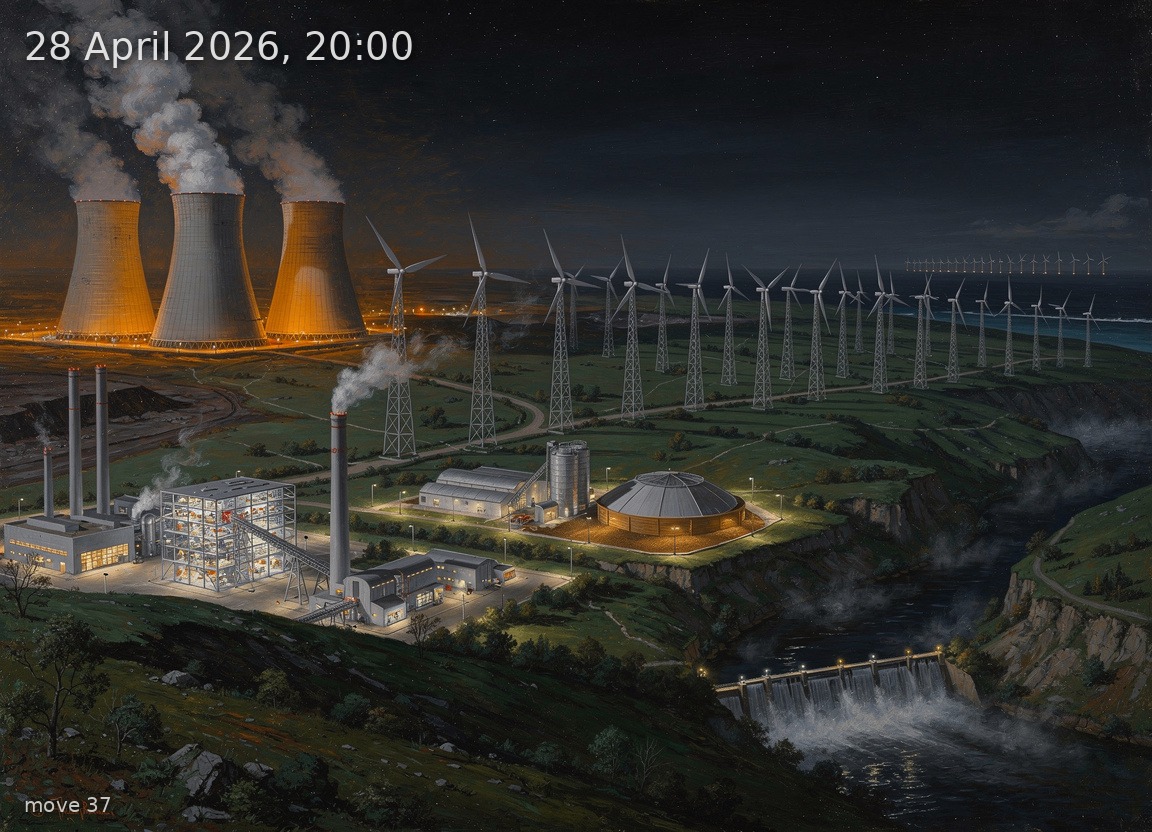
Strong onshore wind leads generation at 21 GW, but evening demand of 55.7 GW requires thermal backup and 9.5 GW net imports.
Back
Generation mix
Wind onshore 46%
Wind offshore 8%
Solar 1%
Biomass 10%
Hydro 3%
Natural gas 11%
Hard coal 7%
Brown coal 14%
68%
Renewable share
25.0 GW
Wind (on + offshore)
0.4 GW
Solar
46.2 GW
Total generation
-9.5 GW
Net import
121.0 €/MWh
Day-ahead price
14.2°C / 12 km/h
Temp / Wind speed
Open-Meteo, Kassel (51.3°N 9.5°E)
0% / 60.0 W/m²
Cloud cover / Radiation
222
gCO₂/kWh
Image prompt
Wind onshore 21.2 GW dominates the right two-thirds of the scene as vast rows of three-blade turbines on lattice towers stretching across rolling hills into darkness; brown coal 6.4 GW occupies the far left as a cluster of massive hyperbolic cooling towers emitting thick white steam plumes lit from below by sodium-orange industrial floodlights; natural gas 5.1 GW appears as a compact CCGT plant with twin exhaust stacks and glowing turbine halls in the left-centre; hard coal 3.4 GW sits beside the lignite plant as a smaller conventional power station with a single tall smokestack and conveyor belts; biomass 4.6 GW is rendered as a mid-ground industrial facility with a cylindrical silo and wood-chip storage dome, warmly lit from within; wind offshore 3.7 GW appears as distant turbines on the far-right horizon above a faintly reflective coastal strip; hydro 1.4 GW is a small dam structure in a valley fold at mid-right, water glinting under floodlights. No solar panels anywhere—the sun is entirely absent. The sky is completely dark, a deep navy-black with no twilight glow, no sunset remnants—it is full nighttime at 20:00 in late April. Stars are faintly visible where steam plumes do not obscure them. A clear sky with zero cloud cover allows crisp starlight. The atmosphere feels heavy and oppressive, reflecting the high electricity price—a faint industrial haze hangs low, tinted amber by the sodium lights of the coal complex. Spring vegetation on the hills is fresh green but rendered in muted nocturnal tones. Wind turbine blades show motion blur suggesting moderate wind. The temperature of 14 °C is suggested by light mist forming near the river by the dam. Highly detailed oil painting in the tradition of 19th-century German Romantic landscape painters—rich impasto colour, visible confident brushwork, atmospheric depth reminiscent of Caspar David Friedrich meets industrial sublime. Each technology rendered with meticulous engineering accuracy: turbine nacelles, three-blade rotors, aluminium-framed details, cooling tower hyperboloid geometry, CCGT exhaust stacks with heat shimmer. The composition feels monumental, a masterwork of the nocturnal industrial landscape. No text, no labels.