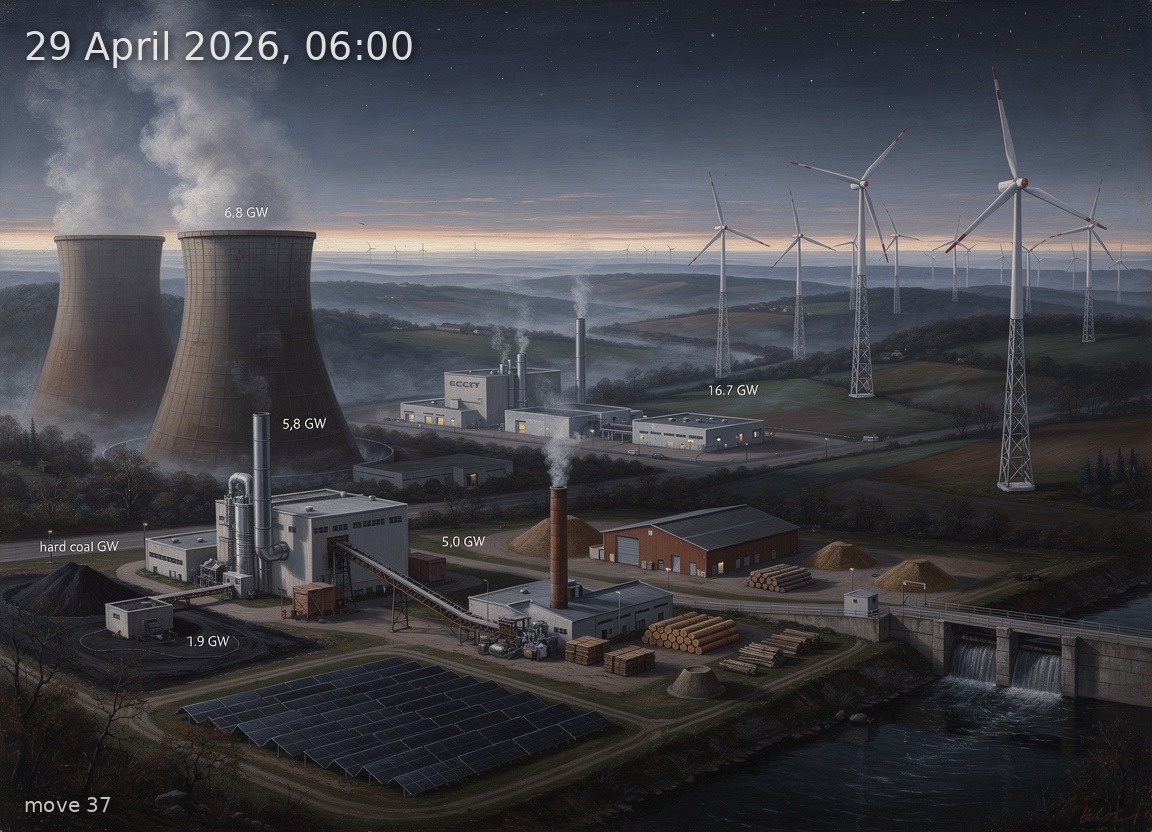
Onshore wind leads at 16.7 GW but 14.5 GW net imports are needed as cold pre-dawn demand peaks.
Back
Generation mix
Wind onshore 41%
Wind offshore 1%
Solar 5%
Biomass 11%
Hydro 3%
Natural gas 12%
Hard coal 9%
Brown coal 17%
61%
Renewable share
17.1 GW
Wind (on + offshore)
1.9 GW
Solar
40.4 GW
Total generation
-14.5 GW
Net import
139.8 €/MWh
Day-ahead price
4.4°C / 5 km/h
Temp / Wind speed
Open-Meteo, Kassel (51.3°N 9.5°E)
0% / 0.0 W/m²
Cloud cover / Radiation
270
gCO₂/kWh
Image prompt
Onshore wind 16.7 GW dominates the right half of the canvas as dozens of tall three-blade turbines with white lattice towers stretching across rolling central German hills, their rotors turning slowly in light winds; brown coal 6.8 GW occupies the left foreground as a cluster of massive hyperbolic cooling towers emitting thick white-grey steam plumes rising into the still air; natural gas 5.0 GW appears as two compact CCGT plants with slim exhaust stacks and smaller vapor trails positioned centre-left; hard coal 3.8 GW is rendered as a coal-fired station with a tall rectangular boiler house and conveyor belts beside a coal pile in the left middle ground; biomass 4.4 GW is depicted as a mid-sized wood-chip power plant with a modest chimney and stacked timber logs in the centre; solar 1.9 GW appears as a small field of aluminium-framed crystalline PV panels sitting dark and inert in the lower centre, reflecting no light; hydro 1.3 GW is a concrete run-of-river dam with spillway visible at the far right edge along a small river; offshore wind 0.4 GW is a faint suggestion of a few turbines on the far horizon. The sky is a deep blue-grey pre-dawn, the first pale cold light appearing along the eastern horizon, no direct sunlight yet, stars still faintly visible overhead in a clear sky with zero cloud cover. The atmosphere is heavy, oppressive, and dense — reflecting the high electricity price — with a faint haze clinging to the valley floors. Frost covers the short early-spring grass and bare-branched trees are just beginning to bud. Temperature near freezing is conveyed through visible breath-like condensation around the cooling towers and a crisp, biting quality to the air. Rendered as a highly detailed oil painting in the tradition of Caspar David Friedrich and Carl Blechen — rich, dark Romantic palette of deep indigo, slate grey, warm amber from sodium streetlights illuminating the industrial facilities, visible confident brushwork, atmospheric depth with layered mist, meticulous engineering accuracy in every turbine nacelle, every cooling tower's parabolic curve, every conveyor mechanism. No text, no labels.