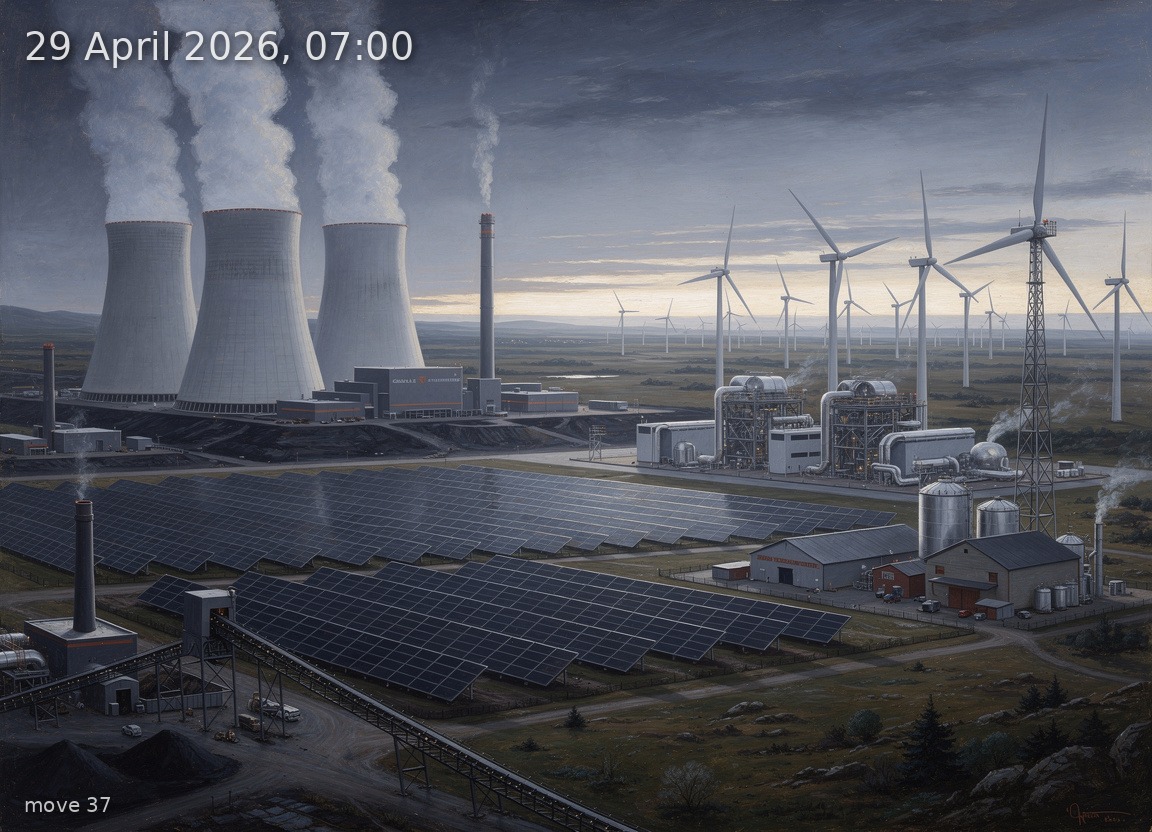
Wind onshore (13 GW) and brown coal (6.8 GW) anchor a 44.1 GW supply requiring 14.8 GW net imports on a cold, clear dawn.
Back
Generation mix
Wind onshore 29%
Wind offshore 1%
Solar 21%
Biomass 10%
Hydro 4%
Natural gas 11%
Hard coal 9%
Brown coal 15%
65%
Renewable share
13.4 GW
Wind (on + offshore)
9.1 GW
Solar
44.1 GW
Total generation
-14.8 GW
Net import
126.8 €/MWh
Day-ahead price
4.4°C / 5 km/h
Temp / Wind speed
Open-Meteo, Kassel (51.3°N 9.5°E)
0% / 11.0 W/m²
Cloud cover / Radiation
247
gCO₂/kWh
Image prompt
Wind onshore 13.0 GW dominates the right third of the scene as dozens of three-blade turbines on lattice and tubular towers stretching across a gently rolling plain with blades barely turning in near-still air; brown coal 6.8 GW occupies the left quarter as a massive lignite power station with three hyperbolic cooling towers emitting thick white steam plumes rising vertically in the calm; solar 9.1 GW appears in the centre-left foreground as extensive rows of aluminium-framed crystalline silicon panels on a flat field, angled low, catching the first faint rays of dawn; natural gas 5.0 GW is rendered as two compact CCGT units with tall single exhaust stacks and smaller vapour trails, positioned behind the solar field; hard coal 3.9 GW shows as a coal-fired station with a single large smokestack and conveyor infrastructure at the far left; biomass 4.5 GW appears as a cluster of medium-sized industrial buildings with wood-chip silos and modest stacks in the centre-right middle ground; hydro 1.6 GW is depicted as a small concrete dam and powerhouse nestled in a wooded valley in the far right background. The sky is deep blue-grey pre-dawn light at 07:00 in late April — no direct sun visible yet, only a thin band of pale cold light along the eastern horizon behind the turbines; the atmosphere is heavy, slightly hazy, conveying the pressure of high electricity prices. Temperature is 4.4 °C: frost dusts the PV panels and grass, bare deciduous trees with only the earliest buds, patches of lingering snow in shaded hollows. Highly detailed oil painting in the tradition of 19th-century German Romantic landscape painters — Caspar David Friedrich's atmospheric depth merged with industrial precision — rich colour palette of steel blues, ashen greys, and pale golds, visible impasto brushwork, meticulous engineering detail on every turbine nacelle, cooling tower, and panel frame. No text, no labels.