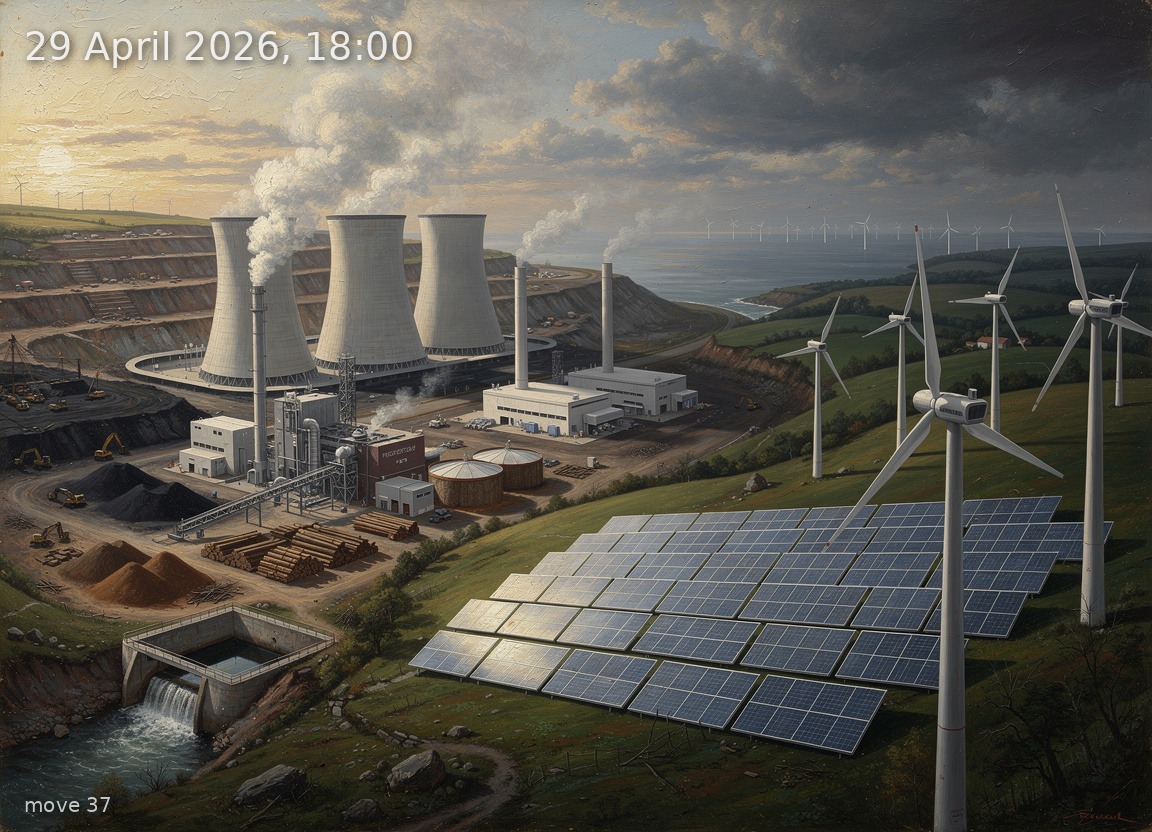
Strong wind and late solar drive 76.5% renewables, but 3.2 GW net imports and coal bridge the evening ramp.
Back
Generation mix
Wind onshore 32%
Wind offshore 3%
Solar 29%
Biomass 9%
Hydro 3%
Natural gas 7%
Hard coal 5%
Brown coal 11%
76%
Renewable share
18.5 GW
Wind (on + offshore)
15.1 GW
Solar
51.7 GW
Total generation
-3.1 GW
Net import
91.2 €/MWh
Day-ahead price
14.9°C / 15 km/h
Temp / Wind speed
Open-Meteo, Kassel (51.3°N 9.5°E)
0% / 348.0 W/m²
Cloud cover / Radiation
165
gCO₂/kWh
Image prompt
Wind onshore 16.8 GW dominates the right half of the scene as dozens of tall three-blade turbines with white tubular towers and detailed nacelles stretching across green rolling hills; solar 15.1 GW fills the centre-right foreground as vast fields of aluminium-framed crystalline silicon panels angled toward a low western sun; brown coal 5.6 GW occupies the far left as a cluster of massive hyperbolic cooling towers emitting thick white steam plumes beside a sprawling open-pit mine; biomass 4.5 GW appears as a mid-sized industrial plant with a tall stack and wood-chip storage silos in the left-centre middle ground; natural gas 3.8 GW is rendered as two compact CCGT units with single tall exhaust stacks and slim vapour trails just right of centre-left; hard coal 2.8 GW sits as a coal-fired station with a rectangular boiler house and conveyor belts beside a coal stockpile, adjacent to the lignite complex; wind offshore 1.7 GW is suggested on the far distant horizon as a faint line of turbines above a hazy sea glimpsed through a valley; hydro 1.5 GW appears as a small dam and spillway in the lower-left foreground with rushing water. The lighting is late dusk at 18:00 in late April — the sun sits very low on the western horizon casting a deep orange-red glow across the lower sky, while the upper sky transitions from warm amber to deepening blue-grey; long dramatic shadows stretch eastward across spring-green meadows dotted with wildflowers and young beech trees in fresh leaf. The atmosphere is heavy and slightly oppressive despite the clear sky, with a warm golden haze suggesting high electricity prices — the air feels thick, saturated with the weight of industrial demand. Moderate wind animates the turbine blades and bends the grass. Rendered as a highly detailed oil painting in the tradition of 19th-century German Romantic landscape painters such as Caspar David Friedrich and Carl Blechen — rich impasto brushwork, luminous atmospheric depth, dramatic chiaroscuro between the glowing west and shadowed east, meticulous engineering accuracy on every turbine nacelle, every PV cell edge, every cooling tower's parabolic curve. No text, no labels.