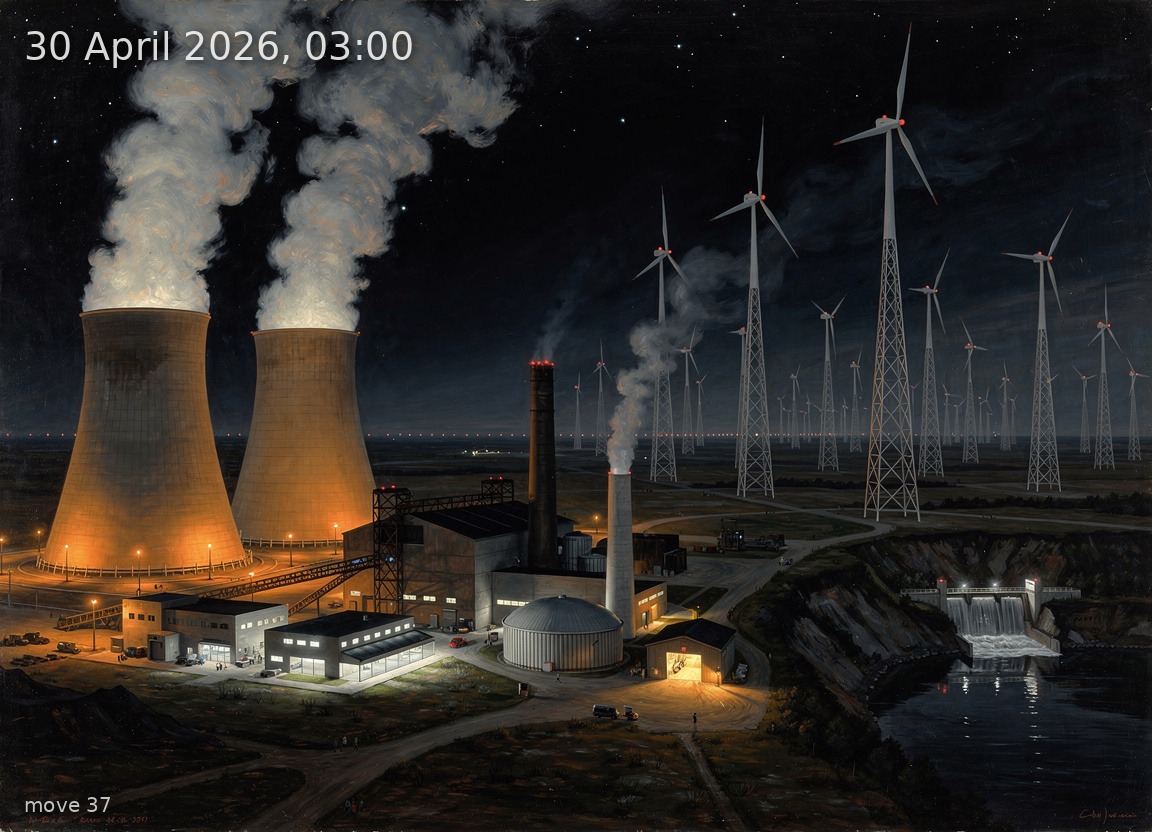
Wind onshore leads at 14.1 GW but thermal plants and net imports cover overnight demand at elevated prices.
Back
Generation mix
Wind onshore 39%
Wind offshore 4%
Biomass 11%
Hydro 4%
Natural gas 17%
Hard coal 9%
Brown coal 16%
59%
Renewable share
15.7 GW
Wind (on + offshore)
0.0 GW
Solar
36.3 GW
Total generation
-7.7 GW
Net import
99.5 €/MWh
Day-ahead price
4.6°C / 3 km/h
Temp / Wind speed
Open-Meteo, Kassel (51.3°N 9.5°E)
0% / 0.0 W/m²
Cloud cover / Radiation
278
gCO₂/kWh
Image prompt
Wind onshore 14.1 GW dominates the right half of the scene as dozens of tall three-blade wind turbines with white lattice towers receding into deep distance across a flat northern German plain, their red aviation warning lights blinking in the darkness; brown coal 5.7 GW occupies the left foreground as three massive hyperbolic cooling towers with thick white steam plumes rising into the black sky, lit from below by orange sodium floodlights illuminating the lignite power station complex; natural gas 6.0 GW appears centre-left as a pair of compact CCGT units with slender exhaust stacks emitting thin heat shimmer, their control buildings glowing with interior fluorescent light; hard coal 3.3 GW sits behind the gas plant as a single large boiler house with a tall chimney and coal conveyor belts dimly visible under industrial spotlights; biomass 4.1 GW appears centre-right as a mid-sized plant with a rounded silo and a modest smokestack trailing faint vapour, warm light spilling from its loading bay; wind offshore 1.6 GW is suggested far in the background as a faint row of red blinking lights on the distant horizon; hydro 1.4 GW appears as a small illuminated dam structure nestled in a valley at far right. The sky is completely black with no twilight — it is 3 AM — a deep navy-to-black firmament with scattered cold stars visible through gaps between the cooling tower plumes. The atmosphere feels heavy and oppressive, reflecting the high electricity price: a faint industrial haze hangs low, tinted amber by the sodium lighting. The ground shows early spring — sparse pale-green grass, bare-branched trees just beginning to bud, frost glinting on metal railings. Temperature near freezing is conveyed by visible breath-like condensation around the cooling towers and crisp edges on every structure. Painted in the style of a highly detailed 19th-century German Romantic oil painting — rich, dark palette of deep blues, warm ambers, and coal blacks, with visible impasto brushwork, dramatic chiaroscuro lighting from the industrial facilities against the void of the night sky, and meticulous engineering accuracy in every turbine nacelle, cooling tower curve, and conveyor mechanism. No text, no labels.