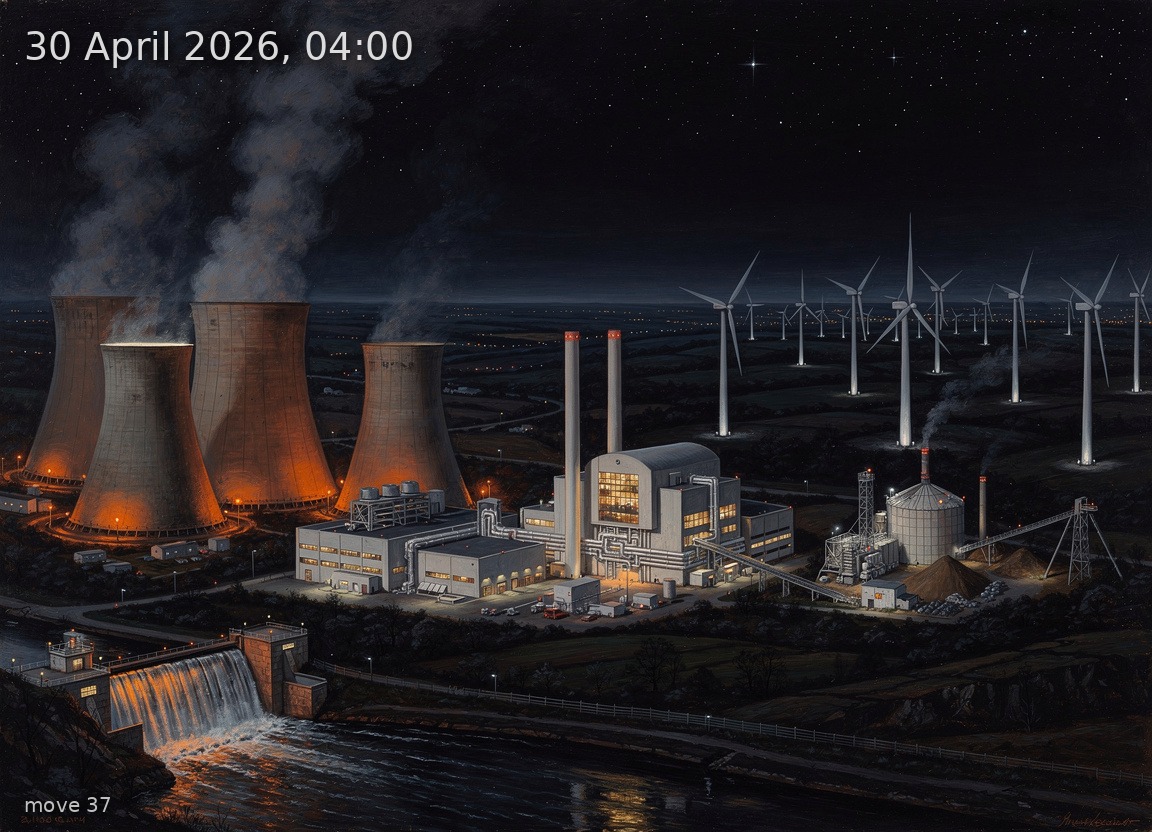
Wind, brown coal, gas, and hard coal share overnight generation as Germany imports 9.8 GW to meet demand.
Back
Generation mix
Wind onshore 37%
Wind offshore 4%
Biomass 12%
Hydro 4%
Natural gas 18%
Hard coal 9%
Brown coal 15%
57%
Renewable share
14.8 GW
Wind (on + offshore)
0.0 GW
Solar
35.5 GW
Total generation
-9.8 GW
Net import
104.1 €/MWh
Day-ahead price
3.3°C / 4 km/h
Temp / Wind speed
Open-Meteo, Kassel (51.3°N 9.5°E)
0% / 0.0 W/m²
Cloud cover / Radiation
285
gCO₂/kWh
Image prompt
Wind onshore 13.2 GW dominates the right half of the scene as dozens of tall three-blade turbines with white tubular towers and nacelles stretching across rolling dark hills into the far distance; brown coal 5.5 GW occupies the left foreground as a cluster of massive hyperbolic cooling towers emitting thick pale steam plumes lit from below by orange sodium lamps; natural gas 6.3 GW fills the centre-left as two modern CCGT power blocks with tall slender exhaust stacks and glowing control-room windows; hard coal 3.3 GW appears as a single large conventional plant with a rectangular boiler house and a tall chimney trailing thin smoke, placed between the gas plant and the cooling towers; biomass 4.2 GW is rendered as a medium-sized wood-chip CHP facility with a conical fuel silo and short stack, nestled behind the coal plant; hydro 1.4 GW appears as a small dam structure with illuminated spillway at the far left edge; wind offshore 1.6 GW is barely visible as tiny red aviation-warning lights on the far horizon line suggesting distant turbines at sea. TIME: 4:00 AM, deep night — the sky is completely black with a scattering of sharp stars visible through perfectly clear air, zero cloud cover, no moon glow; the only illumination comes from sodium-orange industrial lighting around the power plants, white LED spotlights on turbine bases, and the faint amber glow of a distant town on the horizon. The April landscape is early spring: bare dark fields with thin pale-green shoots of winter wheat barely visible, leafless birch trees silhouetted against plant lights, frost glistening on grass in the foreground. The atmosphere feels heavy and oppressive despite the clear sky — a subtle industrial haze clings low, conveying the high electricity price. Style: highly detailed oil painting in the tradition of 19th-century German Romantic landscape painters such as Caspar David Friedrich, with rich dark tones of Prussian blue, lamp black, and warm cadmium orange, visible confident brushwork, dramatic chiaroscuro between the illuminated industrial structures and the vast dark countryside, meticulous engineering detail on every turbine nacelle, cooling tower, and exhaust stack, atmospheric depth achieved through layered darkness receding to the horizon. No text, no labels.