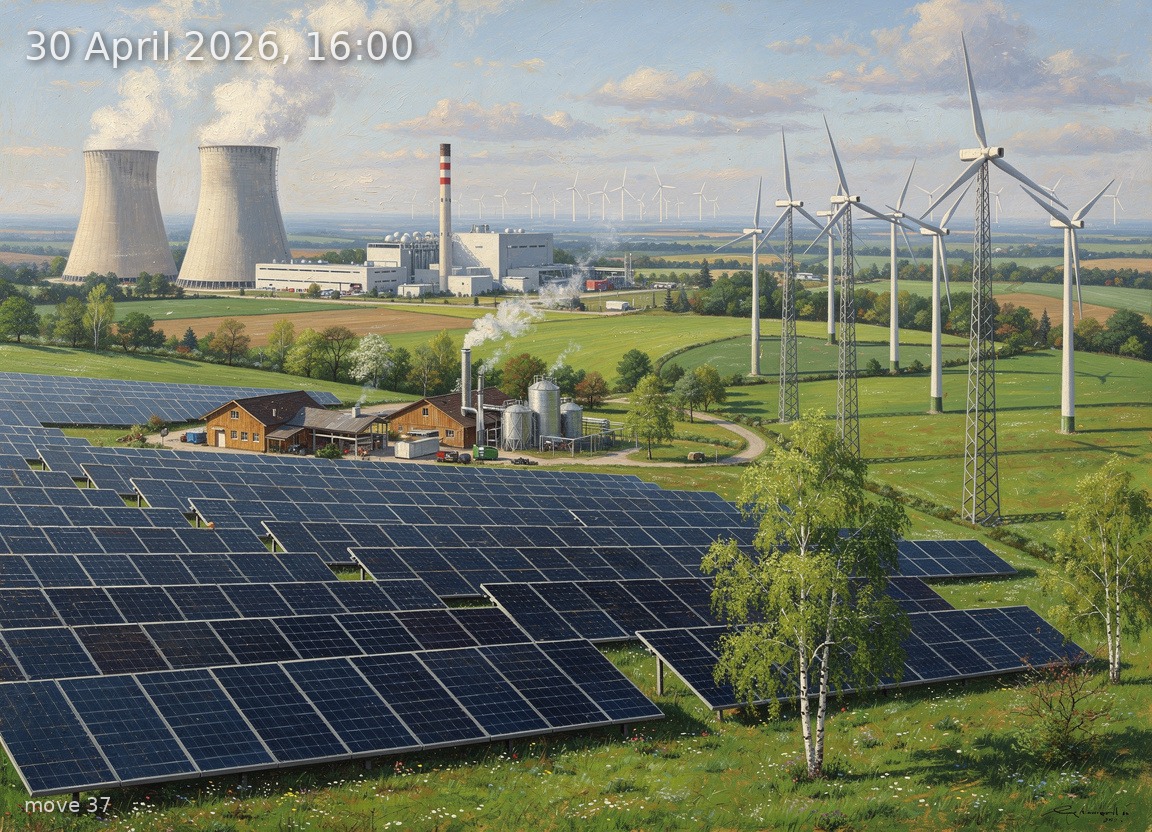
Solar at 38.6 GW drives 9.3 GW net exports and negative prices on a clear spring afternoon.
Back
Generation mix
Wind onshore 17%
Wind offshore 2%
Solar 62%
Biomass 7%
Hydro 2%
Natural gas 3%
Hard coal 2%
Brown coal 4%
91%
Renewable share
12.1 GW
Wind (on + offshore)
38.6 GW
Solar
61.9 GW
Total generation
+9.3 GW
Net export
-2.3 €/MWh
Day-ahead price
16.7°C / 15 km/h
Temp / Wind speed
Open-Meteo, Kassel (51.3°N 9.5°E)
17% / 590.0 W/m²
Cloud cover / Radiation
64
gCO₂/kWh
Image prompt
Solar 38.6 GW dominates the entire foreground and middle ground as vast fields of aluminium-framed crystalline silicon photovoltaic panels stretching across gently rolling central-German farmland, their blue-black surfaces glinting under intense late-afternoon spring sunshine at 16:00. Wind onshore 10.6 GW fills the right third of the composition as dozens of tall three-blade turbines on lattice and tubular towers, rotors turning moderately in a 15 km/h breeze across green spring meadows. Wind offshore 1.5 GW appears as a distant cluster of turbines on a hazy horizon line suggesting the North Sea. Biomass 4.1 GW is rendered as a cluster of modest wood-and-steel biomass plants with short stacks emitting thin wisps of pale smoke in the centre-left middle ground. Brown coal 2.5 GW occupies the far left background as two large hyperbolic cooling towers with lazy steam plumes rising against the sky. Natural gas 1.8 GW appears as a compact combined-cycle gas turbine plant with a single tall exhaust stack beside the cooling towers. Hard coal 1.4 GW is a smaller conventional power station with a single rectangular chimney and faint grey exhaust, tucked behind the gas plant. Hydro 1.4 GW is suggested by a small river with a weir and low-head run-of-river turbine house in the lower left foreground. The sky is 83% clear, a luminous spring blue with only a few high cirrus wisps, the sun relatively high in the west-southwest casting long warm golden light across the landscape; vegetation is fresh spring green, wildflowers dotting field margins, birch and beech trees in bright new leaf. The atmosphere is calm, open, and spacious — reflecting the negative electricity price. Highly detailed oil painting in the tradition of 19th-century German Romantic landscape painters such as Caspar David Friedrich and Carl Blechen — rich saturated colour, visible impasto brushwork, atmospheric aerial perspective giving depth to the receding plains — yet with meticulous technical accuracy for every energy installation: three-blade rotor profiles, nacelle housings, PV module grid patterns, hyperbolic concrete cooling tower geometry, CCGT exhaust stacks. The scene reads as a masterwork industrial landscape painting. No text, no labels.