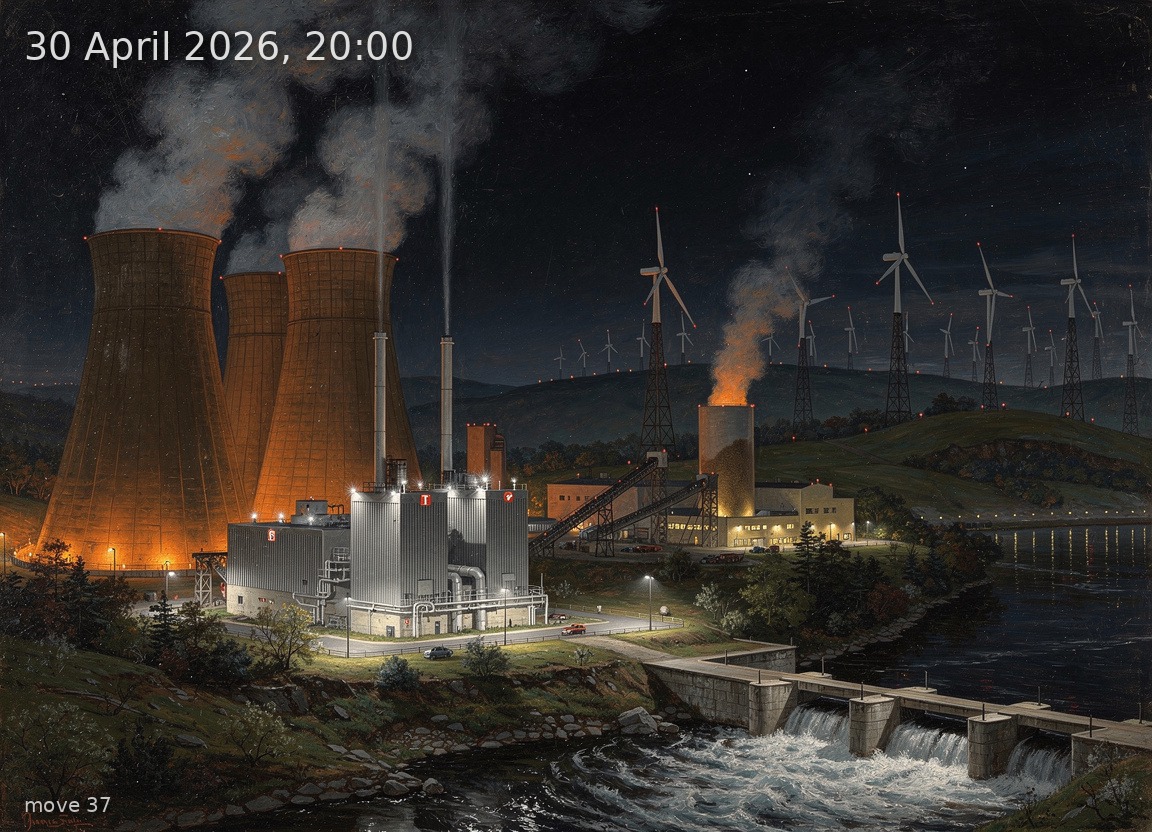
Wind leads at 14.3 GW but a 20.5 GW net import gap and thermal dispatch drive prices to 178.6 EUR/MWh.
Back
Generation mix
Wind onshore 32%
Wind offshore 10%
Solar 1%
Biomass 13%
Hydro 5%
Natural gas 17%
Hard coal 6%
Brown coal 16%
61%
Renewable share
14.2 GW
Wind (on + offshore)
0.5 GW
Solar
34.1 GW
Total generation
-20.5 GW
Net import
178.6 €/MWh
Day-ahead price
15.2°C / 10 km/h
Temp / Wind speed
Open-Meteo, Kassel (51.3°N 9.5°E)
23% / 61.0 W/m²
Cloud cover / Radiation
258
gCO₂/kWh
Image prompt
Brown coal 5.3 GW dominates the left foreground as three massive hyperbolic cooling towers with thick white steam plumes rising into the dark sky, lit from below by orange sodium lamps at the plant base; natural gas 5.8 GW occupies the left-centre as two compact CCGT units with tall single exhaust stacks emitting thin plumes, their corrugated steel housings glowing under floodlights; hard coal 2.1 GW appears as a smaller coal-fired station behind the gas plant, with a single squat stack and conveyor belts visible under work lights; wind onshore 10.9 GW spans the entire right half and background as dozens of tall three-blade turbines on lattice and tubular towers spread across rolling hills, their red aviation warning lights blinking against the black sky, rotors visibly turning in moderate wind; wind offshore 3.4 GW is suggested by a distant cluster of turbines on the far-right horizon over a faintly visible river or lake, navigation lights reflecting; biomass 4.6 GW is rendered as a mid-ground industrial facility with a tall cylindrical silo, wood-chip conveyor, and a single stack with warm amber exhaust, illuminated by yellow facility lighting; hydro 1.6 GW appears as a concrete run-of-river dam in the lower right with turbulent white water spilling over, lit by a single floodlight; solar 0.5 GW is represented by a small darkened ground-mounted array barely visible in shadow near the biomass plant, panels unlit and inactive. The sky is completely dark, deep navy-black with no twilight glow, no sunset remnants — full nighttime at 20:00 in late April. A few stars peek through 23% cloud cover of thin scattered clouds. The atmosphere is oppressive and heavy, a brooding industrial mood reflecting the extreme 178.6 EUR/MWh price — haze hangs around the thermal plants, steam and exhaust merge into the darkness above. Spring vegetation — fresh green grass and leafed-out deciduous trees — is faintly visible under artificial light, temperature around 15°C suggesting mild dampness. Painted in the style of a highly detailed 19th-century German Romantic oil painting with rich impasto brushwork, dramatic chiaroscuro from artificial lighting against the night, atmospheric depth with layered industrial and natural elements receding into darkness, meticulous engineering accuracy on every turbine nacelle, cooling tower flute, and CCGT exhaust stack. No text, no labels.