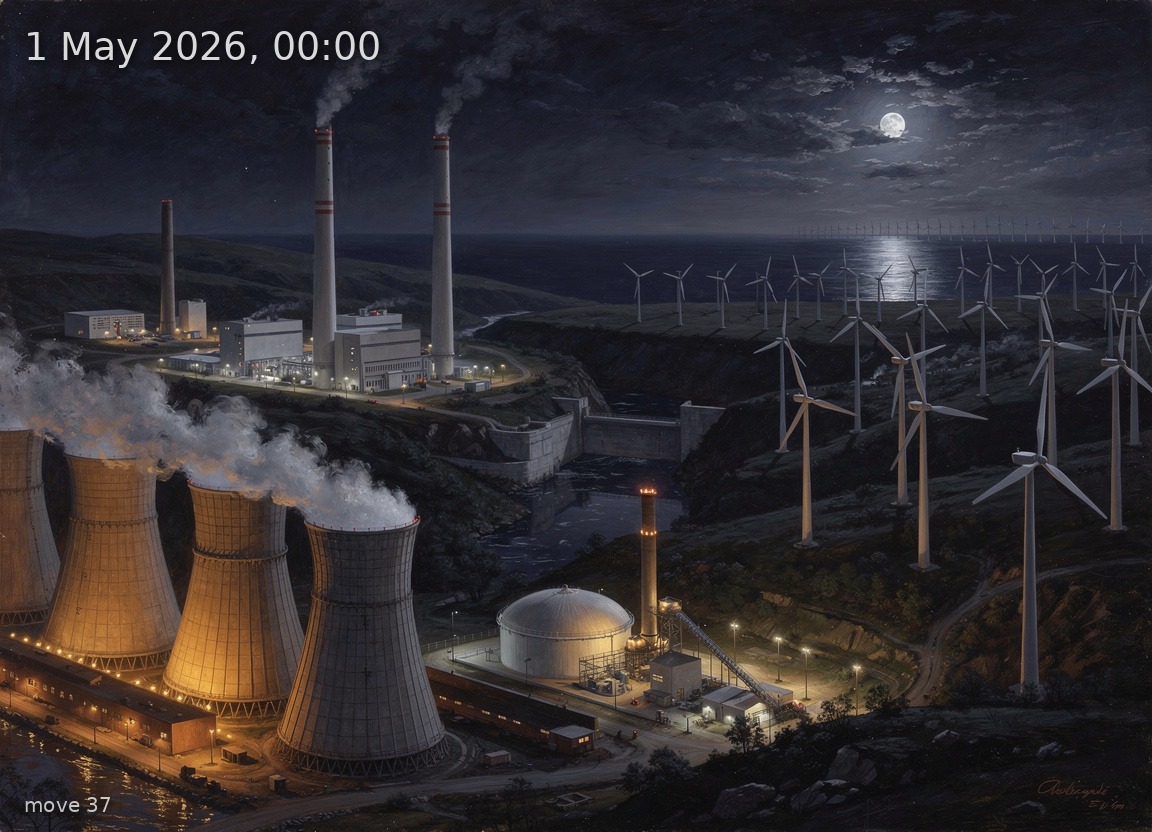
Wind dominates at 19.7 GW with coal and gas backstopping overnight demand under clear, mild spring skies.
Back
Generation mix
Wind onshore 40%
Wind offshore 14%
Biomass 11%
Hydro 4%
Natural gas 12%
Hard coal 5%
Brown coal 14%
70%
Renewable share
19.7 GW
Wind (on + offshore)
0.0 GW
Solar
36.1 GW
Total generation
+1.0 GW
Net export
107.2 €/MWh
Day-ahead price
9.6°C / 4 km/h
Temp / Wind speed
Open-Meteo, Kassel (51.3°N 9.5°E)
3% / 0.0 W/m²
Cloud cover / Radiation
207
gCO₂/kWh
Image prompt
Wind onshore 14.6 GW dominates the right two-fifths of the scene as dozens of tall three-blade turbines with white tubular towers and nacelles, receding in rows across dark rolling hills; wind offshore 5.1 GW appears as a distant line of larger turbines on the far-right horizon above a faintly glinting sea; brown coal 5.1 GW occupies the left foreground as a cluster of massive hyperbolic cooling towers emitting thick white steam plumes, lit from below by orange sodium lamps of an adjacent lignite power station; natural gas 4.2 GW sits centre-left as two compact CCGT units with tall single exhaust stacks and thin grey exhaust streams; biomass 4.1 GW is rendered as a mid-ground industrial facility with a large domed digester, woodchip conveyor, and a moderately tall stack with a faint warm glow; hard coal 1.7 GW appears as a smaller conventional boiler house to the far left with a rectangular chimney and thin dark plume; hydro 1.3 GW is suggested by a small concrete dam with spillway visible in a valley in the centre background. TIME: midnight, completely dark sky — deep navy to black, scattered bright stars visible through the clear 3% cloud cover, no twilight or sky glow whatsoever; a waning crescent moon casts faint silver light on the landscape. The spring vegetation is fresh but muted — young green grass and budding deciduous trees barely visible in moonlight. The atmosphere feels heavy and oppressive despite clear skies, with an amber industrial haze pooling around the coal plant, reflecting the high electricity price. Surface air is calm — no visible motion in grass or trees — yet turbine blades spin steadily at hub height. Style: highly detailed oil painting in the tradition of Caspar David Friedrich and Carl Blechen — rich, dark Romantic palette of deep indigos, warm ambers from industrial lighting, cool silvers from moonlight; visible impasto brushwork in steam plumes and sky; meticulous engineering detail on every turbine nacelle, cooling tower ribbing, gas turbine exhaust geometry, and dam structure; atmospheric depth created through layered fog and diminishing industrial light; no text, no labels.