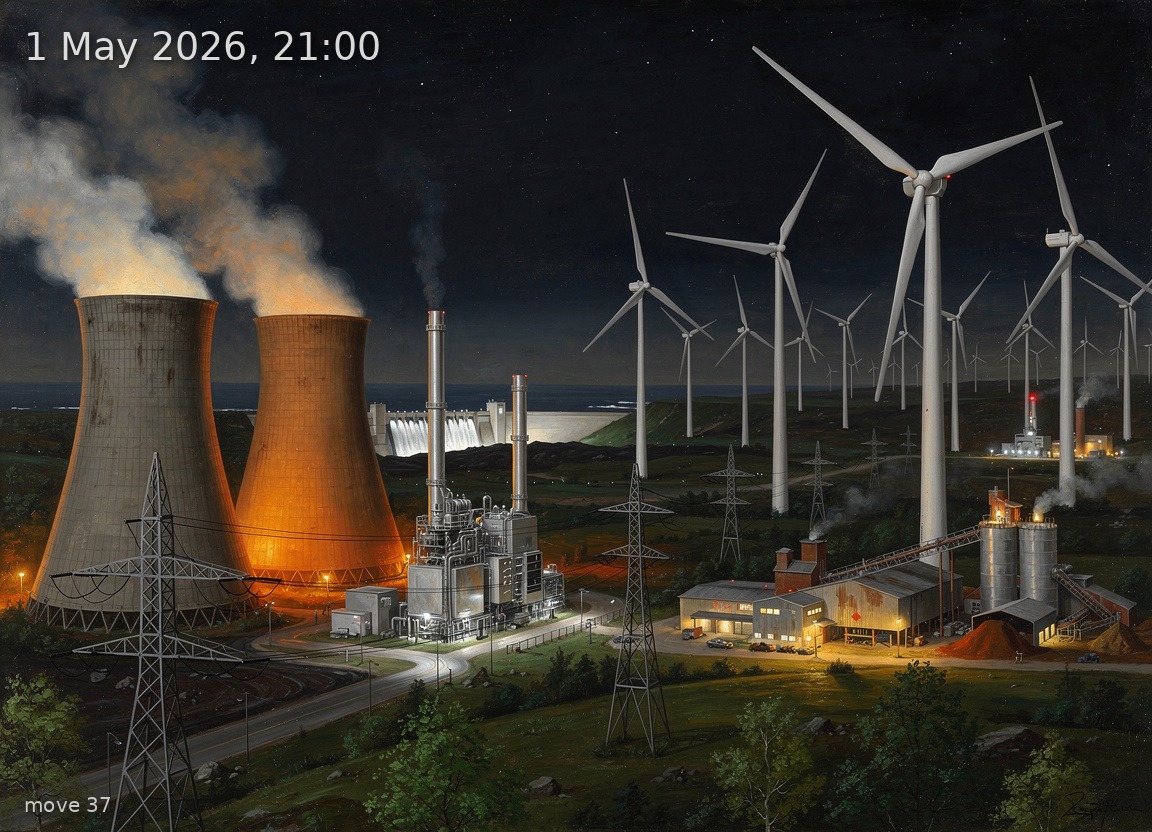
Wind leads at 14.3 GW but 14.1 GW net imports fill a large evening gap as solar drops to zero.
Back
Generation mix
Wind onshore 37%
Wind offshore 11%
Solar 0%
Biomass 15%
Hydro 7%
Natural gas 13%
Hard coal 4%
Brown coal 13%
70%
Renewable share
14.3 GW
Wind (on + offshore)
0.0 GW
Solar
29.8 GW
Total generation
-14.1 GW
Net import
142.9 €/MWh
Day-ahead price
17.8°C / 8 km/h
Temp / Wind speed
Open-Meteo, Kassel (51.3°N 9.5°E)
0% / 3.0 W/m²
Cloud cover / Radiation
204
gCO₂/kWh
Image prompt
Wind onshore 11.0 GW and offshore 3.3 GW together dominate the right two-thirds of the scene as dozens of tall three-blade turbines with white tubular towers and streamlined nacelles, their rotors turning gently, stretching across a dark rolling plain toward the distant coast; brown coal 3.9 GW occupies the left foreground as two massive hyperbolic concrete cooling towers emitting pale steam plumes illuminated from below by sodium-orange industrial lights; natural gas 3.9 GW sits just right of the cooling towers as a pair of compact combined-cycle gas turbine blocks with tall single exhaust stacks venting thin heat shimmer; biomass 4.5 GW appears as a cluster of mid-sized industrial buildings with wood-chip conveyor belts and modest chimneys, warmly lit from within; hard coal 1.2 GW is a smaller single stack with a red aviation warning light; hydro 2.0 GW is rendered as a concrete dam spillway visible in the middle distance, floodlit white. The sky is completely dark—deep navy to black—a clear May night with no twilight, no sky glow, stars faintly visible but atmosphere feels heavy and oppressive, reflecting the high electricity price. Vegetation is lush late-spring green visible only where artificial light falls—fresh leaves on deciduous trees, damp grass. The air is mild at 17.8 °C with calm conditions at ground level. Power transmission lines on lattice pylons cross the scene, symbolising the heavy import flows. Painted in the style of a highly detailed 19th-century German Romantic oil painting—rich dark palette of Prussian blue, lamp black, warm amber, and ivory; visible confident brushwork; atmospheric depth with haze around the cooling tower plumes; meticulous engineering detail on every turbine nacelle, rotor blade pitch mechanism, cooling tower ribbing, and gas turbine exhaust diffuser. No text, no labels.