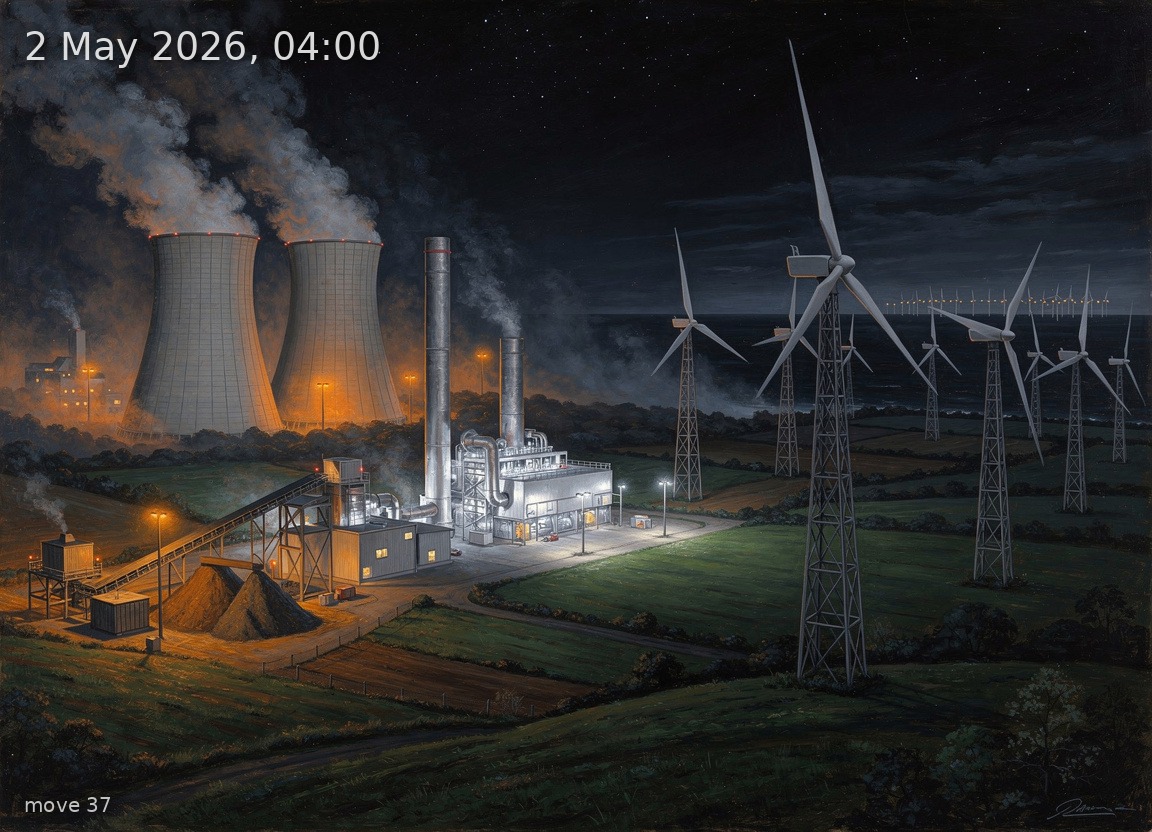
Strong onshore wind leads overnight generation but thermal plants and slight net imports are needed to meet 36.3 GW demand.
Back
Generation mix
Wind onshore 51%
Wind offshore 10%
Biomass 12%
Hydro 4%
Natural gas 9%
Hard coal 3%
Brown coal 11%
77%
Renewable share
21.1 GW
Wind (on + offshore)
0.0 GW
Solar
34.5 GW
Total generation
-1.8 GW
Net import
93.5 €/MWh
Day-ahead price
8.7°C / 1 km/h
Temp / Wind speed
Open-Meteo, Kassel (51.3°N 9.5°E)
0% / 0.0 W/m²
Cloud cover / Radiation
160
gCO₂/kWh
Image prompt
Wind onshore 17.7 GW dominates the right half and background as dozens of tall three-blade turbines on lattice towers stretching across rolling central-German farmland; brown coal 3.9 GW occupies the left foreground as a pair of massive hyperbolic cooling towers emitting thick white steam plumes, lit from below by orange sodium lamps; biomass 4.1 GW appears as a medium-sized industrial facility with a wood-chip conveyor and a single smokestack with pale exhaust, positioned left of centre; natural gas 3.1 GW is rendered as a compact CCGT plant with two cylindrical exhaust stacks and a visible heat-recovery unit, centre-left; wind offshore 3.5 GW is suggested by a cluster of turbines on the far-right horizon standing in a dark sea barely visible; hard coal 1.1 GW appears as a smaller coal plant with a single square stack and modest steam, far left; hydro 1.2 GW is a concrete dam structure with spillway water gleaming faintly, far background left. The sky is completely dark — a black-to-deep-navy canopy with no twilight, no moon, only scattered cold stars above a clear atmosphere (0% cloud cover). The spring landscape at 8.7°C shows fresh green grass barely visible under facility lighting; ground-level wind is calm despite the turbines turning slowly at hub height. The atmosphere feels heavy and oppressive reflecting a high electricity price — a faint industrial haze hangs low, sodium-orange light pools around the thermal plants. Rendered as a highly detailed oil painting in the tradition of 19th-century German Romantic landscape painters — rich, dark palette of Prussian blue, burnt sienna, and lamp black, with visible impasto brushwork, atmospheric depth and chiaroscuro contrast between the glowing industrial facilities and the vast dark countryside. Meticulous engineering detail on every turbine nacelle, cooling tower ribbing, and CCGT exhaust geometry. No text, no labels.