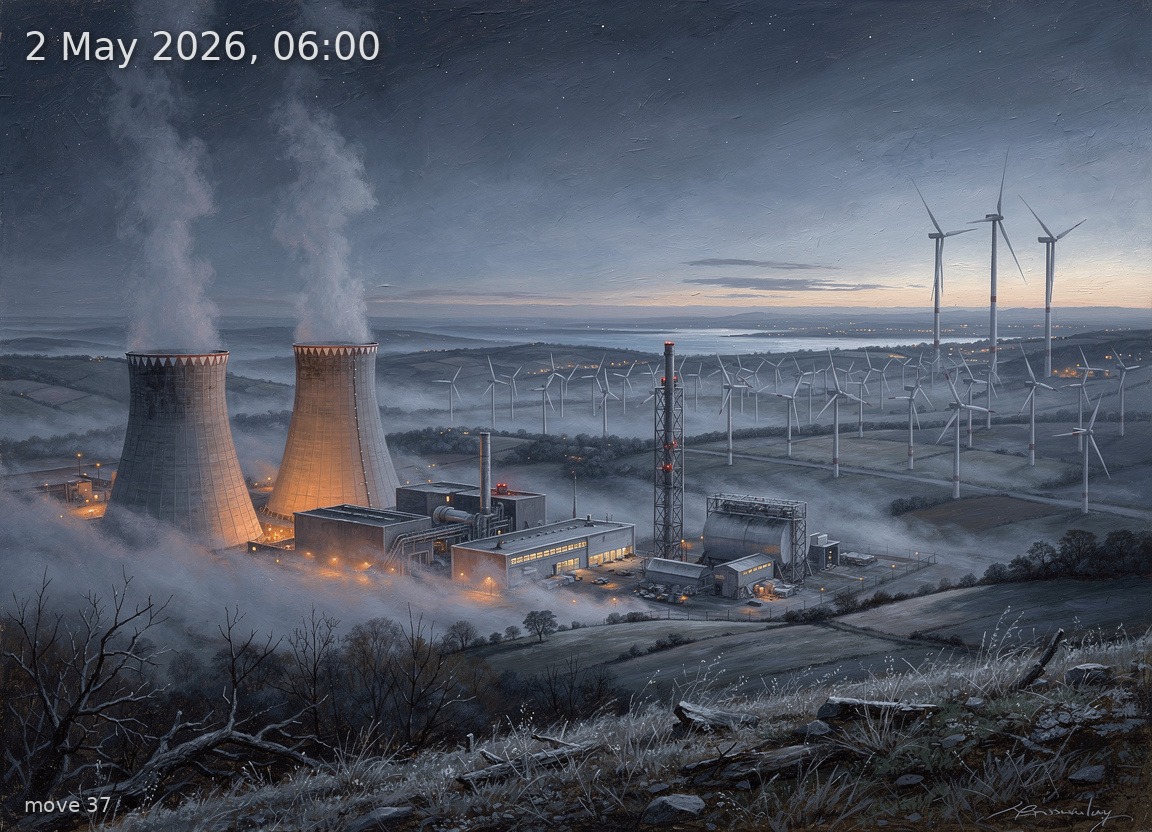
Strong onshore wind leads generation at dawn; thermal plants and net imports cover the gap before solar ramps up.
Back
Generation mix
Wind onshore 48%
Wind offshore 9%
Solar 6%
Biomass 12%
Hydro 3%
Natural gas 8%
Hard coal 3%
Brown coal 11%
79%
Renewable share
21.2 GW
Wind (on + offshore)
2.2 GW
Solar
36.8 GW
Total generation
-1.7 GW
Net import
91.8 €/MWh
Day-ahead price
5.6°C / 1 km/h
Temp / Wind speed
Open-Meteo, Kassel (51.3°N 9.5°E)
0% / 0.0 W/m²
Cloud cover / Radiation
147
gCO₂/kWh
Image prompt
Wind onshore 17.8 GW dominates the right two-thirds of the scene as vast rows of three-blade turbines on lattice towers stretching across rolling central German hills; wind offshore 3.4 GW appears as a distant cluster of larger turbines on the far-right horizon above a faintly visible sea line; brown coal 3.9 GW occupies the left foreground as a lignite power station with two massive hyperbolic cooling towers emitting thick white steam plumes; biomass 4.4 GW is rendered as a mid-ground industrial plant with a tall cylindrical stack and adjacent wood-chip storage silos, slightly larger in visual footprint than the brown coal complex; natural gas 3.0 GW sits as a compact CCGT facility with a single polished exhaust stack and horizontal heat-recovery boiler to the left of centre; hard coal 1.0 GW appears as a smaller conventional coal plant with a square chimney and conveyor belts in the far left background; hydro 1.2 GW is depicted as a concrete run-of-river weir with a small powerhouse nestled in a stream valley in the lower-left corner; solar 2.2 GW is represented by a small field of aluminium-framed crystalline silicon panels in the mid-ground, panels dark and unlit, angled toward an empty sky. The sky is deep blue-grey pre-dawn, the very first pale luminance appearing low on the eastern horizon but no direct sunlight yet; stars still faintly visible overhead. The atmosphere is heavy and slightly oppressive, reflecting the high electricity price — low mist clings to the valley floors and wraps the bases of the cooling towers. Temperature is near freezing: sparse early-spring vegetation, bare branches on deciduous trees, frost glinting on grass in the foreground. Wind turbine blades show almost no motion blur despite high generation, as local surface wind is calm at 1 km/h — the turbines imply strong winds aloft. No clouds in the sky, perfectly clear, yet the hour keeps everything in cool shadow. Rendered as a highly detailed oil painting in the tradition of Caspar David Friedrich and Carl Blechen — rich, moody colour palette of indigo, slate blue, ochre industrial light, and warm sodium-orange glow from the power stations; visible impasto brushwork; atmospheric depth with layered mist planes receding into the distance; meticulous engineering detail on every turbine nacelle, cooling tower ribbing, and panel frame. No text, no labels.