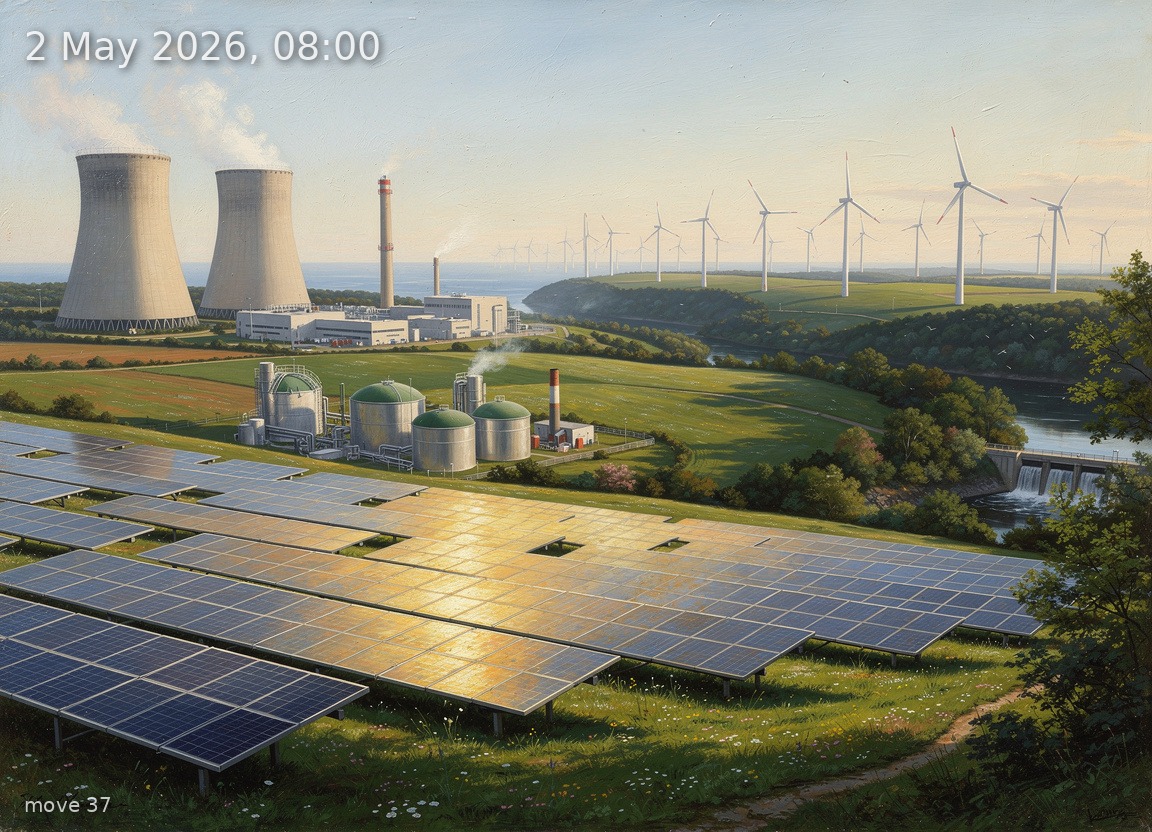
Solar at 23.5 GW and wind at 13.7 GW drive 91% renewable share, pushing 10.7 GW of net exports under clear skies.
Back
Generation mix
Wind onshore 23%
Wind offshore 6%
Solar 50%
Biomass 9%
Hydro 3%
Natural gas 3%
Hard coal 1%
Brown coal 5%
91%
Renewable share
13.7 GW
Wind (on + offshore)
23.5 GW
Solar
47.1 GW
Total generation
+10.7 GW
Net export
18.3 €/MWh
Day-ahead price
8.0°C / 2 km/h
Temp / Wind speed
Open-Meteo, Kassel (51.3°N 9.5°E)
2% / 83.0 W/m²
Cloud cover / Radiation
61
gCO₂/kWh
Image prompt
Solar 23.5 GW dominates the scene as a vast foreground and middle-ground expanse of aluminium-framed crystalline silicon photovoltaic panels stretching across gently rolling green spring fields, occupying roughly half the canvas and reflecting brilliant morning sunlight. Wind onshore 10.9 GW appears as dozens of three-blade turbines with white tubular towers receding across low hills on the right third, their blades barely turning in the light 2.3 km/h breeze. Wind offshore 2.8 GW is visible as a cluster of taller offshore turbines on a distant horizon line above a faint blue sea sliver. Biomass 4.5 GW is rendered as a mid-ground industrial biogas facility with cylindrical digesters, green domed gas holders, and a low exhaust stack with a thin vapour trail. Brown coal 2.1 GW sits in the far left background as two hyperbolic concrete cooling towers releasing modest wisps of white steam against the sky. Natural gas 1.6 GW appears as a compact CCGT plant with a single tall exhaust stack and minimal flue gas, nestled beside the cooling towers. Hydro 1.3 GW is suggested by a small concrete dam with a spillway in a wooded valley at the far right edge. Hard coal 0.4 GW is a single small smokestack barely visible behind the biomass plant. The sky is nearly cloudless—only 2% cover—with luminous spring-morning light from a sun low in the east casting long golden shadows across the PV arrays and fresh green meadows with early wildflowers. Temperature is a cool 8 °C: dew glistens on grass, breath-mist could rise from figures if any were present. The atmosphere is calm, open, and serene, reflecting the low 18.3 EUR/MWh price. Style: highly detailed oil painting in the tradition of Caspar David Friedrich and Carl Blechen—rich saturated colour, visible impasto brushwork, atmospheric aerial perspective with haze softening distant towers, meticulous engineering detail on every turbine nacelle, panel frame, and cooling tower. No text, no labels.