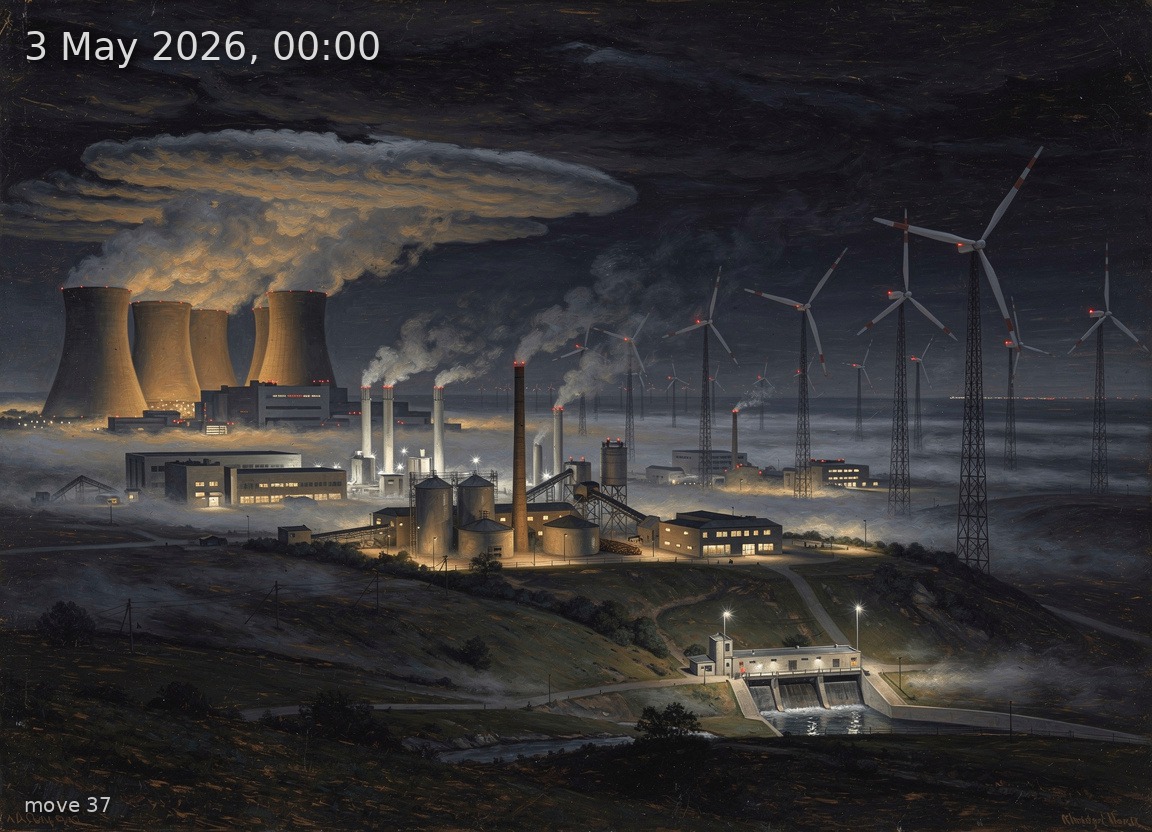
Wind leads at 10 GW with coal and gas backstopping; 11.6 GW net imports cover the overnight shortfall.
Back
Generation mix
Wind onshore 37%
Wind offshore 5%
Biomass 15%
Hydro 5%
Natural gas 16%
Hard coal 4%
Brown coal 17%
62%
Renewable share
11.5 GW
Wind (on + offshore)
0.0 GW
Solar
27.2 GW
Total generation
-11.6 GW
Net import
121.2 €/MWh
Day-ahead price
13.8°C / 2 km/h
Temp / Wind speed
Open-Meteo, Kassel (51.3°N 9.5°E)
100% / 0.0 W/m²
Cloud cover / Radiation
253
gCO₂/kWh
Image prompt
Wind onshore 10.0 GW dominates the right half of the scene as dozens of three-blade turbines on tall lattice towers stretching across a dark rolling northern German plain, rotors slowly turning; brown coal 4.6 GW occupies the far left as a cluster of massive hyperbolic cooling towers emitting thick pale steam plumes lit from below by sodium-orange industrial lights; natural gas 4.5 GW sits left of centre as compact CCGT plants with twin exhaust stacks venting thin white plumes; biomass 4.0 GW appears as a mid-ground group of smaller industrial facilities with wood-chip conveyor belts and warm-lit chimneys; wind offshore 1.5 GW is visible as distant turbines on the far-right horizon above a faintly reflective North Sea strip; hydro 1.4 GW is represented by a small illuminated dam structure nestled in a hillside at centre-right; hard coal 1.2 GW appears as a single compact power station with a tall stack near the brown coal complex. TIME: midnight, completely dark sky — deep black-navy, no twilight, no sky glow, no moon visible, 100% cloud cover creating a featureless void above. All structures lit only by artificial sodium streetlights casting amber pools, control-room windows glowing, and red aviation warning lights on turbine nacelles. The atmosphere is heavy and oppressive reflecting 121 EUR/MWh prices — low haze clings to the ground, steam plumes flatten and spread under the overcast ceiling. Spring vegetation: fresh green grass and leafed-out trees barely visible in the amber light, temperature mild at 14°C. High-voltage transmission lines with lattice pylons cross the mid-ground, suggesting imported power flowing in. Style: highly detailed oil painting in the tradition of 19th-century German Romantic landscape painters — rich, dark, layered colour palette of amber, deep navy, charcoal grey, and ivory steam; visible impasto brushwork; atmospheric depth with aerial perspective fading distant turbines into darkness; meticulous engineering detail on every nacelle, cooling tower, and exhaust stack. The painting evokes the sublime tension between industrial might and the vast unseen night. No text, no labels.