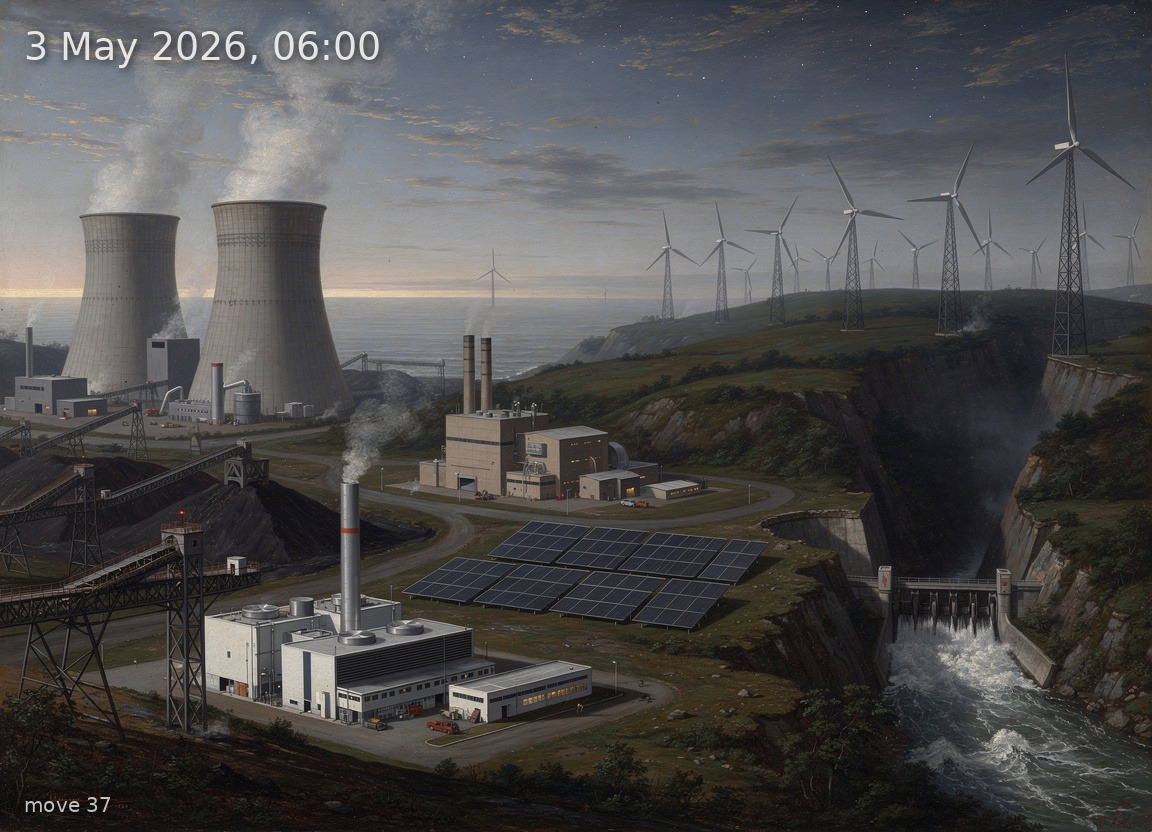
Wind onshore and brown coal anchor a 24.9 GW supply as 10.2 GW net imports cover early-morning demand.
Back
Generation mix
Wind onshore 33%
Wind offshore 0%
Solar 8%
Biomass 18%
Hydro 5%
Natural gas 14%
Hard coal 5%
Brown coal 17%
65%
Renewable share
8.4 GW
Wind (on + offshore)
2.1 GW
Solar
24.9 GW
Total generation
-10.2 GW
Net import
101.7 €/MWh
Day-ahead price
9.9°C / 2 km/h
Temp / Wind speed
Open-Meteo, Kassel (51.3°N 9.5°E)
34% / 0.0 W/m²
Cloud cover / Radiation
240
gCO₂/kWh
Image prompt
Wind onshore 8.3 GW dominates the right third of the scene as a long ridge of three-blade turbines with lattice towers, their rotors barely turning in near-calm air. Brown coal 4.2 GW occupies the left foreground as a pair of massive hyperbolic cooling towers with thick white steam plumes rising vertically in still air, flanked by conveyor gantries and lignite stockpiles. Biomass 4.4 GW appears as a cluster of mid-sized industrial boiler buildings with short chimneys emitting thin grey exhaust, positioned left of centre. Natural gas 3.4 GW is rendered as two compact CCGT units with slender single exhaust stacks and visible heat shimmer, centre-left. Solar 2.1 GW is shown as a modest field of aluminium-framed crystalline silicon panels in the mid-ground, their surfaces dark and unreflective under a sunless sky. Hard coal 1.1 GW appears as a smaller coal plant with a single square stack and coal bunker, far left. Hydro 1.3 GW is a concrete run-of-river dam with churning white water at the base, tucked into a valley at far right. Wind offshore 0.1 GW is barely visible — a single distant turbine silhouette on a grey horizon line. The sky is pre-dawn deep blue-grey, the sun not yet risen, with only the faintest pale glow along the eastern horizon; roughly 34 percent partial cloud cover shows stars through gaps overhead. The atmosphere is heavy and oppressive, hazy with industrial moisture, reflecting the high electricity price. Spring vegetation — fresh green meadows and budding deciduous trees — surrounds the facilities at 9.9 degrees Celsius, with dew visible on grass. Sodium streetlights cast amber pools around the plant perimeters, and lit windows glow in control buildings. Painted in the style of a highly detailed 19th-century German Romantic oil painting — rich, moody colour palette of indigo, slate, amber, and moss green, visible impasto brushwork, atmospheric aerial perspective with distant forms dissolving into mist, meticulous engineering detail on every turbine nacelle, cooling tower rib, and panel frame. No text, no labels.