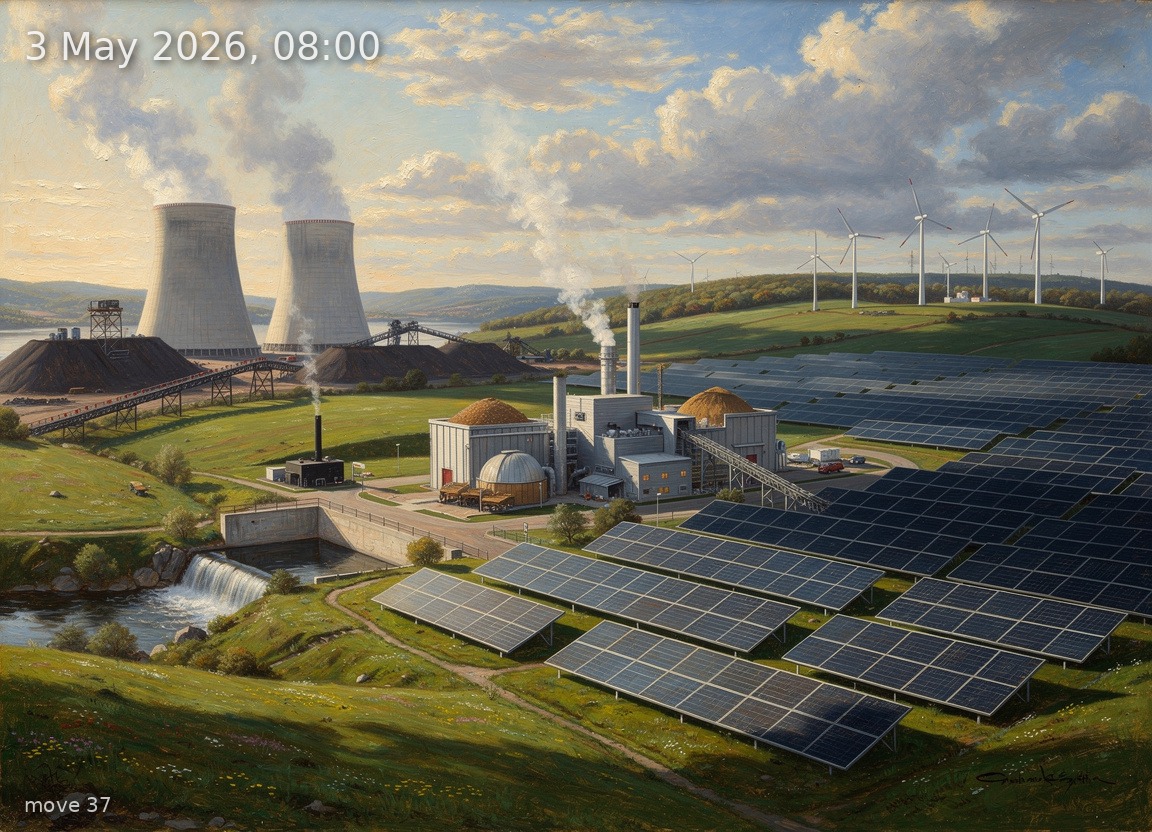
Solar leads at 18.8 GW on a partly cloudy May morning, with wind calm and thermal plants filling the residual load.
Back
Generation mix
Wind onshore 18%
Wind offshore 0%
Solar 50%
Biomass 12%
Hydro 3%
Natural gas 6%
Hard coal 2%
Brown coal 8%
83%
Renewable share
6.8 GW
Wind (on + offshore)
18.8 GW
Solar
37.8 GW
Total generation
+3.5 GW
Net export
71.7 €/MWh
Day-ahead price
11.9°C / 4 km/h
Temp / Wind speed
Open-Meteo, Kassel (51.3°N 9.5°E)
48% / 55.0 W/m²
Cloud cover / Radiation
118
gCO₂/kWh
Image prompt
Solar 18.8 GW dominates the right half and centre of the scene as vast fields of aluminium-framed crystalline silicon photovoltaic panels stretching across gently rolling spring farmland, angled south, glinting under partially cloudy skies; wind onshore 6.7 GW appears as a modest cluster of three-blade turbines on lattice and tubular towers along a distant ridge, their rotors barely turning in near-still air; biomass 4.4 GW is rendered as a mid-ground cluster of compact industrial buildings with wood-chip storage domes and thin exhaust columns releasing pale steam; brown coal 3.2 GW occupies the far left as two large hyperbolic cooling towers with heavy white-grey steam plumes rising and drifting, beside a conveyor belt carrying dark lignite; natural gas 2.4 GW sits as a single modern combined-cycle gas turbine plant with a slender exhaust stack and visible heat shimmer; hydro 1.3 GW is suggested by a small concrete dam and spillway in a valley fold at far left; hard coal 0.9 GW appears as a single smaller stack with thin grey smoke beside the brown coal complex. The time is 08:00 on a spring morning — full daylight, sun at a low-to-moderate angle from the east casting long golden shadows across green meadows dotted with wildflowers and fresh-leafed birch and linden trees at about 12°C. The sky is 48% covered with broken cumulus clouds, allowing patches of warm direct sunlight to alternate with softer diffuse light, creating a dappled mosaic across the landscape. The atmosphere carries a faintly heavy, hazy quality suggesting moderate electricity prices — not oppressive but slightly weighted. Highly detailed oil painting in the tradition of 19th-century German Romantic landscape painters — Caspar David Friedrich's atmospheric depth merged with Adolph Menzel's industrial precision — rich saturated colour, visible confident brushwork, luminous cloud edges, meticulous engineering detail on every turbine nacelle, panel frame, cooling tower curve, and exhaust stack. No text, no labels.