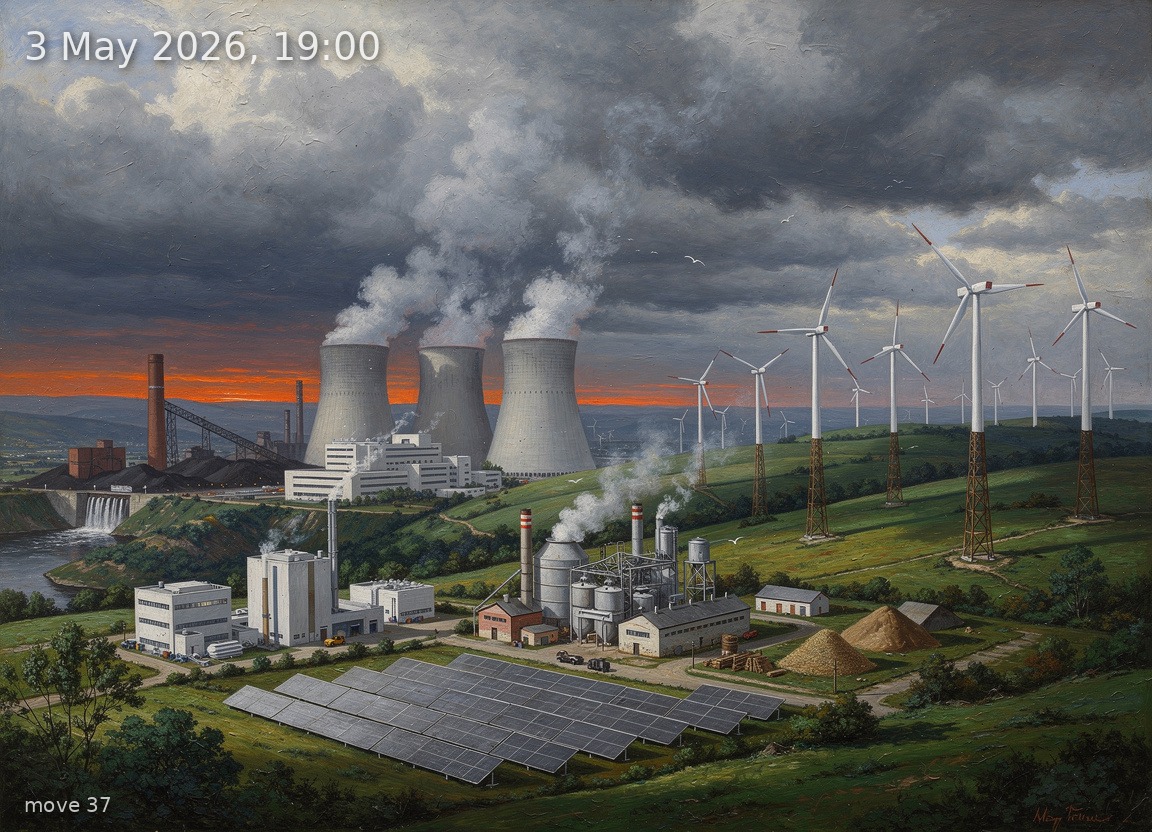
Wind onshore leads at 14.2 GW, but high demand and overcast skies drive coal, gas, and 9.9 GW net imports.
Back
Generation mix
Wind onshore 39%
Wind offshore 5%
Solar 8%
Biomass 12%
Hydro 4%
Natural gas 12%
Hard coal 6%
Brown coal 15%
67%
Renewable share
15.9 GW
Wind (on + offshore)
2.8 GW
Solar
36.6 GW
Total generation
-10.0 GW
Net import
134.8 €/MWh
Day-ahead price
22.0°C / 9 km/h
Temp / Wind speed
Open-Meteo, Kassel (51.3°N 9.5°E)
100% / 11.0 W/m²
Cloud cover / Radiation
224
gCO₂/kWh
Image prompt
Wind onshore 14.2 GW dominates the right half of the composition as dozens of three-blade turbines on lattice and tubular towers stretching across rolling green hills, their rotors turning gently in light wind. Brown coal 5.4 GW occupies the far left as a massive lignite power complex with three hyperbolic cooling towers emitting thick white-grey steam plumes rising into the overcast sky. Natural gas 4.5 GW appears left of centre as a pair of compact CCGT plants with tall slender exhaust stacks venting thin heat shimmer. Biomass 4.5 GW is rendered as a cluster of modest industrial buildings with wood-chip silos and short chimneys releasing pale smoke, placed between the gas plants and the wind turbines. Solar 2.8 GW appears as a small field of aluminium-framed crystalline silicon panels in the mid-ground, their surfaces dull and grey under the overcast sky, reflecting no sunlight. Hard coal 2.1 GW is shown as a single conventional power station with a tall brick smokestack and a coal conveyor, placed near the brown coal complex. Hydro 1.4 GW is visible as a concrete dam with a modest spillway nestled in a valley in the far background. Wind offshore 1.7 GW appears as a faint row of turbines on the distant horizon line. The sky is entirely overcast with heavy, low, oppressive grey clouds—no blue visible—evoking the high electricity price. The lighting is late dusk at 19:00 in May: a narrow band of deep orange-red glow clings to the lower horizon behind the cooling towers, while the upper sky darkens rapidly toward slate grey and deep blue-grey. The landscape is lush late-spring green, warm 22°C evening air suggested by full deciduous canopies on scattered trees and wildflowers in meadow grass. High-voltage transmission pylons and power lines thread through the scene, connecting the generation sources. Style: highly detailed oil painting in the tradition of 19th-century German Romantic landscape painters such as Caspar David Friedrich and Carl Blechen, with rich layered colour, visible impasto brushwork, dramatic atmospheric depth, chiaroscuro contrasts between the glowing horizon and the darkening overcast dome, meticulous engineering detail on every turbine nacelle, cooling tower, and smokestack. No text, no labels.