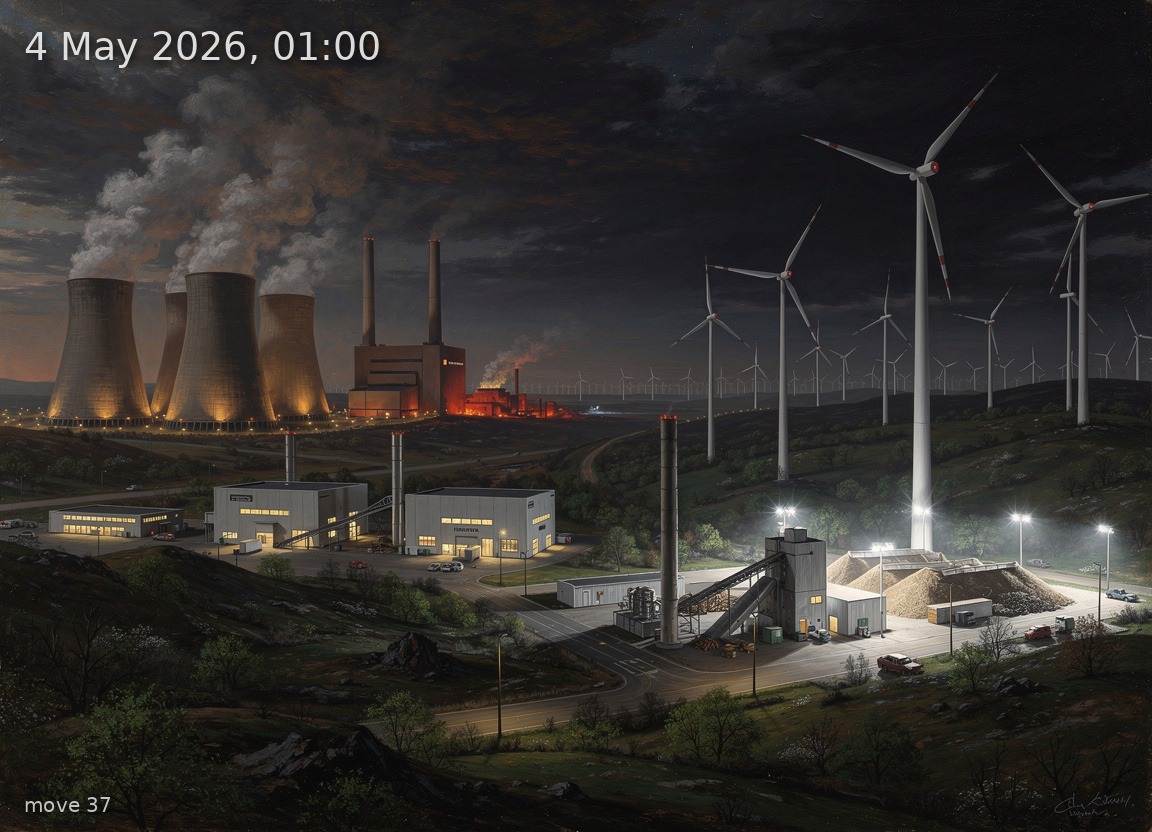
Wind leads at 17.7 GW but brown coal and gas fill the nighttime gap, driving imports and elevated prices.
Back
Generation mix
Wind onshore 39%
Wind offshore 9%
Biomass 11%
Hydro 4%
Natural gas 11%
Hard coal 8%
Brown coal 18%
63%
Renewable share
17.7 GW
Wind (on + offshore)
0.0 GW
Solar
36.6 GW
Total generation
-3.8 GW
Net import
108.4 €/MWh
Day-ahead price
15.9°C / 4 km/h
Temp / Wind speed
Open-Meteo, Kassel (51.3°N 9.5°E)
84% / 0.0 W/m²
Cloud cover / Radiation
262
gCO₂/kWh
Image prompt
Wind onshore 14.3 GW dominates the right half of the composition as dozens of tall three-blade turbines with white tubular towers and nacelles, their rotors turning gently across rolling dark hills; brown coal 6.7 GW fills the left foreground as four massive hyperbolic cooling towers emitting thick white steam plumes lit from below by amber sodium lights; natural gas 4.1 GW appears as two compact CCGT plants with slender exhaust stacks and warm interior glow, positioned left of centre; biomass 4.0 GW is rendered as a mid-ground industrial facility with a tall chimney and wood-chip storage bunkers under floodlights; wind offshore 3.4 GW appears in the far distance as a faint line of turbines on a dark sea visible through a gap in the terrain; hard coal 2.8 GW is a single coal plant with a chunky rectangular boiler house and two broad stacks, glowing red-orange at its base, positioned behind the gas units; hydro 1.3 GW is depicted as a small concrete dam with illuminated spillway in the far right middle ground. TIME: 01:00 at night — completely dark sky, deep navy-black, no twilight, no moon glow, heavy 84% cloud cover creating an oppressive low ceiling that reflects the amber and orange industrial light from below. Temperature is a mild 15.9°C so spring vegetation — fresh green leaves on deciduous trees — is barely visible in the artificial light. Wind speed is low at 4.3 km/h so turbine blades turn slowly, and steam plumes from cooling towers rise nearly vertically. The elevated electricity price of 108.4 EUR/MWh is conveyed through a heavy, brooding, oppressive atmosphere — thick warm-toned haze hanging over the industrial facilities, dense humid air. Style: highly detailed oil painting in the tradition of 19th-century German Romantic landscape painting — rich impasto brushwork, dramatic chiaroscuro between artificial light sources and deep shadow, atmospheric sfumato in the distance, the grandeur and melancholy of Caspar David Friedrich meets industrial realism. Meticulous engineering accuracy on every turbine nacelle, cooling tower profile, and exhaust stack. No text, no labels.