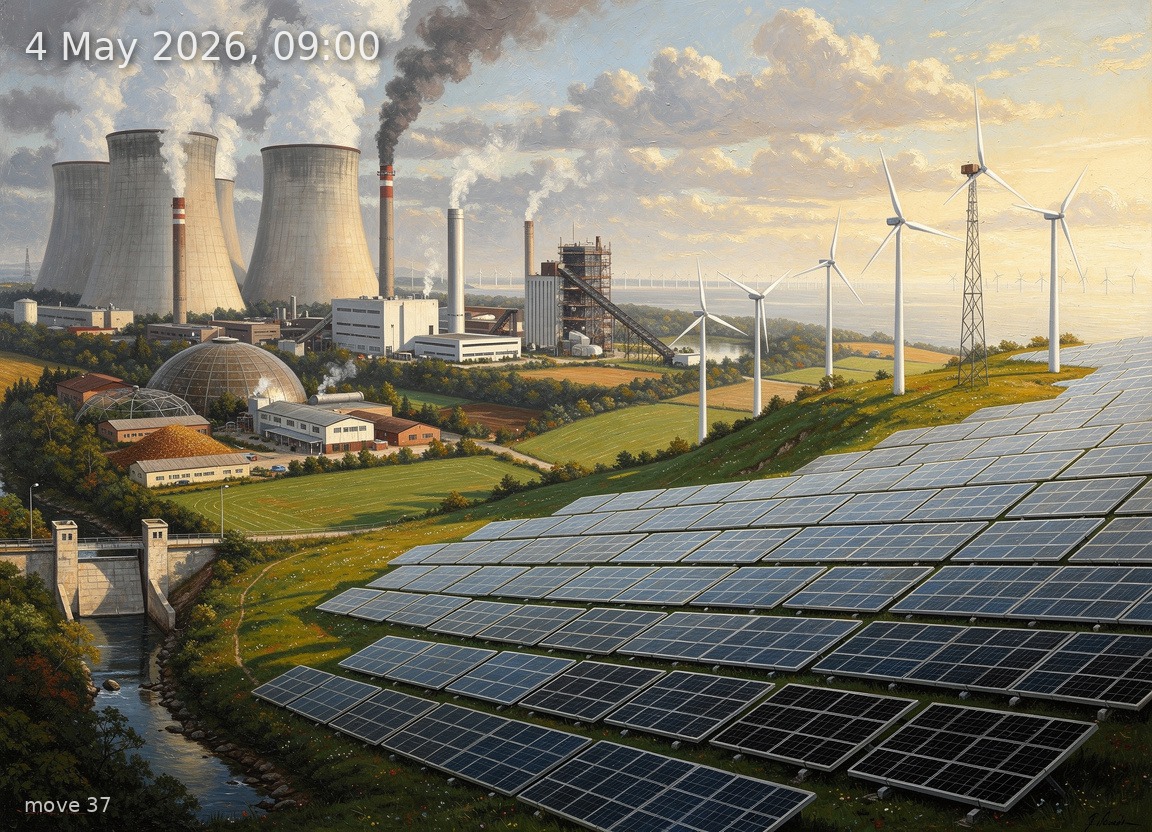
Solar leads at 26.6 GW under partly cloudy skies; lignite and gas persist, keeping prices elevated at 113.6 EUR/MWh.
Back
Generation mix
Wind onshore 7%
Wind offshore 2%
Solar 52%
Biomass 8%
Hydro 3%
Natural gas 9%
Hard coal 7%
Brown coal 11%
72%
Renewable share
4.9 GW
Wind (on + offshore)
26.6 GW
Solar
51.2 GW
Total generation
+2.2 GW
Net export
113.6 €/MWh
Day-ahead price
14.1°C / 7 km/h
Temp / Wind speed
Open-Meteo, Kassel (51.3°N 9.5°E)
35% / 181.0 W/m²
Cloud cover / Radiation
192
gCO₂/kWh
Image prompt
Solar 26.6 GW dominates the scene as an enormous expanse of crystalline silicon PV panels stretching across rolling green spring fields in the right half and centre of the composition, their aluminium frames glinting under a partly cloudy morning sky. Brown coal 5.8 GW occupies the left background as a cluster of massive hyperbolic cooling towers with thick white-grey steam plumes rising into the air. Natural gas 4.6 GW appears as two compact CCGT power plants with tall single exhaust stacks and thinner plumes, positioned left of centre. Hard coal 3.7 GW is rendered as a smaller coal-fired station with a rectangular boiler house and chimney stacks trailing darker smoke, set behind the gas plants. Biomass 4.2 GW appears as a mid-sized industrial facility with a wood-chip storage dome and modest steam vents near the left edge. Wind onshore 3.8 GW is depicted as a line of roughly eight three-blade turbines on lattice and tubular towers along a gentle ridge in the centre-right middle distance, their blades barely turning in the light breeze. Wind offshore 1.1 GW is suggested by a faint row of turbines on the far horizon line. Hydro 1.4 GW appears as a small dam and powerhouse nestled in a wooded valley at the far left edge. The sky is a 09:00 Central European morning — sun well above the eastern horizon at roughly 30 degrees elevation, warm golden-white light illuminating the landscape from the right, with scattered cumulus clouds covering about a third of the sky casting dappled shadows. The atmosphere feels heavy and slightly oppressive despite the sunshine, with a faint industrial haze giving a warm amber tint to the air, reflecting the high electricity price. Spring vegetation is lush — fresh green grass, blooming canola fields in bright yellow patches, deciduous trees in full new leaf. Temperature is mild at 14°C, no frost, gentle light. Style: highly detailed oil painting in the tradition of 19th-century German Romantic landscape painters such as Caspar David Friedrich and Carl Blechen — rich saturated colour palette, visible impasto brushwork, atmospheric depth with subtle aerial perspective, dramatic yet contemplative mood. Each energy technology is rendered with meticulous engineering accuracy: turbine nacelles, three-blade rotors, aluminium PV module frames, hyperbolic concrete cooling towers with realistic condensation plumes, CCGT exhaust stacks. The composition balances the luminous solar foreground against the brooding industrial background, evoking the tension between renewable abundance and fossil persistence. No text, no labels, no people in the foreground.