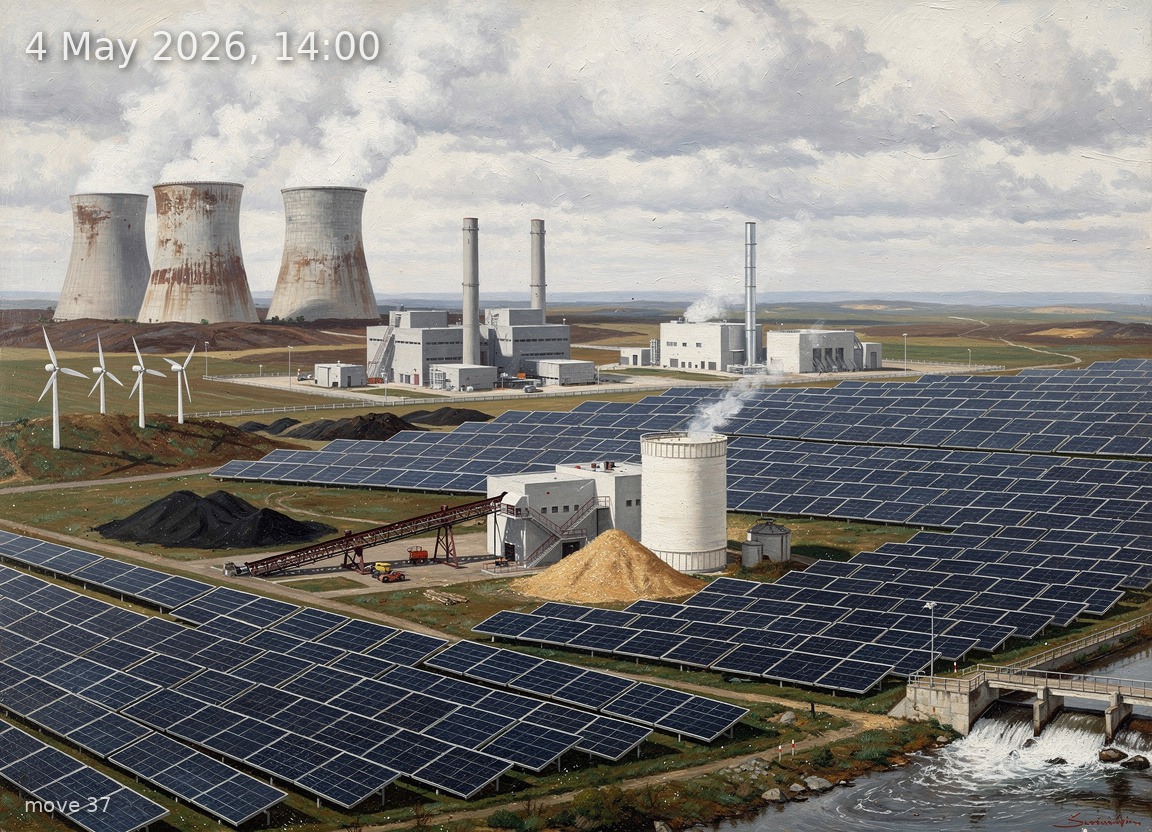
Solar provides 34.4 GW under overcast skies; coal and gas fill the gap left by near-absent wind.
Back
Generation mix
Wind onshore 5%
Wind offshore 0%
Solar 63%
Biomass 7%
Hydro 3%
Natural gas 5%
Hard coal 6%
Brown coal 10%
78%
Renewable share
2.9 GW
Wind (on + offshore)
34.4 GW
Solar
54.8 GW
Total generation
-1.2 GW
Net import
81.1 €/MWh
Day-ahead price
21.5°C / 7 km/h
Temp / Wind speed
Open-Meteo, Kassel (51.3°N 9.5°E)
100% / 418.0 W/m²
Cloud cover / Radiation
160
gCO₂/kWh
Image prompt
Solar 34.4 GW dominates the right two-thirds of the scene as vast rolling fields of aluminium-framed crystalline silicon PV panels stretching to the horizon, their blue-black surfaces reflecting diffuse white light; brown coal 5.7 GW occupies the left background as a cluster of four hyperbolic concrete cooling towers with thick white steam plumes drifting lazily upward; hard coal 3.5 GW sits left of centre as a pair of large coal-fired power stations with tall square chimneys and conveyor belts feeding dark fuel; natural gas 3.0 GW appears as two compact CCGT units with slender silver exhaust stacks emitting thin heat shimmer; biomass 3.8 GW is rendered as a mid-ground wood-chip-fed power plant with a rounded silo and modest smokestack; wind onshore 2.8 GW shows as a small group of four three-blade turbines on a distant ridge, rotors barely turning in the still air; hydro 1.4 GW appears as a small concrete run-of-river weir with a foaming spillway at the far right edge. The sky is fully overcast at 14:00 in May — bright but completely cloud-covered, a high luminous white-grey ceiling with no blue, yet strong diffuse daylight illuminates every surface evenly without harsh shadows. The landscape is late-spring central German: lush green meadows, scattered deciduous trees in full bright leaf, canola fields showing fading yellow, temperature a warm 21.5°C suggested by haze at the horizon. The atmosphere feels heavy and oppressive — thick cloud pressing down, an expensive-electricity tension conveyed through the dense blanket overhead and the industrial exhaust merging with low cloud. Highly detailed oil painting in the tradition of 19th-century German Romantic landscape art — rich saturated colour, visible impasto brushwork, atmospheric aerial perspective, meticulous engineering accuracy on every turbine nacelle, PV module busbar, cooling tower fluting, and CCGT stack detail. No text, no labels, no human figures.