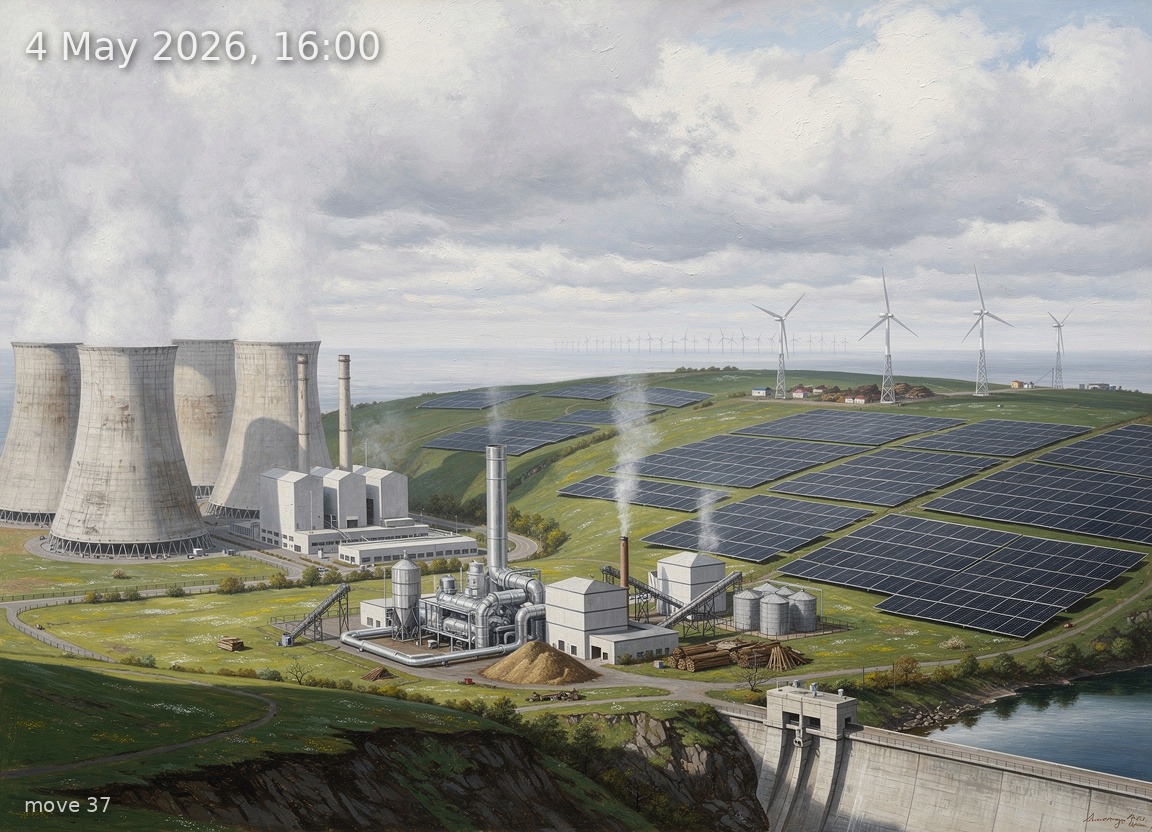
Solar leads at 22.5 GW under overcast skies; brown coal, hard coal, and gas fill the 9.8 GW net import gap.
Back
Generation mix
Wind onshore 6%
Wind offshore 2%
Solar 50%
Biomass 9%
Hydro 3%
Natural gas 8%
Hard coal 7%
Brown coal 15%
69%
Renewable share
3.6 GW
Wind (on + offshore)
22.5 GW
Solar
45.5 GW
Total generation
-9.8 GW
Net import
108.0 €/MWh
Day-ahead price
21.9°C / 8 km/h
Temp / Wind speed
Open-Meteo, Kassel (51.3°N 9.5°E)
100% / 152.0 W/m²
Cloud cover / Radiation
220
gCO₂/kWh
Image prompt
Solar 22.5 GW dominates the right half of the scene as vast fields of aluminium-framed crystalline silicon PV panels stretching across rolling green spring meadows under a bright but fully overcast white sky; brown coal 7.0 GW occupies the left foreground as a cluster of massive hyperbolic cooling towers with thick white steam plumes rising into the grey-white canopy; hard coal 3.3 GW appears just left of centre as a smaller coal plant with twin rectangular stacks emitting pale smoke; natural gas 3.6 GW sits centre-left as a compact CCGT facility with a single tall exhaust stack and visible heat shimmer; biomass 4.1 GW is represented centre-right by a wood-chip fed generating station with a modest chimney and timber stockpiles; wind onshore 2.7 GW appears as a small cluster of three-blade turbines with white lattice towers on a distant ridge, blades barely turning in the light breeze; wind offshore 0.9 GW is a faint line of turbines on the far horizon; hydro 1.4 GW appears as a concrete dam with a thin cascade of water at the far right edge. The lighting is full afternoon daylight at 4 PM — bright but diffuse with no shadows, a thick uniform cloud layer covering the entire sky from edge to edge, the atmosphere heavy and slightly oppressive suggesting high electricity prices. Lush green spring vegetation — beech and lime trees in full leaf, wildflowers in the meadows — at 22°C warmth. Highly detailed oil painting in the tradition of 19th-century German Romantic landscape painters such as Caspar David Friedrich and Carl Blechen, with rich saturated colour, visible impasto brushwork, atmospheric aerial perspective, and meticulous technical accuracy in rendering each energy installation's engineering details. No text, no labels.