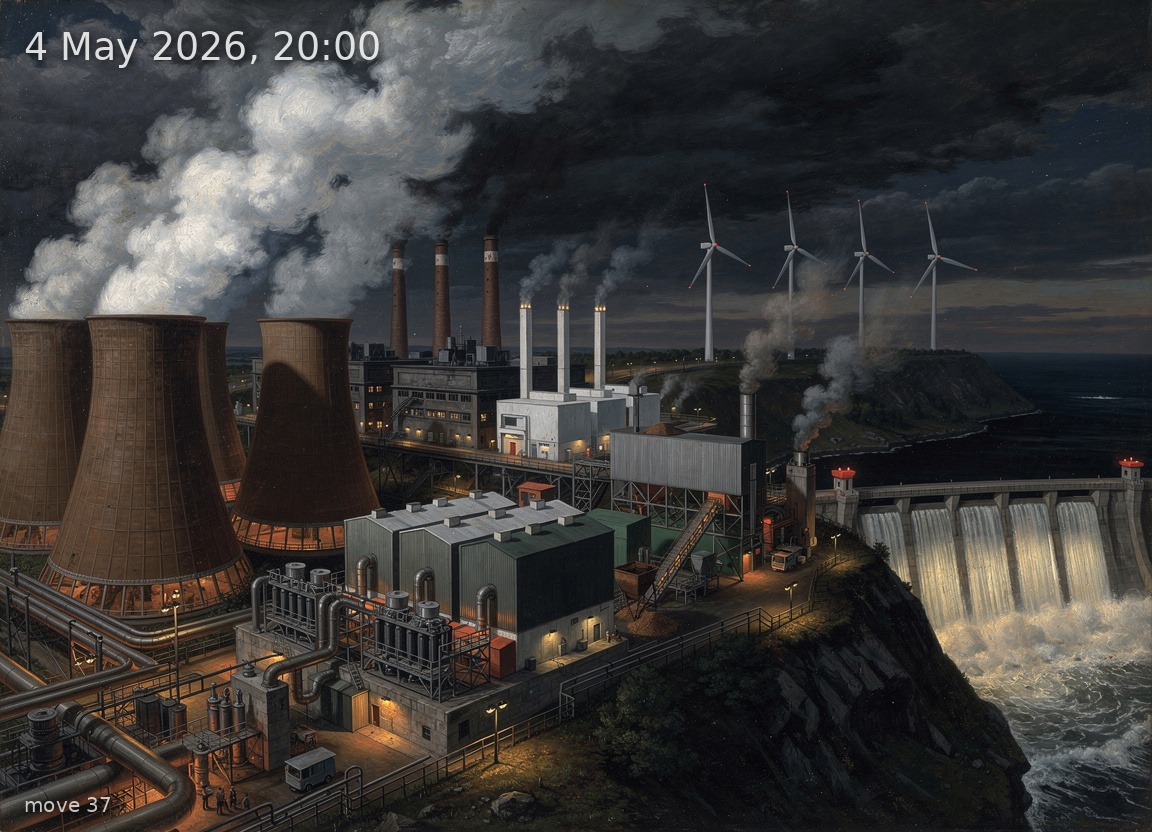
Brown coal and gas dominate as weak wind, no solar, and 26 GW net imports drive prices above 260 EUR/MWh.
Back
Generation mix
Wind onshore 11%
Wind offshore 2%
Solar 1%
Biomass 15%
Hydro 6%
Natural gas 24%
Hard coal 12%
Brown coal 28%
35%
Renewable share
4.0 GW
Wind (on + offshore)
0.3 GW
Solar
30.1 GW
Total generation
-26.0 GW
Net import
266.8 €/MWh
Day-ahead price
15.0°C / 9 km/h
Temp / Wind speed
Open-Meteo, Kassel (51.3°N 9.5°E)
100% / 0.0 W/m²
Cloud cover / Radiation
443
gCO₂/kWh
Records
#1
The Spike
Image prompt
Brown coal 8.5 GW dominates the left third of the scene as a vast lignite power-station complex with four hyperbolic cooling towers emitting thick white steam plumes into the night sky; natural gas 7.4 GW occupies the centre-left as a row of modern CCGT plants with slender exhaust stacks topped by pale gas flares and thin heat shimmer; biomass 4.5 GW appears centre-right as a cluster of industrial biomass boiler buildings with corrugated steel walls, wood-chip conveyors, and modest chimneys trailing wispy grey smoke; hard coal 3.7 GW sits behind the lignite station as a secondary set of older rectangular coal-fired boiler houses with tall brick smokestacks; onshore wind 3.4 GW is represented by a line of five three-blade turbines on a low ridge in the right background, blades turning slowly in light breeze; hydro 1.8 GW is a concrete dam visible in the far right middle-ground, with spillway water glinting under sodium lights; offshore wind 0.7 GW is suggested by two distant turbines silhouetted on a dark horizon line at far right; solar 0.3 GW is entirely absent — no panels visible. The sky is completely dark, 20:00 in May, no twilight remains, a black-to-deep-navy overcast ceiling of 100% cloud cover presses down oppressively with no stars or moon visible. All illumination is artificial: sodium-orange streetlights along access roads, white LED floods on cooling towers and plant structures, glowing control-room windows, red aviation warning lights atop smokestacks and turbine nacelles. The atmosphere is heavy and humid at 15°C, with low haze hugging the ground, amplifying the oppressive feeling of the extreme electricity price. Spring vegetation — fresh green grass and leafy deciduous trees — is barely visible at the edges of lamplight pools. Painted in the style of a highly detailed 19th-century German Romantic oil painting with rich, dark tonal palette, visible impasto brushwork, dramatic chiaroscuro between artificial light pools and deep shadow, meticulous engineering accuracy on every turbine nacelle, lattice tower, cooling-tower parabolic profile, and CCGT exhaust stack. The composition evokes Caspar David Friedrich's sublime darkness married to industrial reality. No text, no labels.