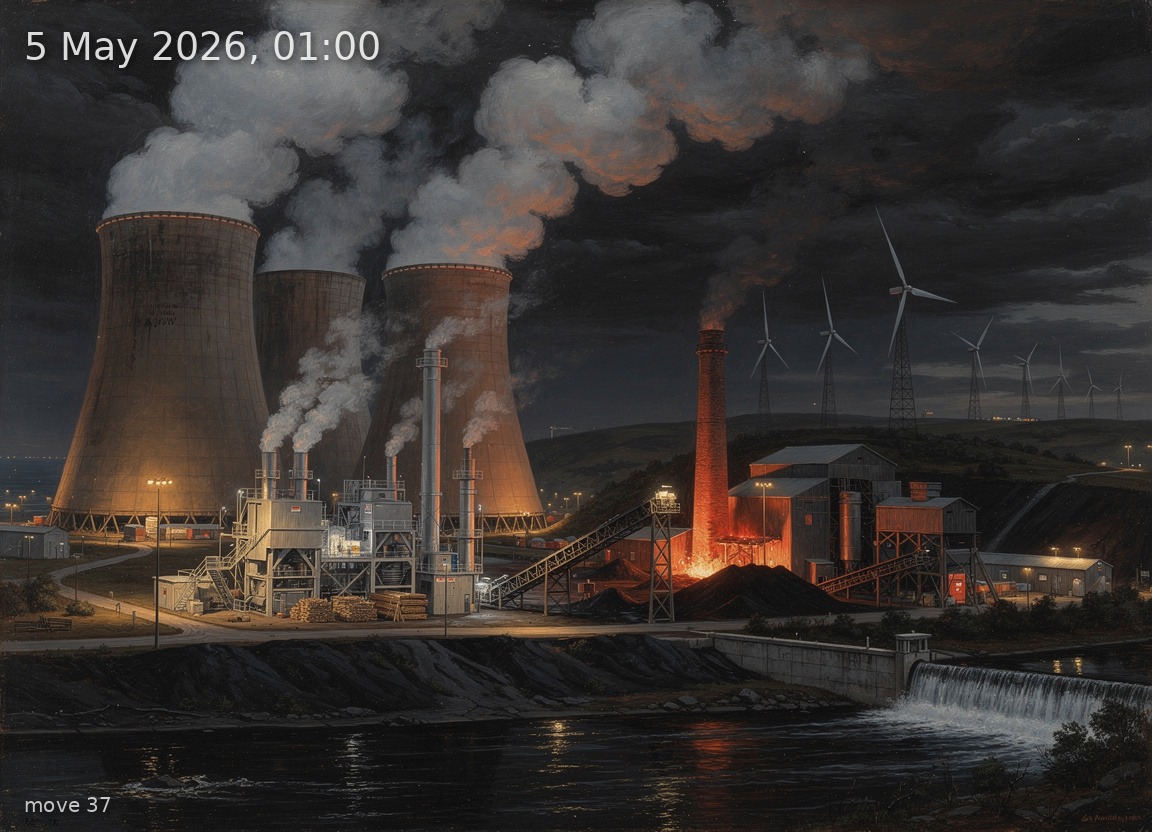
Brown coal and gas dominate a 26.8 GW domestic supply while 18.3 GW of net imports cover overnight demand under calm, overcast skies.
Back
Generation mix
Wind onshore 10%
Wind offshore 1%
Biomass 15%
Hydro 5%
Natural gas 23%
Hard coal 14%
Brown coal 32%
31%
Renewable share
3.0 GW
Wind (on + offshore)
0.0 GW
Solar
26.8 GW
Total generation
-18.2 GW
Net import
126.2 €/MWh
Day-ahead price
13.2°C / 3 km/h
Temp / Wind speed
Open-Meteo, Kassel (51.3°N 9.5°E)
100% / 0.0 W/m²
Cloud cover / Radiation
477
gCO₂/kWh
Image prompt
Brown coal 8.5 GW dominates the left third of the scene as a cluster of massive hyperbolic cooling towers with thick white-grey steam plumes rising into blackness; natural gas 6.2 GW fills the centre-left as two compact CCGT plants with tall single exhaust stacks and smaller heat-shimmer plumes; biomass 4.0 GW appears centre-right as a modest industrial facility with a wood-chip conveyor and a single medium smokestack glowing warmly; hard coal 3.7 GW sits to its right as a classic coal-fired station with a tall brick chimney and coal bunkers; hydro 1.4 GW is represented at the far right by a small concrete dam with water spilling in a pale cascade; wind onshore 2.8 GW appears as a sparse row of three-blade turbines on distant hills, rotors nearly still; wind offshore 0.2 GW is a barely visible single turbine silhouette on the far horizon. Time is 1:00 AM — the sky is completely black, no twilight, no stars visible through 100% cloud cover, only a deep oppressive charcoal-navy darkness pressing down. All structures are lit by harsh sodium-orange industrial floodlights and the dull red glow from furnace openings. Transmission lines with red aviation warning lights stretch across the scene toward the viewer, symbolizing import flows. The atmosphere feels heavy and stifling — low clouds catching faint orange reflections from the industrial lights below, hinting at the high electricity price. Spring vegetation — fresh green grass and leafy trees — is barely discernible in the sodium light, consistent with 13°C in early May. No solar panels anywhere. Highly detailed oil painting in the tradition of 19th-century German Romantic landscape painters — rich saturated colour, visible impasto brushwork, dramatic chiaroscuro, atmospheric depth and sfumato in the smoke and steam — rendered with meticulous engineering accuracy for each technology: three-blade rotor nacelles on lattice towers, hyperbolic reinforced-concrete cooling towers with internal fill, CCGT exhaust diffusers, coal conveyor gantries. The scene evokes Caspar David Friedrich reimagining an industrial nocturne. No text, no labels.