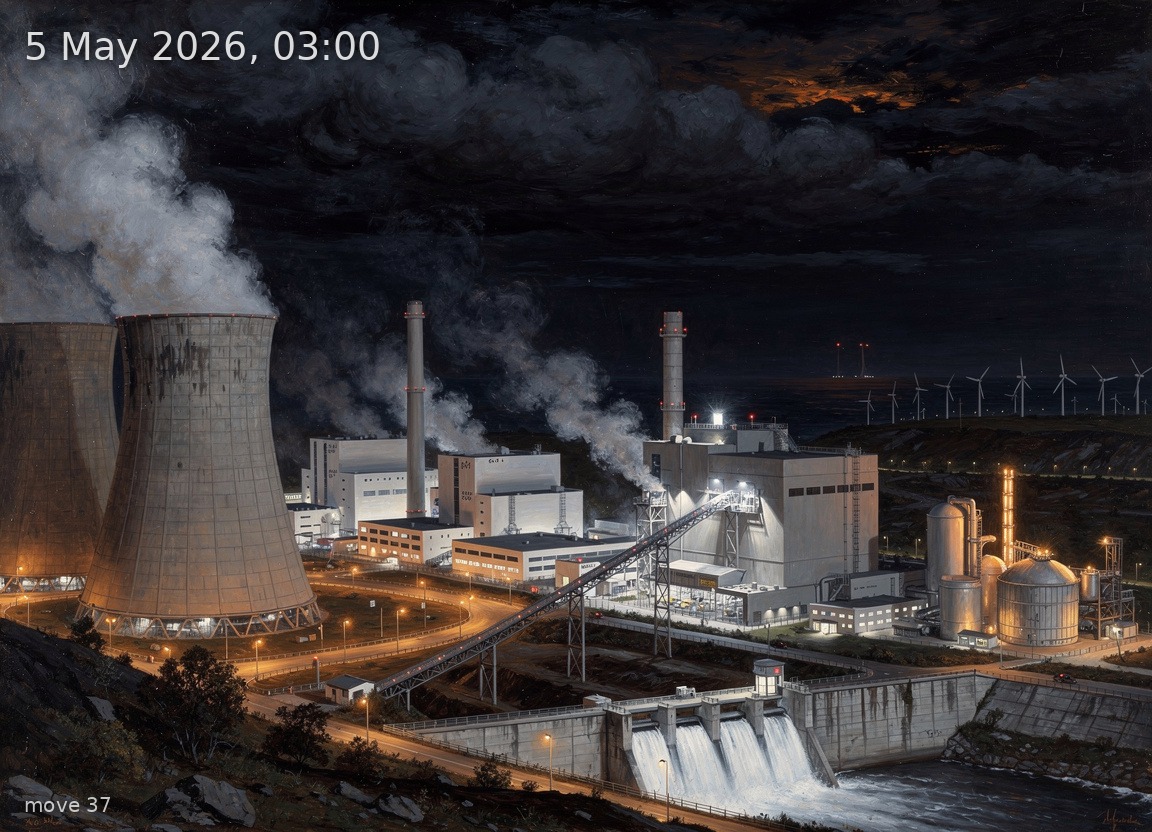
Brown coal, gas, and hard coal dominate a wind-poor 3 AM grid requiring 17.6 GW net imports.
Back
Generation mix
Wind onshore 11%
Wind offshore 1%
Biomass 15%
Hydro 5%
Natural gas 23%
Hard coal 14%
Brown coal 32%
32%
Renewable share
3.2 GW
Wind (on + offshore)
0.0 GW
Solar
26.9 GW
Total generation
-17.6 GW
Net import
122.0 €/MWh
Day-ahead price
12.5°C / 2 km/h
Temp / Wind speed
Open-Meteo, Kassel (51.3°N 9.5°E)
100% / 0.0 W/m²
Cloud cover / Radiation
474
gCO₂/kWh
Image prompt
Brown coal 8.5 GW dominates the left third of the scene as a cluster of massive hyperbolic cooling towers with thick white-grey steam plumes rising into blackness; natural gas 6.1 GW occupies the centre-left as two compact CCGT plants with tall single exhaust stacks emitting thin heat shimmer, lit by sodium-orange floodlights; hard coal 3.7 GW appears centre-right as a blocky power station with a tall chimney and conveyor belts under harsh industrial spotlights; biomass 4.0 GW sits to the right as a mid-sized plant with a dome-topped digester and a modest stack glowing warmly; hydro 1.4 GW is rendered as a concrete dam with illuminated spillway in the far right middle distance; wind onshore 2.8 GW appears as a sparse row of three-blade turbines on a distant ridge, rotors nearly still, their red aviation warning lights blinking; wind offshore 0.3 GW is a barely visible pair of turbines on a dark horizon line. The sky is completely dark — deep black-navy, no moon, no stars, solid 100% overcast — with the only illumination coming from sodium streetlights casting amber pools, floodlit industrial yards, and the faint orange glow reflecting off the undersides of low clouds from the plant complexes. Spring vegetation — fresh green grass and leafy trees — is just barely discernible at the edges of lamplight. The atmosphere feels heavy, oppressive, and costly, with haze and industrial particulate thickening the air around the thermal plants. Highly detailed oil painting in the tradition of 19th-century German Romantic landscape painters — rich dark palette of indigo, amber, charcoal, and ivory, visible impasto brushwork, deep atmospheric perspective — but with meticulous engineering accuracy on every turbine nacelle, cooling tower shell, CCGT stack, and conveyor structure. No text, no labels.