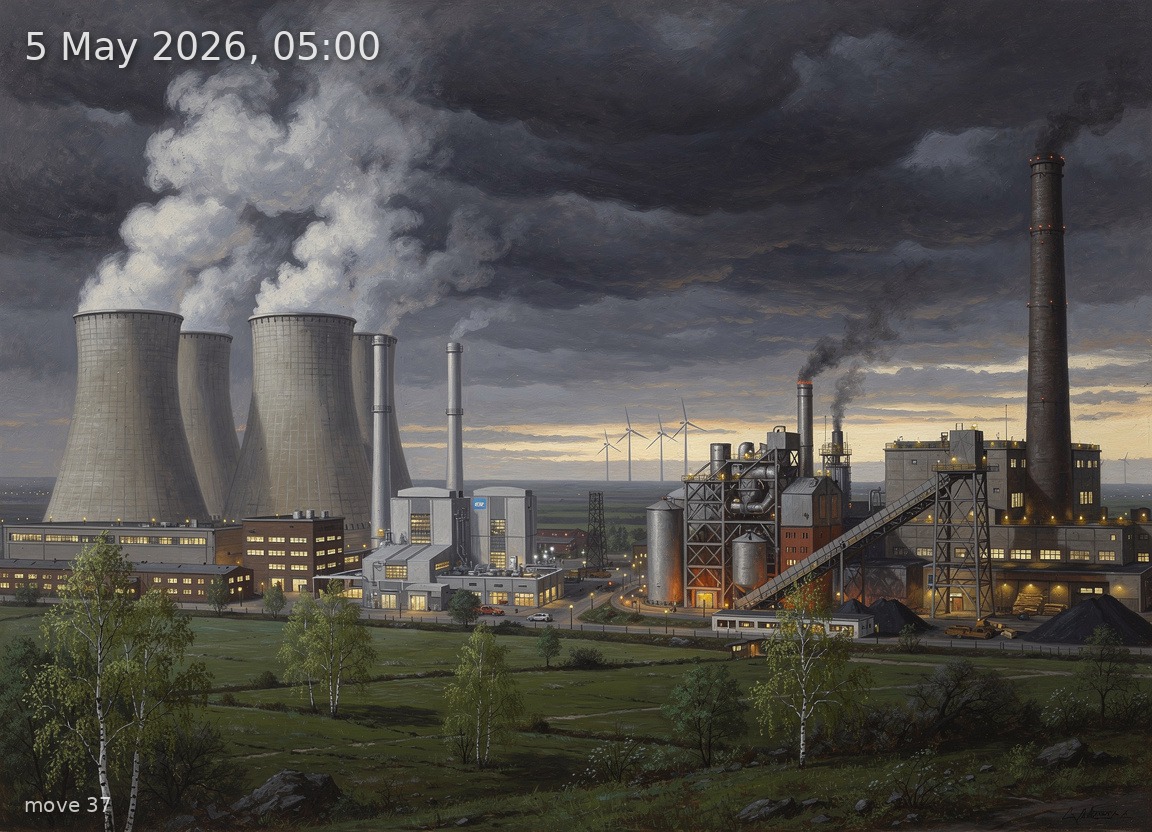
Brown coal and gas dominate a 27 GW domestic supply; 21 GW net imports fill the gap under windless, sunless skies.
Back
Generation mix
Wind onshore 10%
Wind offshore 2%
Solar 0%
Biomass 15%
Hydro 6%
Natural gas 21%
Hard coal 14%
Brown coal 32%
34%
Renewable share
3.4 GW
Wind (on + offshore)
0.0 GW
Solar
27.0 GW
Total generation
-21.1 GW
Net import
133.9 €/MWh
Day-ahead price
12.1°C / 2 km/h
Temp / Wind speed
Open-Meteo, Kassel (51.3°N 9.5°E)
99% / 0.0 W/m²
Cloud cover / Radiation
464
gCO₂/kWh
Image prompt
Brown coal 8.5 GW dominates the left third of the scene as a massive lignite power station with four hyperbolic cooling towers emitting thick white steam plumes into the heavy sky; natural gas 5.6 GW occupies the centre-left as two compact CCGT units with tall single exhaust stacks venting thin heat shimmer; biomass 4.1 GW appears centre-right as a cluster of wood-chip-fed industrial boiler houses with short chimneys and moderate grey smoke; hard coal 3.8 GW sits to the right as a traditional coal plant with a single large chimney and conveyor belt infrastructure; wind onshore 2.8 GW is represented by a sparse row of four three-blade turbines on a distant ridge, rotors completely still; wind offshore 0.6 GW is a faint silhouette of two turbines on the far horizon; hydro 1.6 GW appears as a small dam structure with white water spilling at the far right edge. Pre-dawn hour: deep blue-grey sky with no direct sunlight, only the faintest pale luminescence on the eastern horizon suggesting approaching dawn; 99 percent cloud cover renders the sky a continuous oppressive blanket of dark stratocumulus; no stars visible. Landscape is flat northern German terrain with spring-green grass barely visible in the dim light, scattered birch trees with fresh May foliage. The atmosphere feels heavy and weighty, reflecting the high electricity price — an industrial haze hangs low, sodium-orange lights glow from within the plant complexes, illuminating steam and smoke from below. Transmission pylons with high-voltage lines recede into the murky distance, symbolising the massive import flows. Temperature around 12°C: damp, cool feeling with dew on surfaces. Highly detailed oil painting in the tradition of 19th-century German Romantic landscape painters — Caspar David Friedrich meets industrial sublime — with rich dark colour palette of navy, slate grey, burnt umber, and warm amber from artificial lights; visible confident brushwork; deep atmospheric perspective and chiaroscuro. Meticulous engineering detail on all infrastructure: lattice turbine towers, aluminium nacelles, reinforced concrete cooling towers with condensation rings, CCGT exhaust diffusers, coal conveyor gantries. No text, no labels.