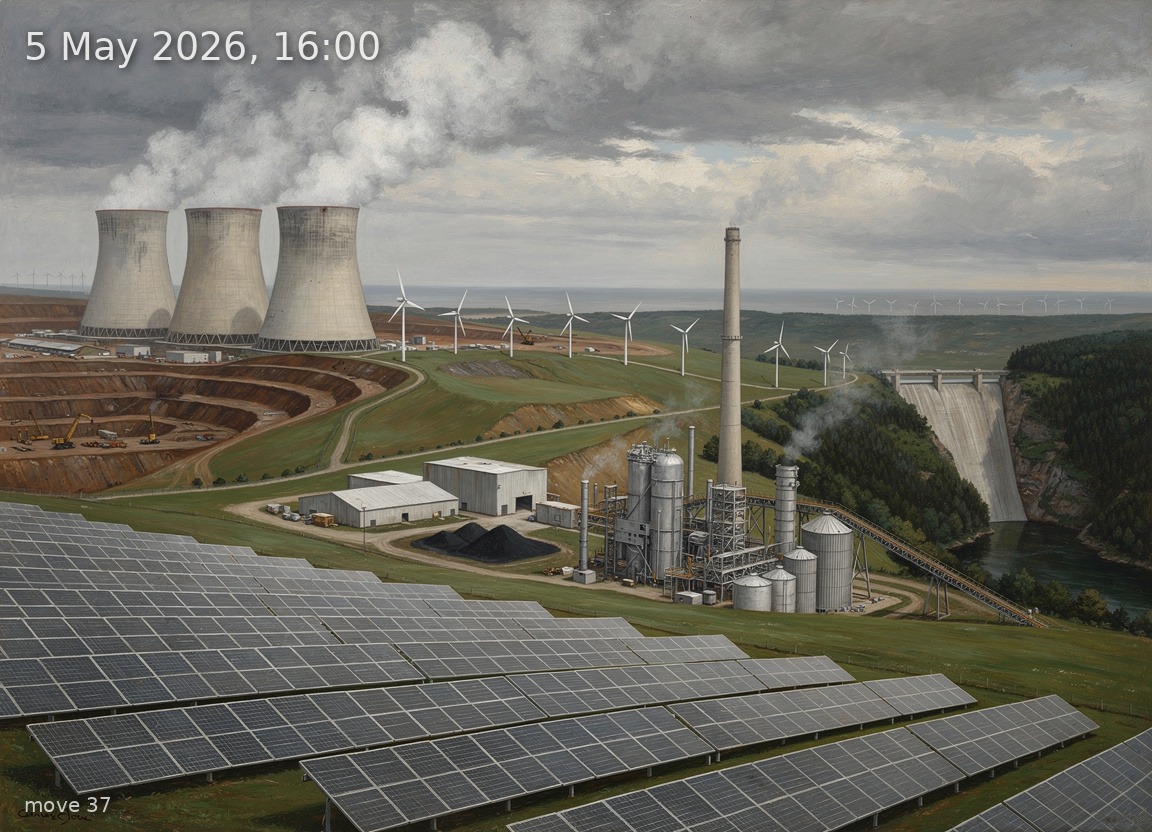
Overcast skies limit solar and wind; brown coal, imports, and gas bridge a 16.4 GW domestic shortfall.
Back
Generation mix
Wind onshore 11%
Wind offshore 2%
Solar 32%
Biomass 10%
Hydro 4%
Natural gas 11%
Hard coal 9%
Brown coal 21%
60%
Renewable share
5.4 GW
Wind (on + offshore)
13.4 GW
Solar
41.2 GW
Total generation
-16.4 GW
Net import
112.0 €/MWh
Day-ahead price
18.8°C / 9 km/h
Temp / Wind speed
Open-Meteo, Kassel (51.3°N 9.5°E)
100% / 39.0 W/m²
Cloud cover / Radiation
289
gCO₂/kWh
Image prompt
Solar 13.4 GW dominates the foreground as a vast plain of aluminium-framed crystalline silicon PV panels stretching across gently rolling green farmland, their surfaces reflecting only dull grey sky with no direct sunlight. Brown coal 8.5 GW occupies the left quarter as a massive lignite power station with three hyperbolic cooling towers emitting thick white steam plumes that merge into the overcast ceiling, adjacent open-pit mine terraces visible. Wind onshore 4.7 GW appears as a scattered line of modern three-blade turbines on ridgelines in the middle distance, rotors turning sluggishly in light wind. Natural gas 4.3 GW is rendered as a compact CCGT facility with tall slender exhaust stacks and heat recovery steam generators in the centre-right. Biomass 4.0 GW sits as a cluster of medium-sized industrial buildings with cylindrical wood-chip silos and modest chimneys producing thin grey smoke. Hard coal 3.8 GW appears as a coal-fired station with rectangular boiler houses, conveyor belts of black coal, and a single large concrete chimney. Hydro 1.8 GW is a dam set into a wooded valley in the far right background. Wind offshore 0.7 GW is barely visible as tiny turbines on the far horizon where land meets a distant grey sea. The sky is entirely blanketed in heavy, oppressive, low stratiform clouds at 100% cover, no sun visible, the atmosphere dense and weighty conveying high electricity prices. Lighting is consistent with 16:00 Central European afternoon — full diffuse daylight but flat and shadowless, lush green May vegetation on rolling hills, temperature around 19°C suggesting warm spring air. Style: highly detailed oil painting in the tradition of 19th-century German Romantic landscape painters — Caspar David Friedrich meets industrial sublime — rich colour palette of slate greys, muted greens, and warm ochre from coal infrastructure, visible impasto brushwork, atmospheric depth with haze between foreground and distant features, meticulous engineering detail on every nacelle, panel frame, cooling tower, and smokestack. No text, no labels.