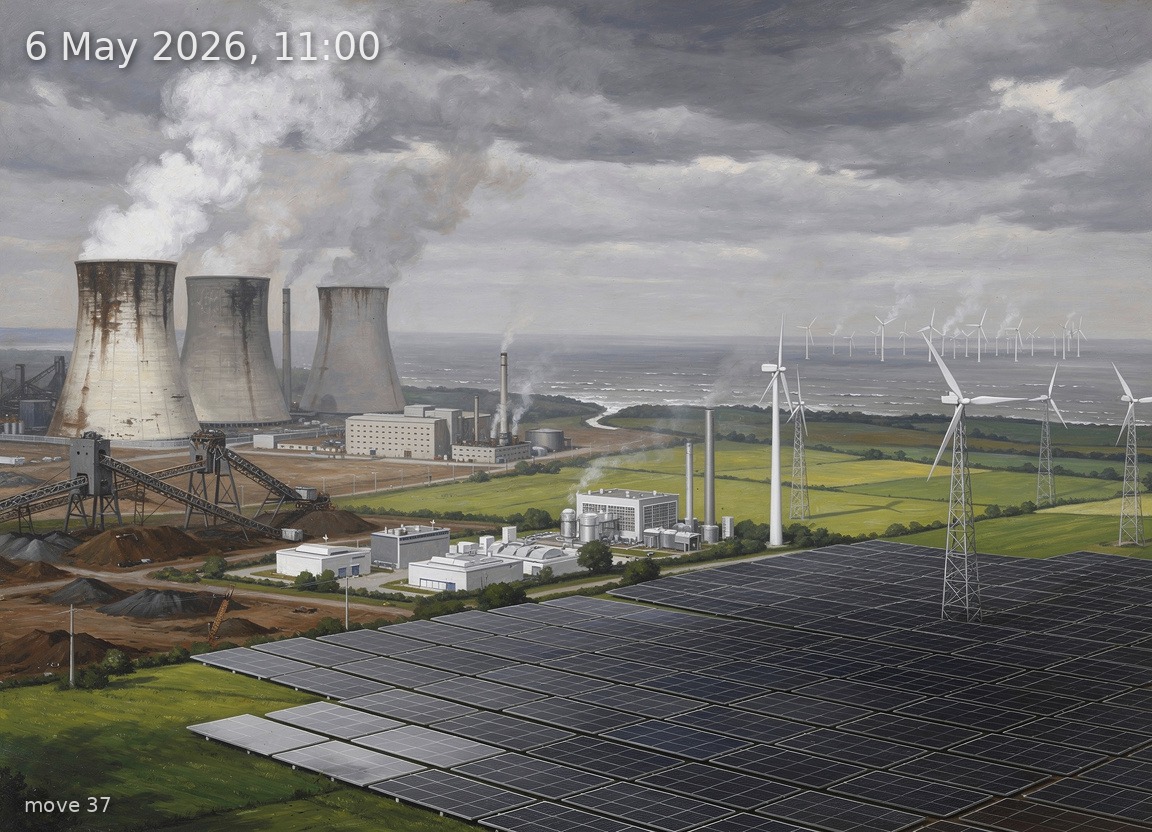
Overcast solar leads at 24.2 GW, but 100% cloud cover and moderate wind keep coal and imports elevated.
Back
Generation mix
Wind onshore 17%
Wind offshore 5%
Solar 42%
Biomass 7%
Hydro 3%
Natural gas 6%
Hard coal 7%
Brown coal 13%
74%
Renewable share
12.7 GW
Wind (on + offshore)
24.2 GW
Solar
57.8 GW
Total generation
-6.1 GW
Net import
104.1 €/MWh
Day-ahead price
14.4°C / 9 km/h
Temp / Wind speed
Open-Meteo, Kassel (51.3°N 9.5°E)
100% / 19.0 W/m²
Cloud cover / Radiation
188
gCO₂/kWh
Image prompt
Solar 24.2 GW dominates the right half of the scene as vast fields of aluminium-framed crystalline silicon PV panels stretching across flat farmland under a uniformly grey overcast sky, their surfaces reflecting diffuse pewter light; wind onshore 10.0 GW occupies the centre-right as dozens of three-blade turbines on lattice and tubular towers turning slowly in light breeze across rolling green spring meadows; wind offshore 2.8 GW appears as a distant cluster of turbines on the far horizon above a grey sea glimpsed through a gap in terrain; brown coal 7.8 GW fills the left third with massive hyperbolic cooling towers emitting thick white steam plumes that merge with the overcast ceiling, flanked by conveyor belts and lignite stockpiles; hard coal 3.8 GW sits adjacent as a smaller cluster of industrial stacks and coal bunkers with thinner grey exhaust; natural gas 3.5 GW appears as compact CCGT units with single tall exhaust stacks and visible heat shimmer; biomass 4.1 GW is rendered as a mid-sized wood-chip-fed power plant with a modest rounded stack and piled timber; hydro 1.8 GW appears as a small dam and penstock structure in the far left background against wooded hills. The sky is entirely blanketed in heavy, oppressive stratiform cloud at 100% cover with no blue visible, the atmosphere dense and slightly hazy suggesting elevated electricity prices. The lighting is full diffuse daytime at 11:00 with no shadows, flat illumination across all surfaces. Spring vegetation: fresh bright-green grass and leafy deciduous trees in full May foliage, temperature around 14°C with a cool damp feel. Overhead high-voltage transmission lines with lattice pylons cross the scene, subtly referencing the 6.1 GW net import dependency. Rendered as a highly detailed oil painting in the tradition of 19th-century German Romantic landscape art—rich layered colour, visible confident brushwork, atmospheric depth and aerial perspective—but with meticulous technical accuracy in every turbine nacelle, every cooling tower curve, every PV module frame. The mood is contemplative, industrial, not alarming—an honest portrait of a working grid under grey skies. No text, no labels.