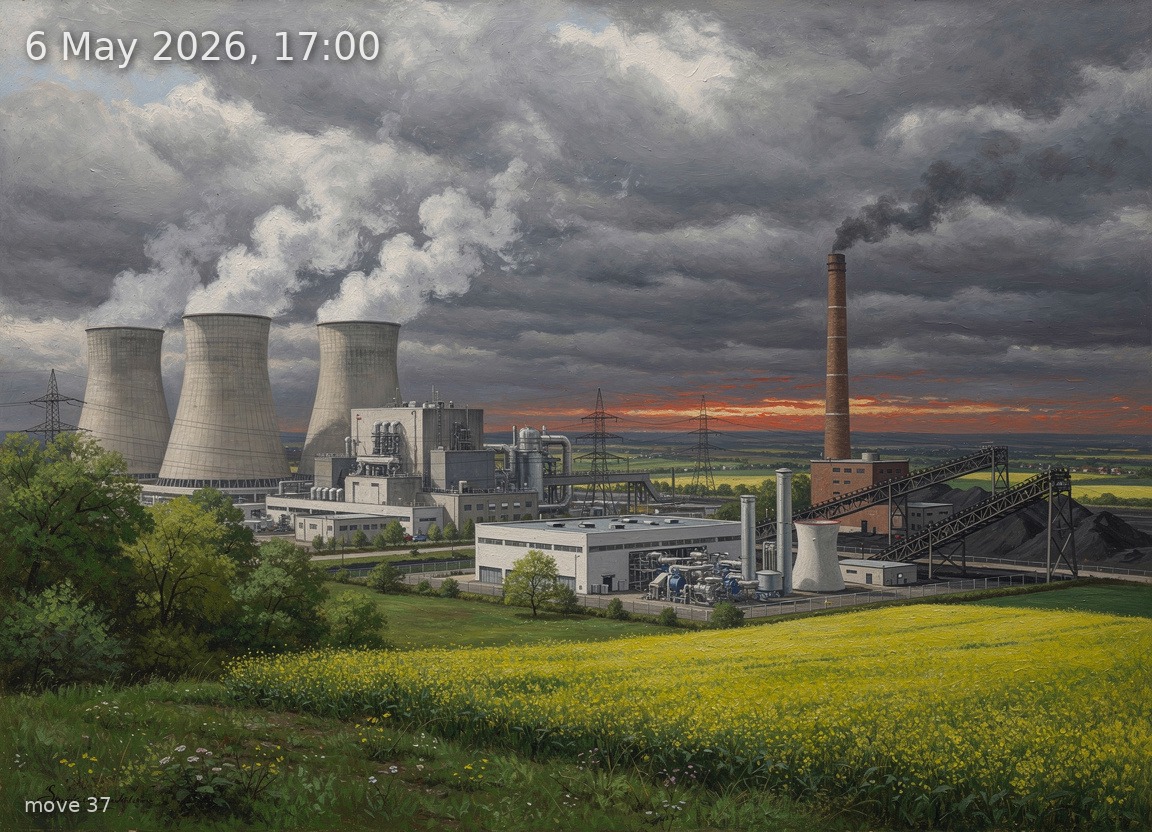
Wind and lignite anchor a 46.7 GW domestic mix while 12.6 GW net imports fill the gap under dense overcast.
Back
Generation mix
Wind onshore 20%
Wind offshore 10%
Solar 20%
Biomass 9%
Hydro 4%
Natural gas 11%
Hard coal 8%
Brown coal 18%
62%
Renewable share
13.6 GW
Wind (on + offshore)
9.3 GW
Solar
46.7 GW
Total generation
-12.6 GW
Net import
125.0 €/MWh
Day-ahead price
12.1°C / 13 km/h
Temp / Wind speed
Open-Meteo, Kassel (51.3°N 9.5°E)
98% / 15.0 W/m²
Cloud cover / Radiation
268
gCO₂/kWh
Image prompt
Brown coal 8.5 GW dominates the left quarter as a massive lignite power station complex with four hyperbolic cooling towers billowing thick white steam plumes into heavy grey air; solar 9.3 GW occupies the lower-centre foreground as vast fields of aluminium-framed crystalline silicon PV panels stretching across flat terrain, their surfaces dull and muted under near-total overcast with no sun reflections; wind onshore 9.1 GW fills the centre-right as dozens of tall three-blade turbines on lattice and tubular towers, blades turning at moderate speed in 12.6 km/h winds, scattered across rolling green spring fields; wind offshore 4.5 GW appears in the far right distance as a line of turbines standing in a grey North Sea glimpsed through a gap in the landscape; natural gas 5.4 GW sits as a compact modern CCGT plant with twin exhaust stacks and a single smaller cooling tower between the coal complex and the wind farm; hard coal 3.9 GW appears as a conventional coal plant with a tall brick chimney and coal conveyor belts just behind the lignite station; biomass 4.3 GW is rendered as a mid-sized industrial facility with a rounded dome digester and a wood-chip storage yard, positioned in the middle distance; hydro 1.8 GW appears as a modest dam and reservoir nestled in low hills at the far left edge. The sky is 98% overcast — a thick, oppressive blanket of grey-white stratus clouds pressing low, no blue visible, the atmosphere heavy and brooding to reflect the 125 EUR/MWh price tension. Time is 17:00 dusk in early May: a narrow band of muted orange-red glow lines the western horizon beneath the cloud base, while the upper sky darkens to slate grey, casting long dim shadows. Spring vegetation is lush — fresh bright green on deciduous trees in early leaf, meadow grasses, rapeseed fields with faint yellow bloom. The entire scene rendered as a highly detailed oil painting in the tradition of 19th-century German Romantic landscape painters — Caspar David Friedrich's atmospheric depth merged with Adolph Menzel's industrial precision — rich impasto brushwork, deep colour values, dramatic chiaroscuro between the fading western glow and the dark eastern sky. Every technology rendered with meticulous engineering accuracy: turbine nacelles, blade pitch mechanisms, PV cell grid patterns, cooling tower parabolic geometry, conveyor belt trusses. No text, no labels.