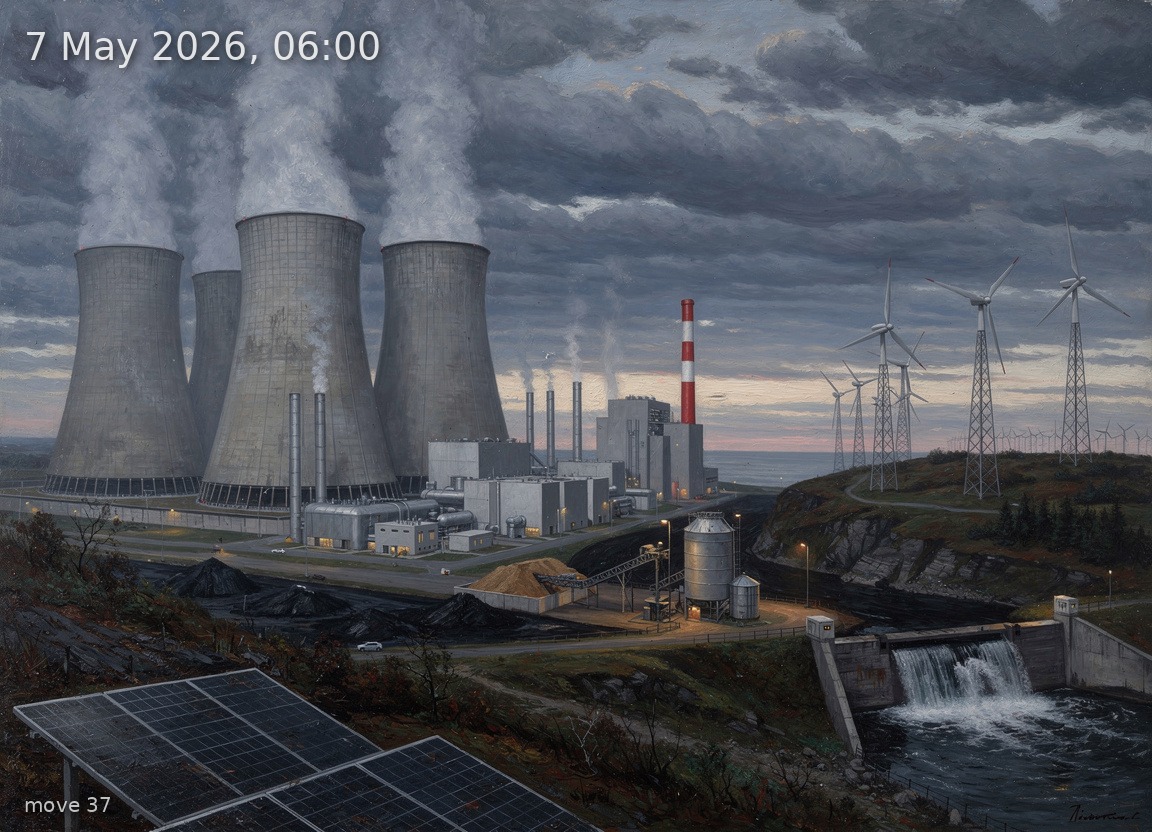
Brown coal, gas, and onshore wind lead generation as full overcast suppresses solar, driving 19.5 GW net imports.
Back
Generation mix
Wind onshore 22%
Wind offshore 3%
Solar 3%
Biomass 12%
Hydro 5%
Natural gas 21%
Hard coal 11%
Brown coal 24%
44%
Renewable share
8.8 GW
Wind (on + offshore)
1.0 GW
Solar
35.8 GW
Total generation
-19.5 GW
Net import
151.0 €/MWh
Day-ahead price
8.4°C / 9 km/h
Temp / Wind speed
Open-Meteo, Kassel (51.3°N 9.5°E)
100% / 0.0 W/m²
Cloud cover / Radiation
379
gCO₂/kWh
Image prompt
Brown coal 8.6 GW dominates the left third of the scene as a cluster of massive hyperbolic cooling towers with thick white-grey steam plumes rising into the sky; natural gas 7.4 GW occupies the centre-left as a row of compact CCGT power blocks with slender exhaust stacks emitting thin vapour trails; hard coal 3.9 GW appears centre-right as a smaller coal plant with a single tall chimney and coal conveyors; onshore wind 7.7 GW spans the right third as a line of tall three-blade turbines on lattice towers along a low ridge, blades turning slowly in light wind; offshore wind 1.1 GW is suggested by distant turbines barely visible on a grey horizon far right; biomass 4.4 GW appears as a mid-ground industrial facility with a wood-chip silo and modest smokestack; hydro 1.8 GW is represented by a small concrete dam with spillway in a valley at far right; solar 1.0 GW is a small cluster of aluminium-framed crystalline PV panels in the foreground, their surfaces dark and reflective under heavy clouds, catching no sunlight. Time is early dawn, 06:00 in May — the sky is deep blue-grey pre-dawn light with no direct sun visible, the horizon shows the faintest pale luminance in the east but the landscape is mostly lit by sodium-orange industrial lights glowing from the power plants. The sky is completely overcast with a thick, heavy, unbroken layer of low stratus clouds pressing down oppressively. Temperature is cool spring at 8°C — fresh green grass and budding deciduous trees with early May foliage, damp ground suggesting morning moisture. The atmosphere feels heavy and oppressive, reflecting the extreme 151 EUR/MWh price — the clouds seem to weigh on the land. Painted as a highly detailed oil painting in the tradition of 19th-century German Romantic landscape painters like Caspar David Friedrich and Carl Blechen, with rich dark colour palette, visible impasto brushwork, profound atmospheric depth and chiaroscuro lighting contrasts between the glowing industrial facilities and the dark pre-dawn landscape. Meticulous engineering accuracy on all technology: correct nacelle shapes on wind turbines, proper cooling tower parabolic geometry with condensation plumes, detailed CCGT exhaust configurations. No text, no labels.