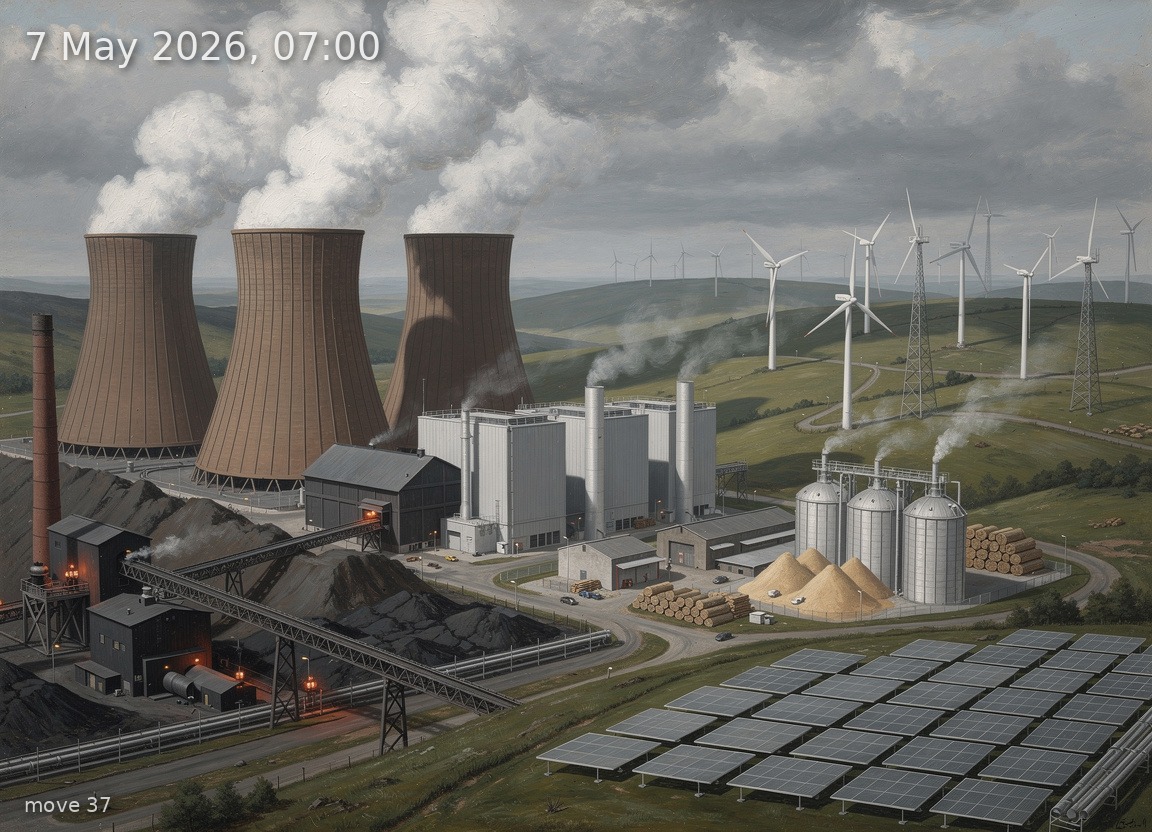
Brown coal, gas, and onshore wind lead a 37.6 GW domestic supply against 59.4 GW demand under full overcast.
Back
Generation mix
Wind onshore 18%
Wind offshore 2%
Solar 11%
Biomass 12%
Hydro 5%
Natural gas 20%
Hard coal 10%
Brown coal 23%
47%
Renewable share
7.5 GW
Wind (on + offshore)
4.0 GW
Solar
37.6 GW
Total generation
-21.8 GW
Net import
167.3 €/MWh
Day-ahead price
8.2°C / 11 km/h
Temp / Wind speed
Open-Meteo, Kassel (51.3°N 9.5°E)
100% / 0.0 W/m²
Cloud cover / Radiation
362
gCO₂/kWh
Image prompt
Brown coal 8.5 GW dominates the left quarter as a sprawling lignite complex with four massive hyperbolic cooling towers emitting thick white steam plumes into the grey sky, conveyor belts feeding raw lignite into boiler houses. Natural gas 7.5 GW occupies the left-centre as three compact CCGT power blocks with slender exhaust stacks releasing thin heat haze. Onshore wind 6.7 GW spans the right-centre as two dozen three-blade turbines on lattice and tubular towers across gently rolling green hills, blades turning slowly in moderate wind. Biomass 4.5 GW appears as a cluster of medium-scale industrial plants with wood-chip silos and modest smokestacks in the mid-ground. Solar 4.0 GW is rendered as fields of aluminium-framed crystalline silicon panels in the right foreground, their surfaces dull and reflective-grey under the overcast, producing no glint. Hard coal 3.9 GW sits beside the brown coal as a smaller coal-fired station with a single tall brick chimney and coal bunkers. Hydro 1.8 GW appears as a concrete run-of-river dam with spillway in the far right background along a wooded valley. Offshore wind 0.7 GW is a faint silhouette of a small cluster of turbines on the distant horizon line. The sky is entirely blanketed in heavy, low, oppressive stratiform cloud — no blue, no sun — conveying the 167.3 EUR/MWh price tension. The lighting is pale pre-dawn to earliest morning: a thin band of cold blue-grey light along the eastern horizon, the rest of the sky a uniform slate grey. Spring vegetation: fresh green grass, budding deciduous trees, cool 8°C atmosphere with visible breath-like mist near the ground. High-voltage transmission pylons with sagging cables cross the scene diagonally, symbolising the massive 21.8 GW import flow. Highly detailed oil painting in the tradition of 19th-century German Romantic landscape painters — Caspar David Friedrich's atmospheric depth combined with Adolph Menzel's industrial precision — rich muted colour palette of greys, slate blues, olive greens, and warm browns, visible confident brushwork, dramatic chiaroscuro in the steam and cloud layers, meticulous engineering detail on every turbine nacelle, cooling tower fluting, and panel frame. No text, no labels.