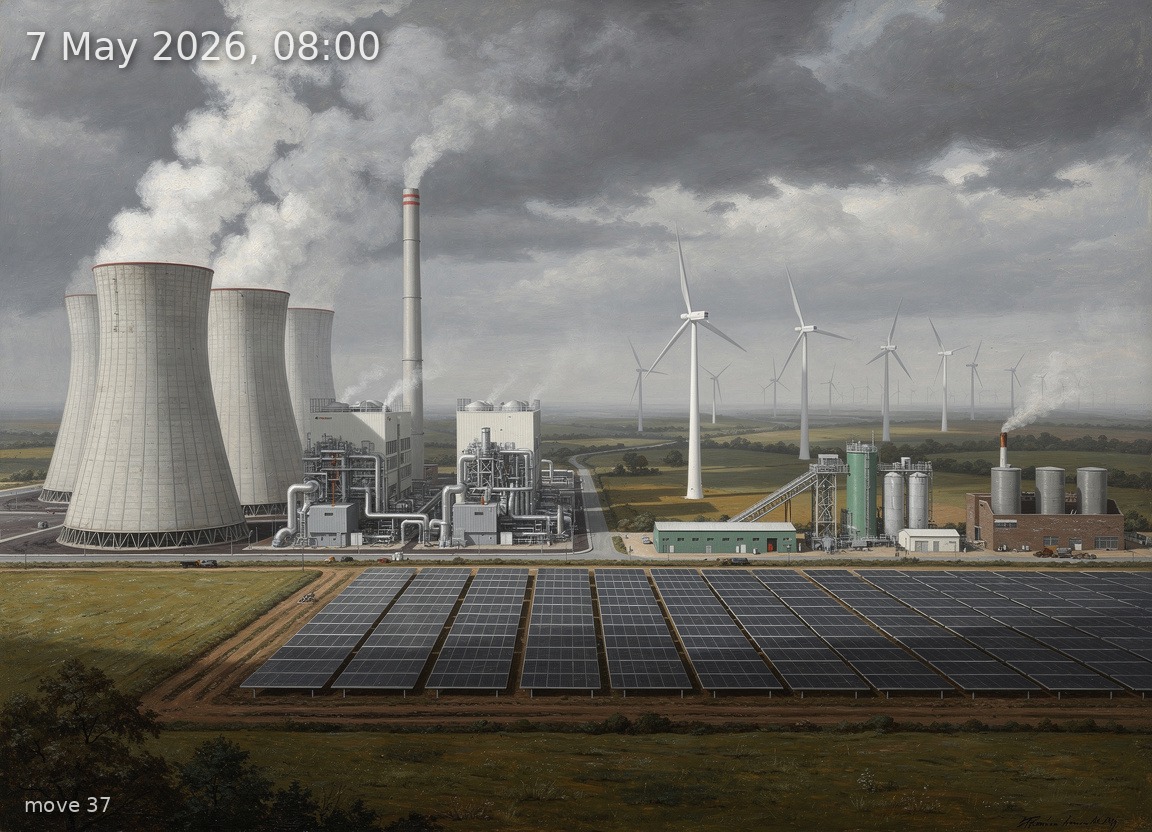
Brown coal and gas anchor a 40.8 GW domestic supply as overcast skies and light winds drive 20.3 GW of net imports.
Back
Generation mix
Wind onshore 15%
Wind offshore 1%
Solar 20%
Biomass 11%
Hydro 4%
Natural gas 19%
Hard coal 10%
Brown coal 21%
51%
Renewable share
6.5 GW
Wind (on + offshore)
8.0 GW
Solar
40.8 GW
Total generation
-20.3 GW
Net import
155.6 €/MWh
Day-ahead price
8.3°C / 11 km/h
Temp / Wind speed
Open-Meteo, Kassel (51.3°N 9.5°E)
100% / 0.0 W/m²
Cloud cover / Radiation
335
gCO₂/kWh
Image prompt
Brown coal 8.5 GW dominates the left quarter of the scene as a massive lignite power station with four hyperbolic cooling towers emitting thick white steam plumes rising into a uniform grey overcast sky; natural gas 7.6 GW occupies the centre-left as two modern combined-cycle gas turbine blocks with tall single exhaust stacks venting thin translucent heat haze; solar 8.0 GW fills the centre as a broad field of aluminium-framed crystalline silicon photovoltaic panels stretching across flat farmland, their surfaces reflecting only dull grey light under total cloud cover with no sunshine and no shadows; wind onshore 6.0 GW spans the centre-right as a line of modern three-blade turbines on lattice-free tubular towers, blades rotating slowly in light wind; biomass 4.4 GW appears as a mid-sized industrial plant with a wood-chip conveyor and modest smokestack near the right-centre; hard coal 3.9 GW sits to the right as a traditional coal-fired station with rectangular cooling towers and coal stockpiles; hydro 1.8 GW is visible at the far right as a concrete dam with water spilling into a green river valley; wind offshore 0.5 GW is suggested by a few distant turbines barely visible on a grey horizon line at the far back. The time is 08:00 in May—full but flat daylight with no direct sun, entirely overcast with a heavy oppressive slate-grey sky pressing down, conveying the tension of a 155.6 EUR/MWh price. Temperature is 8.3°C: spring vegetation is fresh green but subdued, grass damp, bare patches of brown earth near coal stockpiles. High-voltage transmission pylons with bundled conductors thread across the middle ground, connecting all facilities. Style: highly detailed oil painting in the tradition of 19th-century German Romantic landscape painters—Caspar David Friedrich meets industrial realism—rich but muted colour palette of grey, olive, ochre, and slate blue, visible confident brushwork, deep atmospheric perspective with haze softening distant elements, meticulous engineering detail on every turbine nacelle, PV module frame, and cooling tower fluting. No text, no labels.