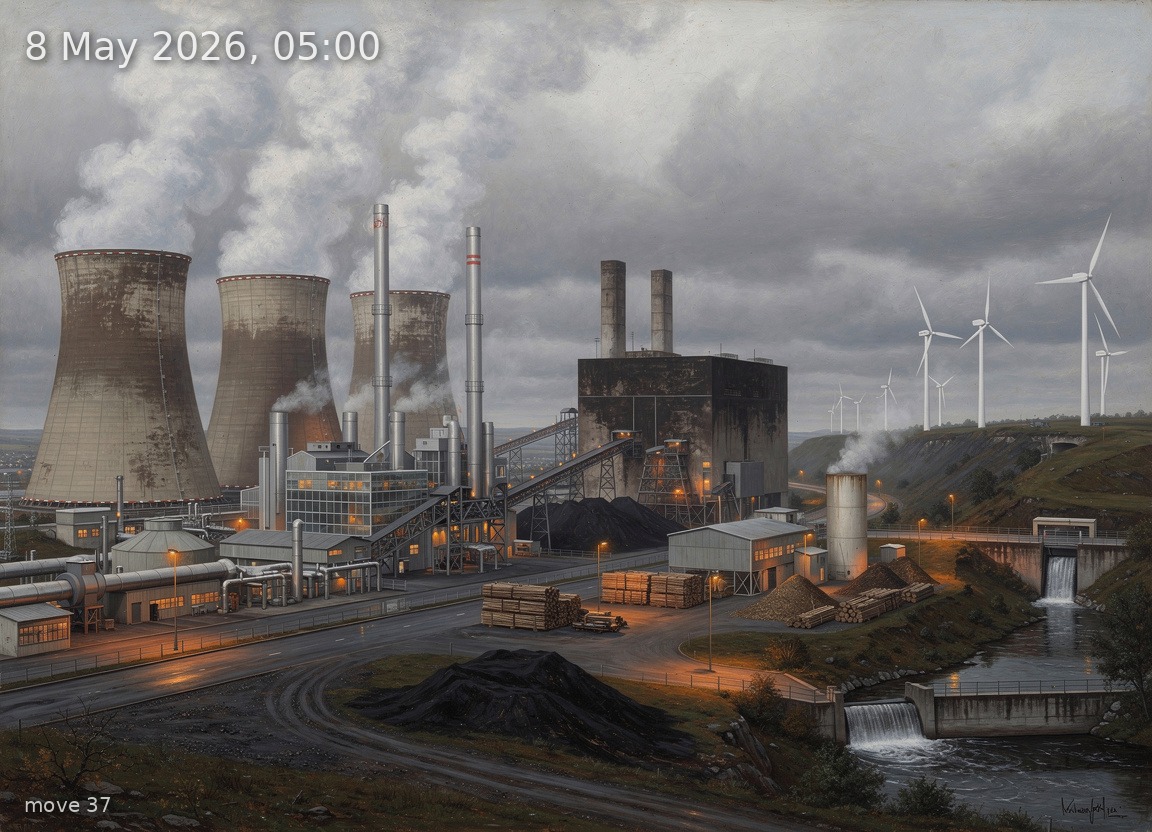
Brown coal, gas, and hard coal dominate a 30.3 GW supply requiring 18.5 GW net imports under calm, overcast pre-dawn conditions.
Back
Generation mix
Wind onshore 13%
Wind offshore 1%
Solar 0%
Biomass 14%
Hydro 6%
Natural gas 25%
Hard coal 12%
Brown coal 30%
34%
Renewable share
4.2 GW
Wind (on + offshore)
0.1 GW
Solar
30.3 GW
Total generation
-18.6 GW
Net import
126.2 €/MWh
Day-ahead price
7.6°C / 4 km/h
Temp / Wind speed
Open-Meteo, Kassel (51.3°N 9.5°E)
87% / 0.0 W/m²
Cloud cover / Radiation
455
gCO₂/kWh
Image prompt
Brown coal 8.9 GW dominates the left third of the scene as a massive lignite power station complex with four hyperbolic cooling towers emitting thick white steam plumes into a heavy overcast sky; natural gas 7.5 GW fills the centre-left as a cluster of modern CCGT plants with tall slender exhaust stacks venting faint heat haze; hard coal 3.7 GW appears centre-right as a dark industrial block with twin rectangular chimneys and coal conveyors; biomass 4.2 GW is rendered as a wood-chip-fired plant with a single squat stack and piled timber in its yard; wind onshore 4.0 GW occupies the right portion as a sparse row of three-blade turbines on a ridge, their rotors barely turning in the near-still air; hydro 1.7 GW appears in the far right background as a small dam with water spilling gently into a river; solar is absent—no panels, no sun. The sky is deep blue-grey pre-dawn, 05:00 Berlin time, with the faintest pale luminescence low on the eastern horizon but no direct sunlight; 87% cloud cover creates a heavy unbroken overcast pressing down oppressively, reinforcing the 126.2 EUR/MWh high-price atmosphere. Temperature is a cool 7.6 °C; early-May vegetation is fresh green but muted in the darkness, with dew glistening on grass. Sodium-orange streetlights and industrial floodlights illuminate the power plants from below, casting warm pools of light against the cold sky. Transmission pylons recede into the murky distance suggesting import corridors. Style: highly detailed oil painting in the tradition of 19th-century German Romantic landscape painters—Caspar David Friedrich's atmospheric moodiness meets industrial realism—rich deep colour palette of navy, slate grey, warm amber, and cool green, visible confident brushwork, meticulous engineering detail on every turbine nacelle, cooling tower curve, and exhaust stack, atmospheric depth with haze between layers. No text, no labels.