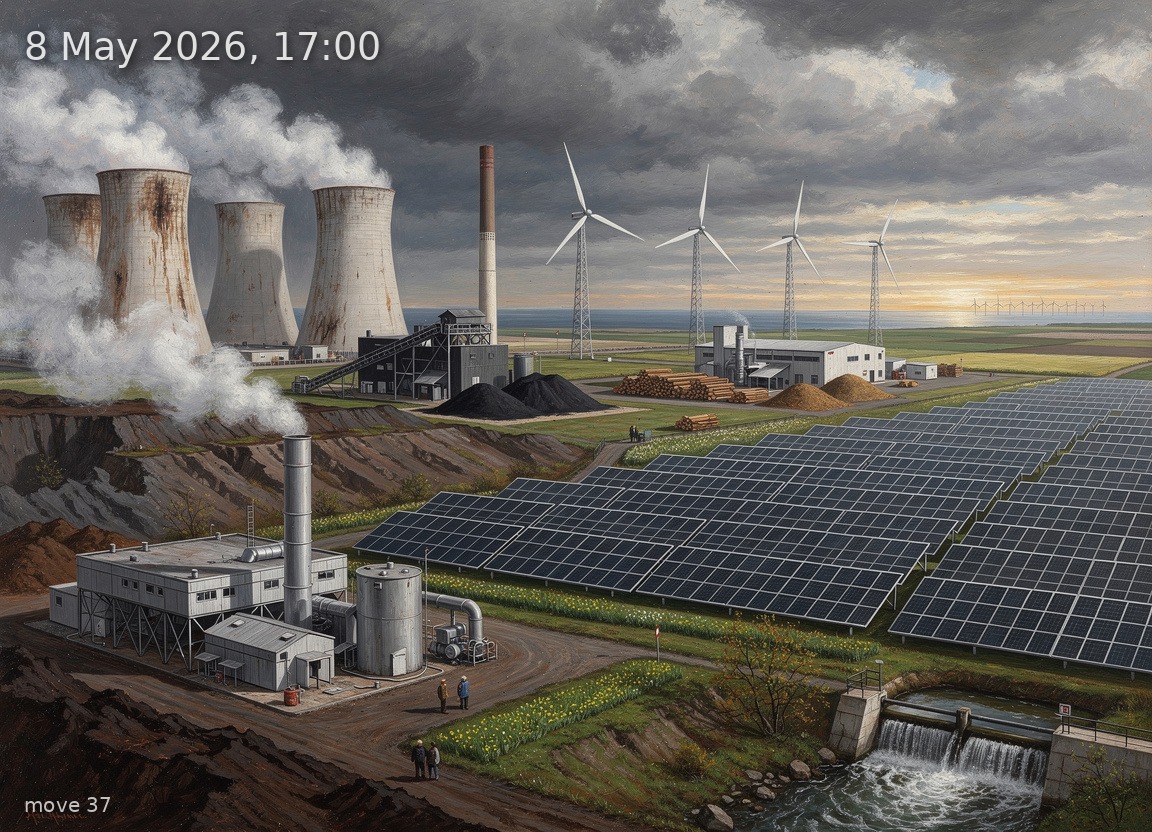
Solar leads at 20.5 GW but fading; brown coal and gas fill the gap as prices rise to 109.5 EUR/MWh.
Back
Generation mix
Wind onshore 11%
Wind offshore 2%
Solar 42%
Biomass 9%
Hydro 3%
Natural gas 10%
Hard coal 7%
Brown coal 16%
66%
Renewable share
6.3 GW
Wind (on + offshore)
20.5 GW
Solar
49.2 GW
Total generation
-3.9 GW
Net import
109.5 €/MWh
Day-ahead price
11.5°C / 8 km/h
Temp / Wind speed
Open-Meteo, Kassel (51.3°N 9.5°E)
83% / 6.0 W/m²
Cloud cover / Radiation
236
gCO₂/kWh
Image prompt
Solar 20.5 GW dominates the right half of the composition as vast fields of aluminium-framed crystalline silicon PV panels stretching across flat farmland, their surfaces reflecting a dim, diffused pewter light under heavy overcast; brown coal 7.9 GW occupies the left foreground as a massive lignite power complex with four hyperbolic concrete cooling towers emitting thick white steam plumes drifting eastward; wind onshore 5.3 GW appears as a line of eight three-blade turbines on lattice towers along a ridge in the mid-ground, rotors turning slowly; natural gas 5.1 GW sits centre-left as a compact CCGT plant with twin cylindrical exhaust stacks and a single smaller cooling tower; hard coal 3.6 GW appears behind the gas plant as a dark industrial block with a tall chimney and conveyor belts feeding a coal bunker; biomass 4.3 GW is rendered as a mid-sized wood-chip fired plant with a modest smokestack amid stacked timber in the centre-right background; hydro 1.6 GW is a small concrete dam with water cascading over a spillway at the far right edge; wind offshore 1.0 GW is barely visible as distant turbines on the horizon line. The sky is 83% overcast — a thick, oppressive blanket of grey-violet clouds with only a narrow band of deep orange-red light glowing along the lower western horizon, characteristic of 17:00 dusk in May in central Germany, the last sun already below the cloud deck casting long warm shadows across the industrial landscape. The atmosphere feels heavy and expensive — the high electricity price rendered as a brooding, weighty air pressing down on the scene. Spring vegetation: fresh green grass and young crops in the fields between the installations, temperature around 11.5°C suggested by figures in jackets near the gas plant. Highly detailed oil painting in the tradition of 19th-century German Romantic landscape painters — Caspar David Friedrich's atmospheric grandeur merged with meticulous industrial-engineering accuracy — rich impasto brushwork, deep tonal contrasts, luminous horizon glow against sombre upper sky, atmospheric aerial perspective fading the distant offshore turbines into mist. No text, no labels.