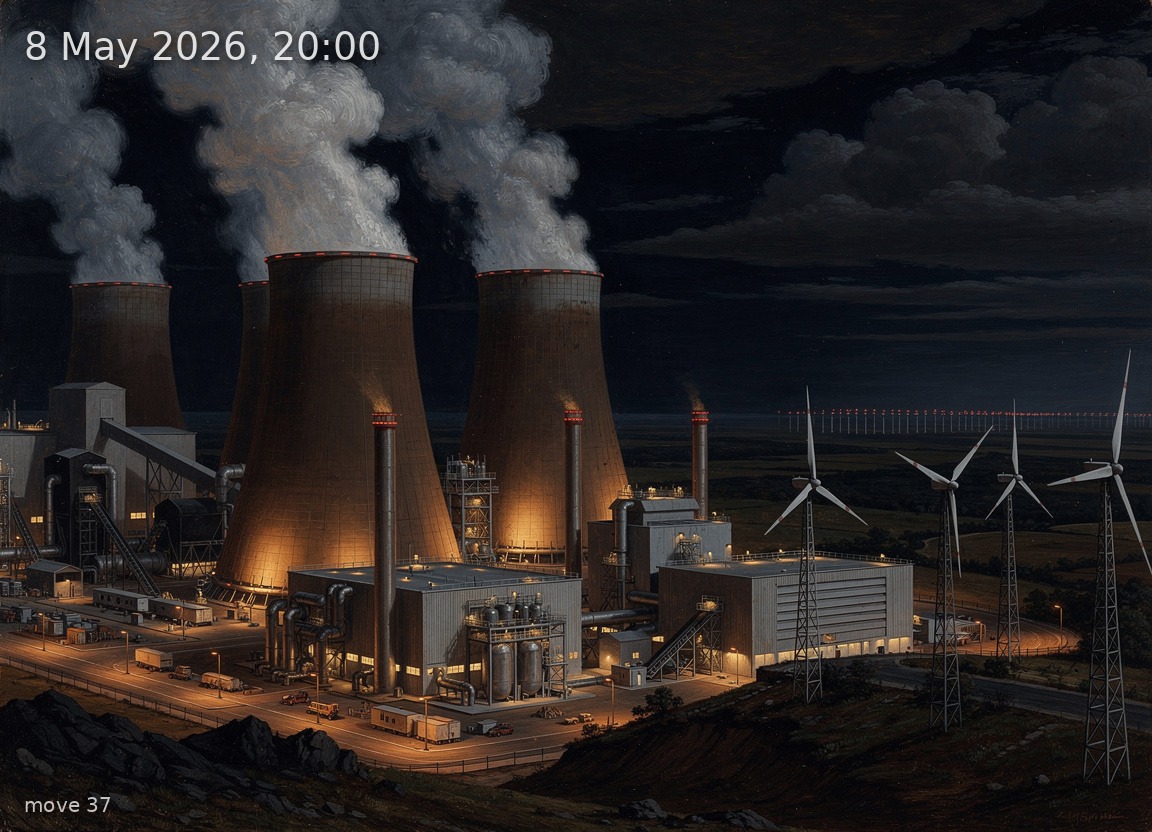
Brown coal, gas, and wind anchor a tight evening grid requiring ~20 GW of net imports at elevated prices.
Back
Generation mix
Wind onshore 18%
Wind offshore 7%
Solar 2%
Biomass 13%
Hydro 5%
Natural gas 19%
Hard coal 11%
Brown coal 25%
45%
Renewable share
8.7 GW
Wind (on + offshore)
0.7 GW
Solar
34.8 GW
Total generation
-19.7 GW
Net import
153.0 €/MWh
Day-ahead price
11.6°C / 7 km/h
Temp / Wind speed
Open-Meteo, Kassel (51.3°N 9.5°E)
50% / 63.0 W/m²
Cloud cover / Radiation
379
gCO₂/kWh
Image prompt
Brown coal 8.5 GW dominates the left third of the scene as a massive lignite power station complex with four hyperbolic cooling towers emitting thick white steam plumes into the night sky; natural gas 6.7 GW fills the center-left as two compact CCGT plants with tall single exhaust stacks and glowing orange sodium-lit service areas; wind onshore 6.2 GW spans the center-right as a row of tall three-blade turbines on lattice towers with slow-turning rotors; wind offshore 2.5 GW appears in the far distance as a faint cluster of red aviation warning lights on turbines barely visible on the dark horizon; biomass 4.5 GW sits in the right-center as a medium-sized industrial facility with a wood-chip conveyor belt, lit warmly from within, smoke drifting from a single stack; hard coal 3.8 GW appears as a traditional coal-fired station with a single large square cooling tower and coal bunkers at the far left; hydro 1.7 GW is rendered as a small dam structure in a valley in the right background with illuminated spillway; solar 0.7 GW appears only as a small dark field of aluminium-framed crystalline PV panels reflecting no light, nearly invisible in the darkness. The time is 20:00 in May — the sky is completely dark, deep navy-black, no twilight glow remains, stars faintly visible through 50% broken cloud cover. The atmosphere is heavy and oppressive, reflecting the 153 EUR/MWh price — low thick clouds pressing down, a sense of industrial tension. Temperature is a cool 11.6°C spring night: fresh green foliage on trees barely visible in artificial light, damp grass. Gentle breeze stirs branches. All facilities are lit by sodium-orange streetlamps and security lighting casting warm pools of light against the dark landscape. Painted in the style of a highly detailed 19th-century German Romantic oil painting — rich dark palette of navy, burnt umber, warm amber, and grey-white steam — with visible expressive brushwork, deep atmospheric perspective, meticulous engineering accuracy on every turbine nacelle, cooling tower curve, and exhaust stack, evoking Caspar David Friedrich's sublime darkness meeting industrial modernity. No text, no labels.