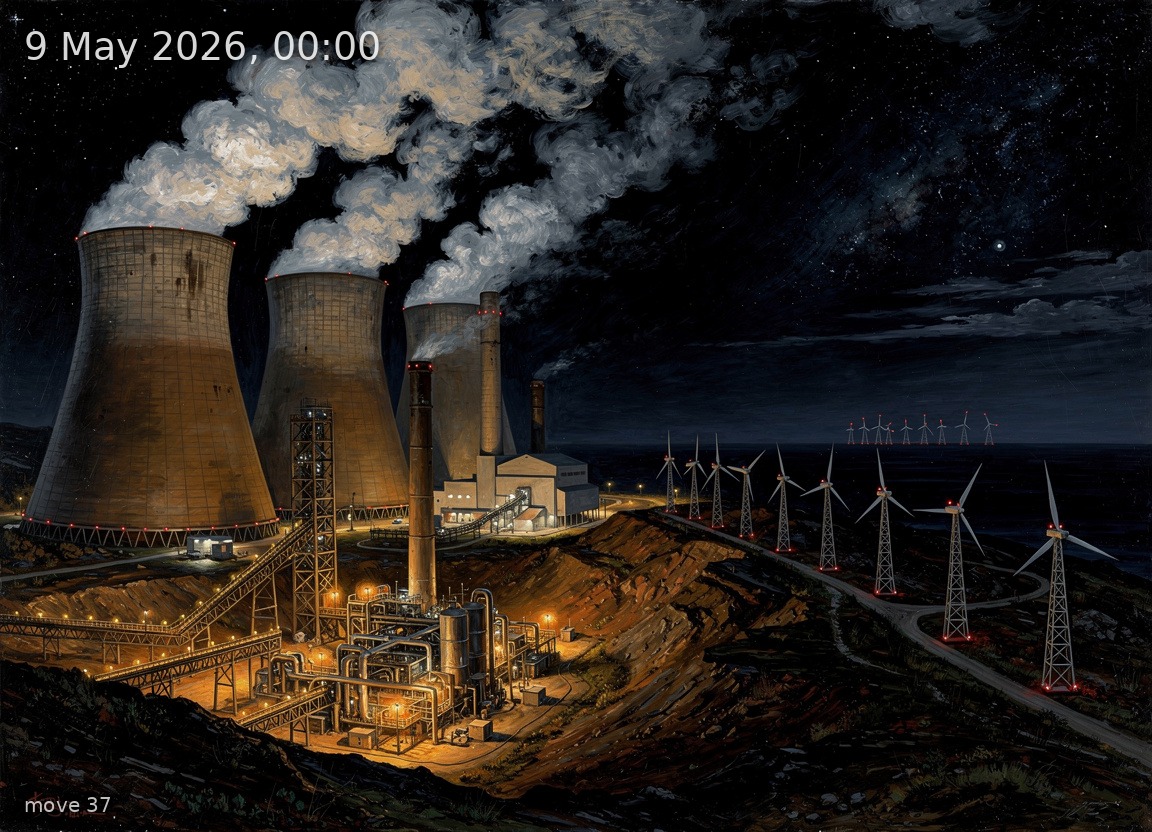
Brown coal and wind dominate overnight generation while 8.7 GW of net imports fill Germany's demand gap at elevated prices.
Back
Generation mix
Wind onshore 22%
Wind offshore 8%
Biomass 12%
Hydro 4%
Natural gas 16%
Hard coal 11%
Brown coal 26%
47%
Renewable share
10.8 GW
Wind (on + offshore)
0.0 GW
Solar
35.0 GW
Total generation
-8.7 GW
Net import
127.7 €/MWh
Day-ahead price
7.4°C / 2 km/h
Temp / Wind speed
Open-Meteo, Kassel (51.3°N 9.5°E)
5% / 0.0 W/m²
Cloud cover / Radiation
374
gCO₂/kWh
Image prompt
Brown coal 9.2 GW dominates the left third of the scene as a massive lignite power station with four hyperbolic cooling towers trailing thick white steam plumes into the black night sky; wind onshore 7.8 GW fills the centre-right as a long ridge of three-blade turbines on lattice towers, their red aviation warning lights blinking against deep navy darkness, rotors turning very slowly in near-calm air; wind offshore 3.0 GW appears as a distant line of turbines on the far-right horizon above a dark sea; natural gas 5.7 GW sits centre-left as a compact CCGT facility with twin exhaust stacks emitting thin heat shimmer, lit by sodium-orange floodlights; hard coal 3.7 GW appears as a smaller coal plant with a single large smokestack and conveyor belt structures behind the gas plant; biomass 4.1 GW is rendered as a timber-clad industrial facility with a modest chimney and stacked woodchip piles, warmly lit from within; hydro 1.5 GW is a small concrete dam structure with illuminated spillway in the far background valley. The sky is completely dark, no twilight, no glow on the horizon — a black canopy scattered with cold stars and a clear Milky Way band, consistent with 5% cloud cover. The atmosphere feels heavy and oppressive despite the clear sky, a subtle haze from industrial emissions hanging low, reflecting the amber sodium lights of the facilities. Early May vegetation — fresh birch and beech leaves — is barely discernible in the darkness at the margins of the scene. The ground is damp, 7°C chill suggested by condensation on metal surfaces. A network of high-voltage transmission pylons crosses the middle ground, cables disappearing into the darkness toward distant borders, hinting at the large import flows. Highly detailed oil painting in the tradition of 19th-century German Romantic landscape painters — rich, dark colour palette of indigo, umber, ochre, and warm amber; visible impasto brushwork; atmospheric depth with layered industrial smoke and steam; meticulous engineering accuracy on turbine nacelles, cooling tower parabolic profiles, CCGT stacks, and pylon insulators. The scene evokes Caspar David Friedrich's contemplation of nature, recast as an industrial nocturne. No text, no labels.