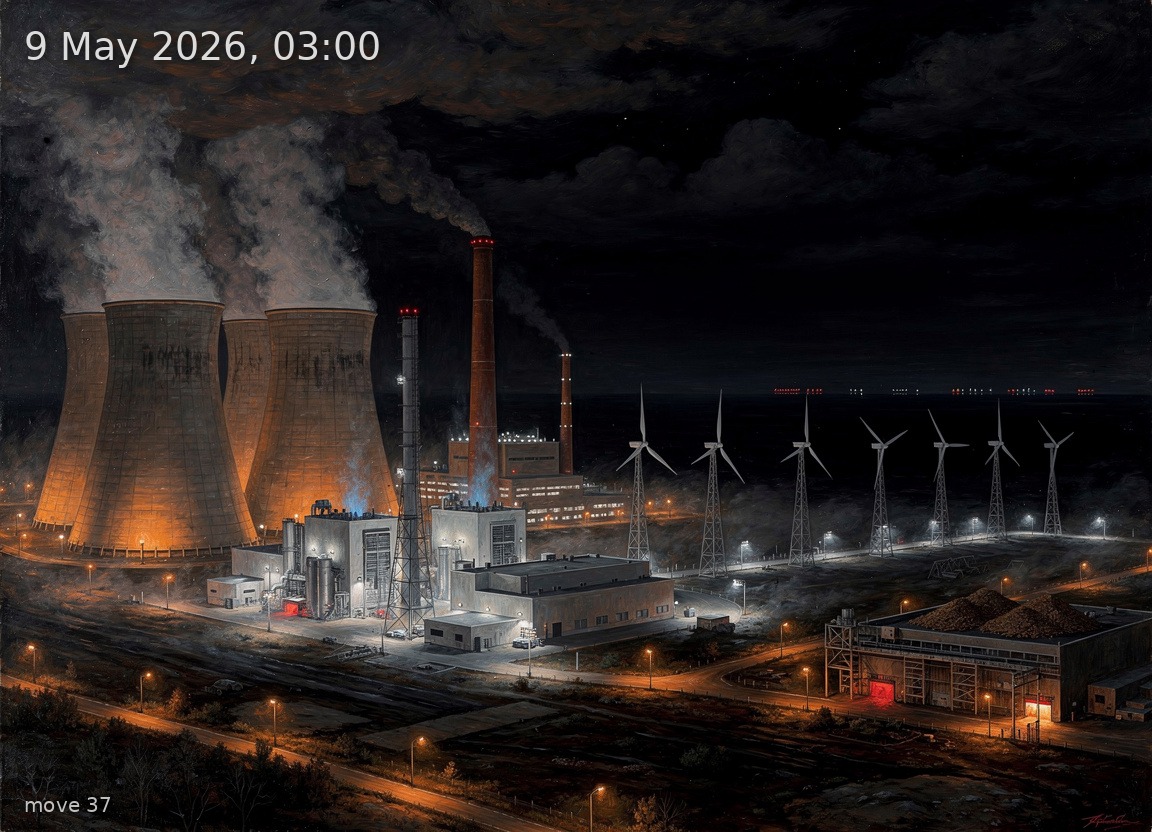
Brown coal and gas anchor overnight supply as calm winds and heavy cloud drive imports above 10 GW.
Back
Generation mix
Wind onshore 18%
Wind offshore 4%
Biomass 13%
Hydro 5%
Natural gas 18%
Hard coal 12%
Brown coal 30%
40%
Renewable share
6.7 GW
Wind (on + offshore)
0.0 GW
Solar
30.6 GW
Total generation
-10.2 GW
Net import
124.3 €/MWh
Day-ahead price
4.9°C / 2 km/h
Temp / Wind speed
Open-Meteo, Kassel (51.3°N 9.5°E)
94% / 0.0 W/m²
Cloud cover / Radiation
425
gCO₂/kWh
Image prompt
Brown coal 9.1 GW dominates the left third of the scene as a massive lignite power station with four hyperbolic cooling towers emitting thick white-grey steam plumes lit from below by orange sodium lights; natural gas 5.6 GW occupies the centre-left as two compact CCGT plants with tall single exhaust stacks and faint blue gas flames visible through vents; wind onshore 5.5 GW appears across the centre-right as a row of large three-blade turbines on lattice towers standing utterly still with no blade motion; wind offshore 1.1 GW is suggested in the far distance as tiny nacelle lights on the dark horizon; biomass 4.1 GW is rendered as a wood-chip-fired industrial facility with a single squat stack and warm amber-lit conveyor belts in the right foreground; hard coal 3.7 GW appears behind the brown coal station as a smaller conventional plant with a single tall brick chimney trailing thin smoke; hydro 1.4 GW is a small concrete dam visible in a valley at far right with floodlit spillway. Time is 03:00 in early May — the sky is completely black with no twilight whatsoever, a low thick overcast ceiling blocks all stars, the only illumination comes from sodium streetlamps casting orange pools, industrial facility lighting, and the dull red glow of furnace openings. The temperature is near 5°C so there is a thin ground mist curling around the base of the cooling towers and across damp spring meadows. The atmosphere is heavy and oppressive, conveying the high energy price — the air feels dense and laden. Vegetation shows early spring growth, pale green grass and budding trees barely visible in the artificial light. No solar panels anywhere. Style: highly detailed oil painting in the tradition of 19th-century German Romantic landscape painters such as Caspar David Friedrich crossed with industrial realism, rich dark colour palette of deep navy, burnt orange, and charcoal grey, visible impasto brushwork, atmospheric depth with layered mist, meticulous engineering accuracy on every turbine nacelle, cooling tower curvature, and exhaust stack detail. No text, no labels.