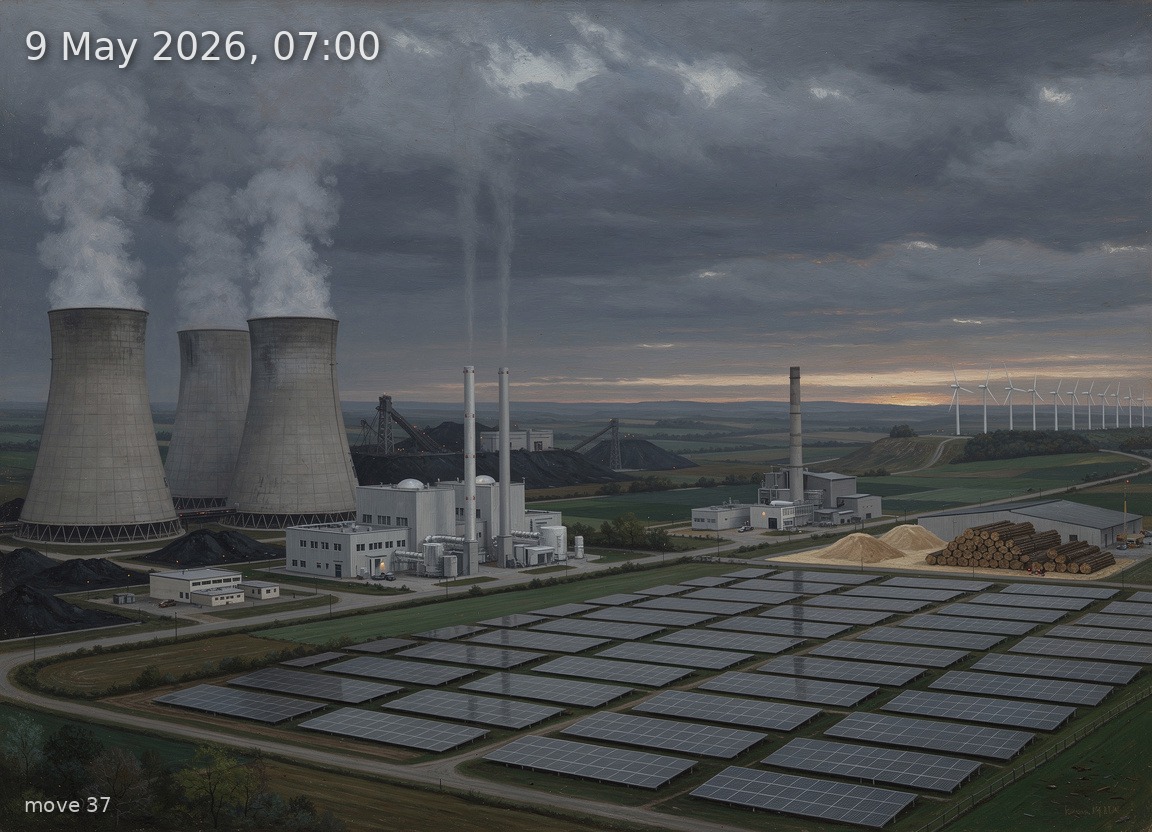
Brown coal and solar lead a tight, import-dependent grid under full overcast with negligible wind.
Back
Generation mix
Wind onshore 11%
Wind offshore 1%
Solar 25%
Biomass 13%
Hydro 4%
Natural gas 13%
Hard coal 9%
Brown coal 24%
54%
Renewable share
4.4 GW
Wind (on + offshore)
8.7 GW
Solar
35.3 GW
Total generation
-10.9 GW
Net import
118.7 €/MWh
Day-ahead price
3.3°C / 2 km/h
Temp / Wind speed
Open-Meteo, Kassel (51.3°N 9.5°E)
100% / 2.0 W/m²
Cloud cover / Radiation
332
gCO₂/kWh
Image prompt
Brown coal 8.5 GW dominates the left third of the scene as a cluster of massive hyperbolic cooling towers with thick white-grey steam plumes merging into the overcast sky; solar 8.7 GW occupies the centre-right as extensive fields of aluminium-framed crystalline silicon PV panels stretching across flat farmland, their surfaces dull and grey under dense cloud with no reflections; natural gas 4.5 GW appears as two compact CCGT plants with tall single exhaust stacks and smaller heat-recovery units emitting thin vapour trails in the centre-left; biomass 4.4 GW is rendered as a wood-chip-fed power station with a tall chimney and timber storage yard in the mid-ground right; wind onshore 4.0 GW shows a sparse row of three-blade turbines with white nacelles on lattice-free tubular towers standing completely motionless on a ridge in the far background right; hard coal 3.3 GW appears as a coal-fired plant with conveyor belts and a single large stack behind the brown coal complex on the far left; hydro 1.4 GW is a small concrete dam and penstock visible in a valley at the far right edge; wind offshore 0.4 GW is barely suggested as tiny turbine silhouettes on a distant grey horizon line. The time is early dawn at 07:00 in May — the sky is a uniform deep blue-grey pre-dawn light with no sun visible, no golden tones, only the faintest pale brightening along the eastern horizon behind heavy unbroken stratus cloud cover. The atmosphere feels heavy, oppressive, and still, reflecting the high electricity price. Temperature is 3.3°C: there is frost on the grass, bare patches on some late-leafing trees, early spring vegetation is sparse and muted green-brown. No wind motion anywhere — flags limp, grass still, turbine blades frozen. The landscape is flat central German terrain with gentle hills. Rendered as a highly detailed oil painting in the tradition of 19th-century German Romantic landscape painters such as Caspar David Friedrich and Carl Blechen — rich sombre colour palette of slate greys, umber browns, and cold blue-greens, visible confident brushwork, deep atmospheric perspective with industrial haze, meticulous engineering accuracy on every power plant detail. No text, no labels.