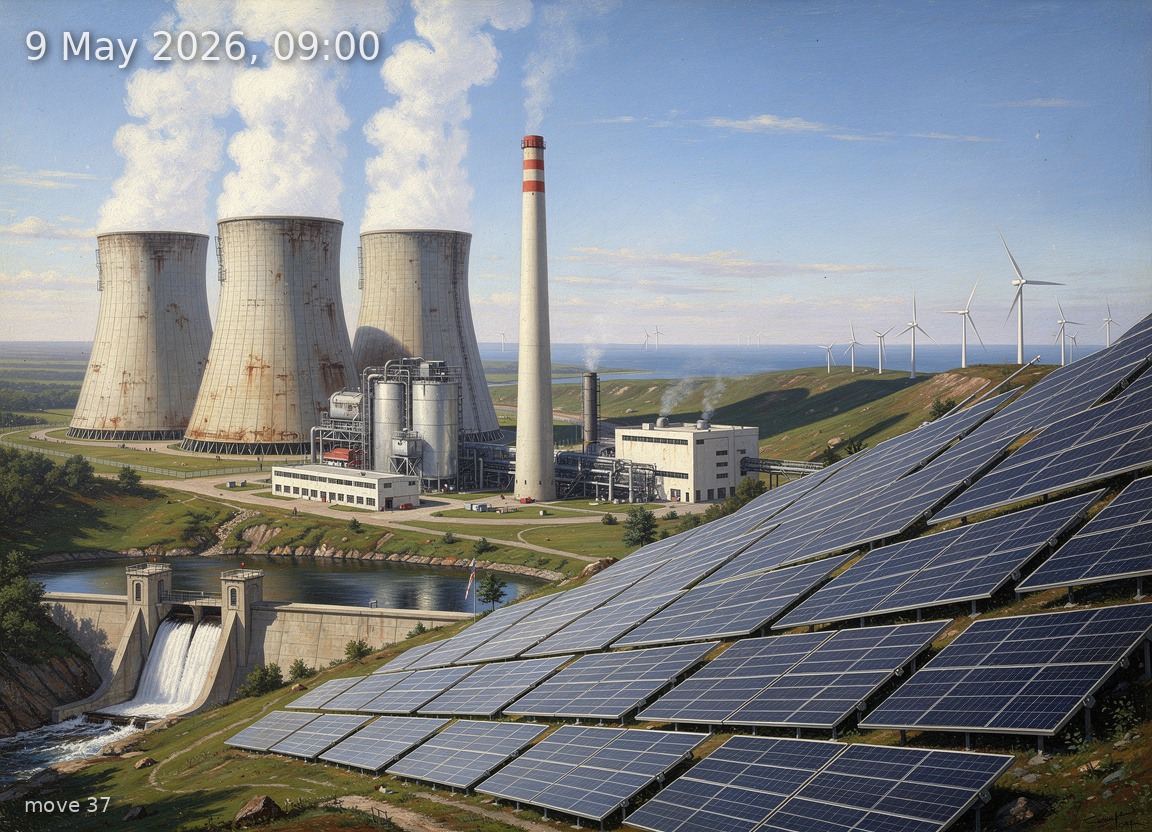
Clear-sky solar at 30.5 GW leads generation but near-zero wind and 2.6 GW net imports sustain a 48.1 GW morning load.
Back
Generation mix
Wind onshore 3%
Wind offshore 1%
Solar 67%
Biomass 9%
Hydro 3%
Natural gas 6%
Hard coal 2%
Brown coal 9%
83%
Renewable share
1.7 GW
Wind (on + offshore)
30.5 GW
Solar
45.5 GW
Total generation
-2.6 GW
Net import
68.3 €/MWh
Day-ahead price
7.9°C / 2 km/h
Temp / Wind speed
Open-Meteo, Kassel (51.3°N 9.5°E)
0% / 152.0 W/m²
Cloud cover / Radiation
117
gCO₂/kWh
Image prompt
Solar 30.5 GW dominates the scene as vast fields of aluminium-framed crystalline silicon photovoltaic panels stretching across the entire right two-thirds of the composition, angled south, glinting under brilliant morning sun. Brown coal 4.0 GW occupies the left background as a cluster of massive hyperbolic concrete cooling towers trailing thick white steam plumes into the sky. Biomass 4.3 GW appears in the left-centre as a medium-sized industrial plant with squat cylindrical silos and a modest smokestack emitting faint grey haze, visually comparable in area to the brown coal. Natural gas 2.6 GW is rendered as a compact CCGT facility with a single tall exhaust stack and visible heat shimmer, positioned just left of centre. Hard coal 1.0 GW is a smaller power station with a single rectangular boiler house and short stack, tucked beside the brown coal complex. Wind onshore 1.4 GW appears as a small handful of distant three-blade turbines on a ridge at far right, their rotors utterly still. Wind offshore 0.3 GW is suggested by two tiny turbines barely visible on a hazy horizon line. Hydro 1.4 GW appears as a concrete dam and spillway nestled in a shallow valley at far left. The time is 09:00 in May: full bright daylight, the sun low-to-moderate in the eastern sky casting long golden-warm shadows westward. The sky is completely cloudless, an expansive clear blue. The atmosphere carries a slight heaviness — a faint industrial haze suggesting moderately elevated electricity prices. Vegetation is fresh spring green: young beech and birch leaves, wildflower meadows between the solar arrays, cool 7.9 °C dew glistening on grass. The air is perfectly still — no motion in trees, flags, or smoke plumes, which rise vertically. Painted in the style of a highly detailed 19th-century German Romantic oil painting — rich saturated colour, visible confident brushwork, meticulous atmospheric perspective and depth — reminiscent of Caspar David Friedrich meeting industrial realism, with precise engineering detail on every turbine nacelle, panel frame, cooling tower rib, and exhaust stack. No text, no labels.