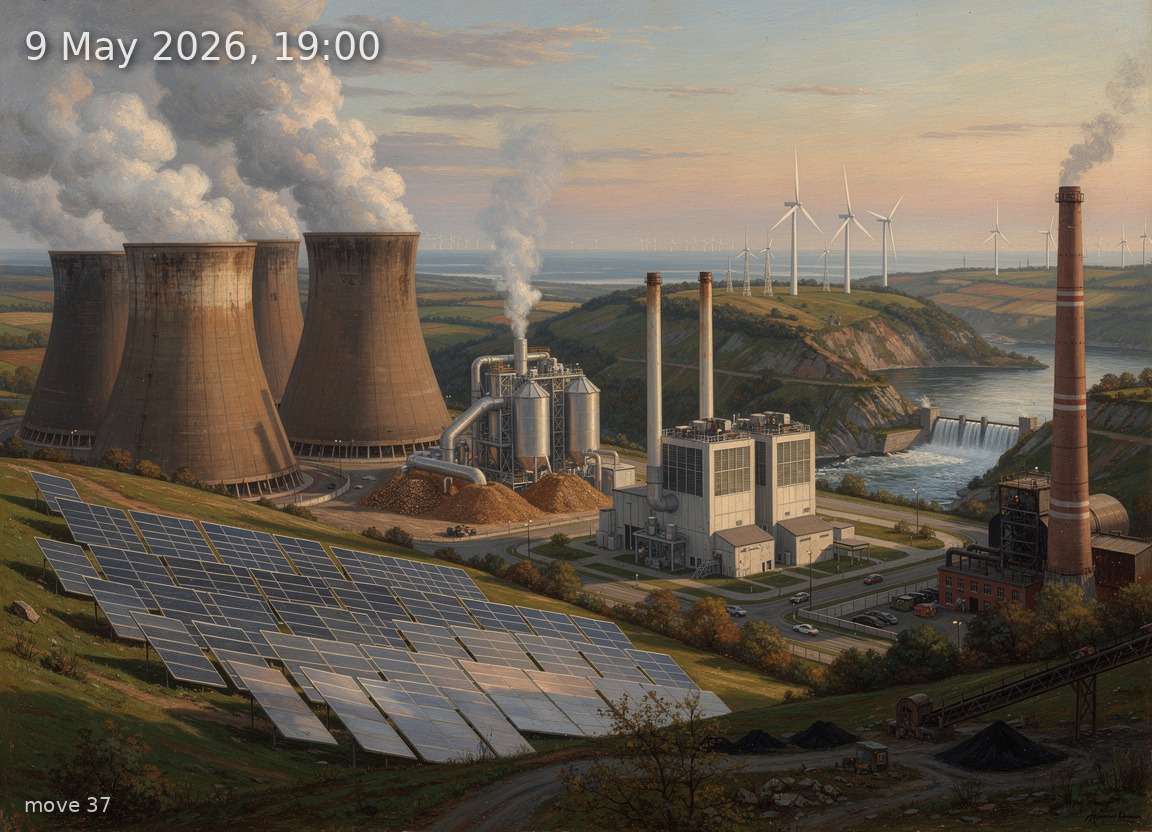
Brown coal, gas, solar, and biomass lead a 30.2 GW domestic supply requiring 18 GW net imports at evening peak.
Back
Generation mix
Wind onshore 12%
Wind offshore 1%
Solar 18%
Biomass 15%
Hydro 5%
Natural gas 14%
Hard coal 12%
Brown coal 22%
52%
Renewable share
4.1 GW
Wind (on + offshore)
5.3 GW
Solar
30.2 GW
Total generation
-18.0 GW
Net import
138.5 €/MWh
Day-ahead price
16.6°C / 11 km/h
Temp / Wind speed
Open-Meteo, Kassel (51.3°N 9.5°E)
9% / 134.0 W/m²
Cloud cover / Radiation
342
gCO₂/kWh
Image prompt
Brown coal 6.7 GW dominates the left quarter as a cluster of massive hyperbolic cooling towers with thick white-grey steam plumes rising into the sky; solar 5.3 GW occupies the centre-left as rows of aluminium-framed crystalline silicon panels on a gentle hillside catching the last angled rays; biomass 4.5 GW appears centre as a wood-chip-fed industrial plant with a tall stack and modest steam; natural gas 4.3 GW sits centre-right as two compact CCGT units with slender exhaust stacks venting thin heat shimmer; wind onshore 3.8 GW is rendered as a sparse line of three-blade turbines on a ridge at right, rotors turning slowly; hard coal 3.6 GW appears far right as a traditional coal plant with a single large smokestack and conveyor belt; hydro 1.6 GW is a small concrete dam with cascading water in the far background valley; wind offshore 0.4 GW is barely visible as tiny turbines on a distant hazy horizon line. Time of day is late dusk at 19:00 in May: the sky transitions from a warm amber-orange band along the lower western horizon to deepening slate blue and indigo overhead, the sun already below the horizon casting only residual glow. The atmosphere feels heavy and oppressive, reflecting the high electricity price — a brooding, hazy warmth with faintly tinted clouds. Temperature is mild at 16.6°C; fresh green spring foliage on deciduous trees, lush meadow grass, wildflowers. Cloud cover is minimal at 9%, so the sky is mostly open but the oppressive mood comes from industrial haze and the warm, thick air. Light wind barely stirs the grass. High-voltage transmission lines cross the middle ground, symbolising the large import flows. Highly detailed oil painting in the tradition of 19th-century German Romantic landscape painters — rich saturated colour, visible impasto brushwork, atmospheric depth and sfumato in the distance — rendered with meticulous engineering accuracy for each technology: correct turbine nacelles with three-blade rotors on lattice towers, realistic cooling tower geometry with parabolic profiles, detailed PV panel framing. The scene is a monumental industrial landscape masterwork. No text, no labels.