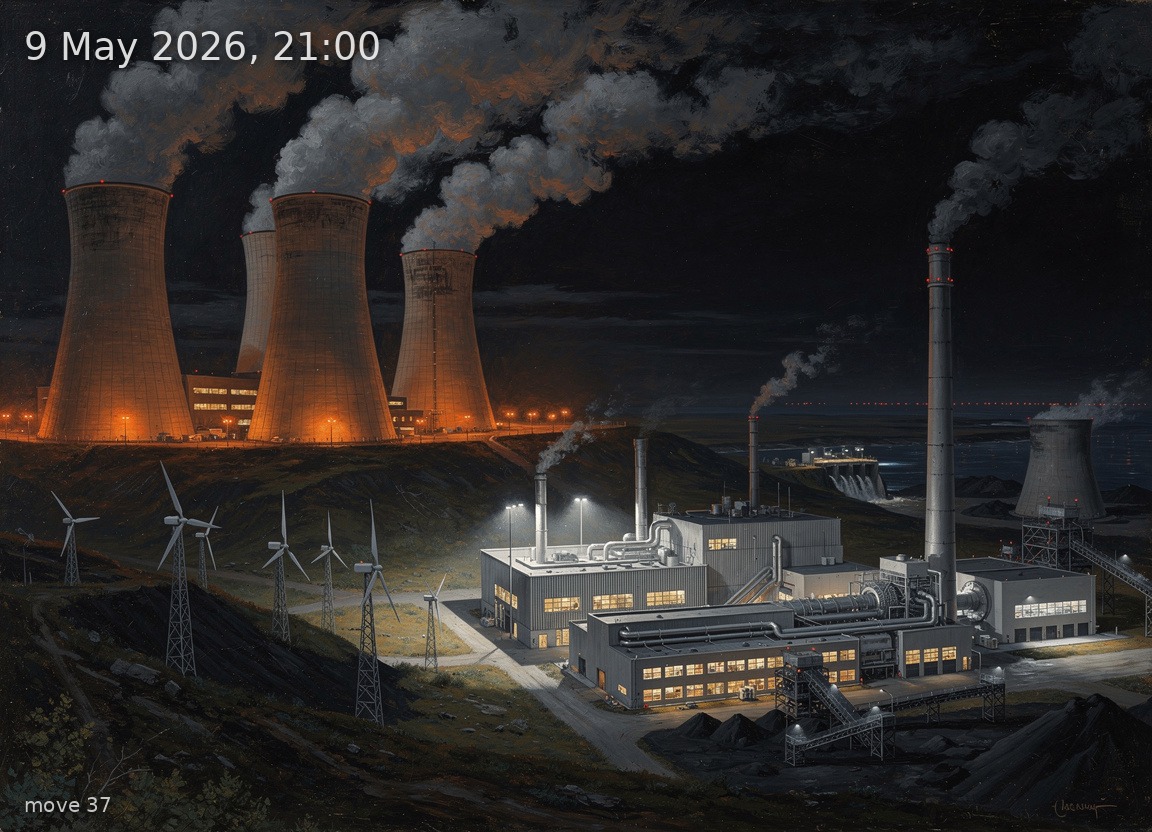
Brown coal, gas, and hard coal dominate evening generation as zero solar and modest wind drive high prices and 19 GW net imports.
Back
Generation mix
Wind onshore 22%
Wind offshore 2%
Solar 0%
Biomass 16%
Hydro 6%
Natural gas 16%
Hard coal 13%
Brown coal 25%
46%
Renewable share
6.5 GW
Wind (on + offshore)
0.0 GW
Solar
27.5 GW
Total generation
-19.1 GW
Net import
143.5 €/MWh
Day-ahead price
14.2°C / 4 km/h
Temp / Wind speed
Open-Meteo, Kassel (51.3°N 9.5°E)
75% / 8.0 W/m²
Cloud cover / Radiation
380
gCO₂/kWh
Image prompt
Brown coal 6.8 GW dominates the left quarter of the scene as a massive lignite power station with three hyperbolic cooling towers releasing thick white-grey steam plumes into the dark sky, lit from below by orange sodium lamps. Wind onshore 6.1 GW occupies the centre-left as a scattered line of three-blade turbines on a gentle ridge, their rotors barely turning in the light breeze, red aviation warning lights blinking at each nacelle. Biomass 4.5 GW appears centre-right as a cluster of mid-sized industrial buildings with short chimneys emitting thin smoke, illuminated by floodlights. Natural gas 4.4 GW sits to the right as two compact CCGT units with tall single exhaust stacks venting faint heat shimmer, their turbine halls glowing warmly through windows. Hard coal 3.7 GW appears in the far right as a coal plant with a single large cooling tower and conveyor belts visible under industrial lighting. Hydro 1.7 GW is glimpsed in the far background as a small dam structure with faint spillway lights reflected in dark water. Wind offshore 0.4 GW is barely suggested as a distant cluster of tiny red lights on the far horizon line. The scene is set at 21:00 in May — full nighttime with a completely black sky, no twilight, no sunset glow, overcast at 75% blocking all stars. The atmosphere is heavy and oppressive, reflecting 143.5 EUR/MWh pricing: low clouds tinged sickly orange-brown by the upward wash of sodium streetlights and industrial floodlights. Spring vegetation — fresh green grass and leafy trees at 14°C — is barely discernible in the artificial light. A network of high-voltage transmission pylons marches across the middle ground, cables sagging under heavy load, symbolizing the 19 GW of imports flowing into the region. Style: highly detailed oil painting in the tradition of 19th-century German Romantic landscape painters — rich, moody colour palette of deep navy, burnt orange, sulphurous yellow, and charcoal grey; visible impasto brushwork; atmospheric depth with industrial haze softening distant elements. Each technology rendered with meticulous engineering accuracy: lattice turbine towers, aluminium nacelle housings, reinforced-concrete cooling towers with internal ribbing visible, steel CCGT exhaust stacks. The painting evokes Caspar David Friedrich's sublime contemplation recast onto a modern industrial nocturne. No text, no labels.